Most roundups of chatgpt statistics mix real figures with numbers someone made up to fill a slide. This one does the opposite: every figure below is attributed to a named source, and where sources disagree, we say so. These are the chatgpt statistics worth citing in a client deck or a strategy doc — the ones with a paper trail back to OpenAI, Reuters, Pew Research, Semrush, and a handful of other outfits that actually measure this stuff.
ChatGPT stopped being a novelty a while ago. It is now one of the most-used software products on the planet, and for anyone doing SEO, that matters — because a growing share of the questions your customers used to type into Google now go to a chatbot instead. Here is where the numbers stand, and what they mean for your work.
How fast ChatGPT actually grew
The headline number keeps moving, so pin it to a date. OpenAI said ChatGPT reached roughly 700 million weekly active users in September 2025, and Sam Altman put the figure near 800 million weekly by October 2025 (OpenAI, via TechCrunch). By February 2026, several outlets including Reuters reported ChatGPT sitting around 900 million weekly active users. The trajectory is the story — this is one of the fastest adoption curves any consumer product has ever posted.
To see the slope, line up the milestones each reported at the time:
| Weekly active users | When | Reported by |
|---|---|---|
| 100 million | November 2023 | Axios |
| 200 million | August 2024 | Axios |
| 300 million | December 2024 | TechCrunch |
| 400 million | February 2025 | Reuters |
| 700 million | September 2025 | OpenAI |
| ~800 million | October 2025 | OpenAI / TechCrunch |
For context on how unusual that is: ChatGPT hit one million users in its first five days after launching in November 2022, and crossed 100 million monthly users by January 2023 — at the time the fastest-growing consumer application on record (Reuters). By mid-2026, Reuters and Sensor Tower data pointed to ChatGPT crossing one billion monthly active users. The app has been downloaded well over a billion times, with Statista tracking total downloads past 1.44 billion by February 2026.
Who actually uses it
Adoption is broad but uneven. Pew Research Center found that 34% of US adults had used ChatGPT as of June 2025 — roughly double the 18% Pew measured in 2023. That is fast, but it also means two-thirds of American adults still had not touched it.
Age is the sharpest divide. In the same Pew survey, usage broke down like this:
- Ages 18–29: 58% had used ChatGPT (Pew Research Center, 2025)
- Ages 30–49: 41% (Pew Research Center, 2025)
- Ages 50–64: 25% (Pew Research Center, 2025)
- Ages 65+: 10% (Pew Research Center, 2025)
On gender, an OpenAI and Harvard-linked analysis of usage found the share of women among users with gendered first names climbed from about 37% in early 2024 to roughly 52% by mid-2025 — the audience started skewed and evened out fast. Geographically, Semrush traffic data has put the United States as the largest single source of ChatGPT web visits at around 18%, followed by India near 9% and Brazil near 5%.
Engagement: prompts, sessions and visits
Scale shows up in the query volume. OpenAI said ChatGPT was handling more than 2.5 billion prompts per day as of July 2025 (reported by The Verge). That is the number to sit with if you do SEO — billions of daily questions being answered somewhere other than a search results page.
On the web side, SimilarWeb has tracked ChatGPT’s site at roughly 190 million daily visits, with an average session lasting around six minutes. Sessions that long tell you people are not bouncing in and out; they are working through problems, drafting, and asking follow-ups. That behavior is very different from a typical Google search, where the goal is usually to click off to a website as fast as possible.
Revenue and paying subscribers
The money side is where sources diverge most, so treat these as ranges. CNBC reported OpenAI hit roughly $10 billion in annual recurring revenue by June 2025, and Reuters reporting later in 2025 pointed to an annualized revenue run-rate climbing toward $20 billion. Statista tracked ChatGPT mobile in-app revenue at around $227 million for February 2026 alone.
Subscriber counts are messier. Estimates for paying ChatGPT subscribers in 2025 ranged from about 10 million (CNBC) at the lower end up to figures around 35–50 million cited by various analysts and OpenAI executives, depending on whether Team, Enterprise, and Edu seats are counted. The honest read: tens of millions of people pay, but the exact number depends heavily on who is counting and what they include. What is not disputed is the pricing structure — ChatGPT Plus at $20 per month, and ChatGPT Pro launched in December 2024 at $200 per month (OpenAI).
Market share against other AI tools
ChatGPT still dominates its category. StatCounter’s tracking of AI chatbot/platform usage has put ChatGPT’s share of the generative-AI market well above 70%. On the spending side, Andreessen Horowitz reported ChatGPT accounted for about 62.5% of consumer AI tool subscription sales as of June 2025 — meaning even where rivals like Gemini, Claude, and Perplexity have strong products, ChatGPT captures most of the dollars consumers actually spend.
That concentration matters for a simple reason: if you are optimizing for AI-assistant visibility and you only have time for one surface, ChatGPT is where the users and the money are.
ChatGPT as a search engine
This is the shift that should change how you think about SEO. With 2.5 billion-plus prompts a day (The Verge, 2025) and sessions averaging around six minutes (SimilarWeb), a meaningful slice of research and buying questions now gets answered inside ChatGPT — often without the user ever clicking to a website. When ChatGPT does cite sources, being one of those cited pages is the new “ranking on page one.”
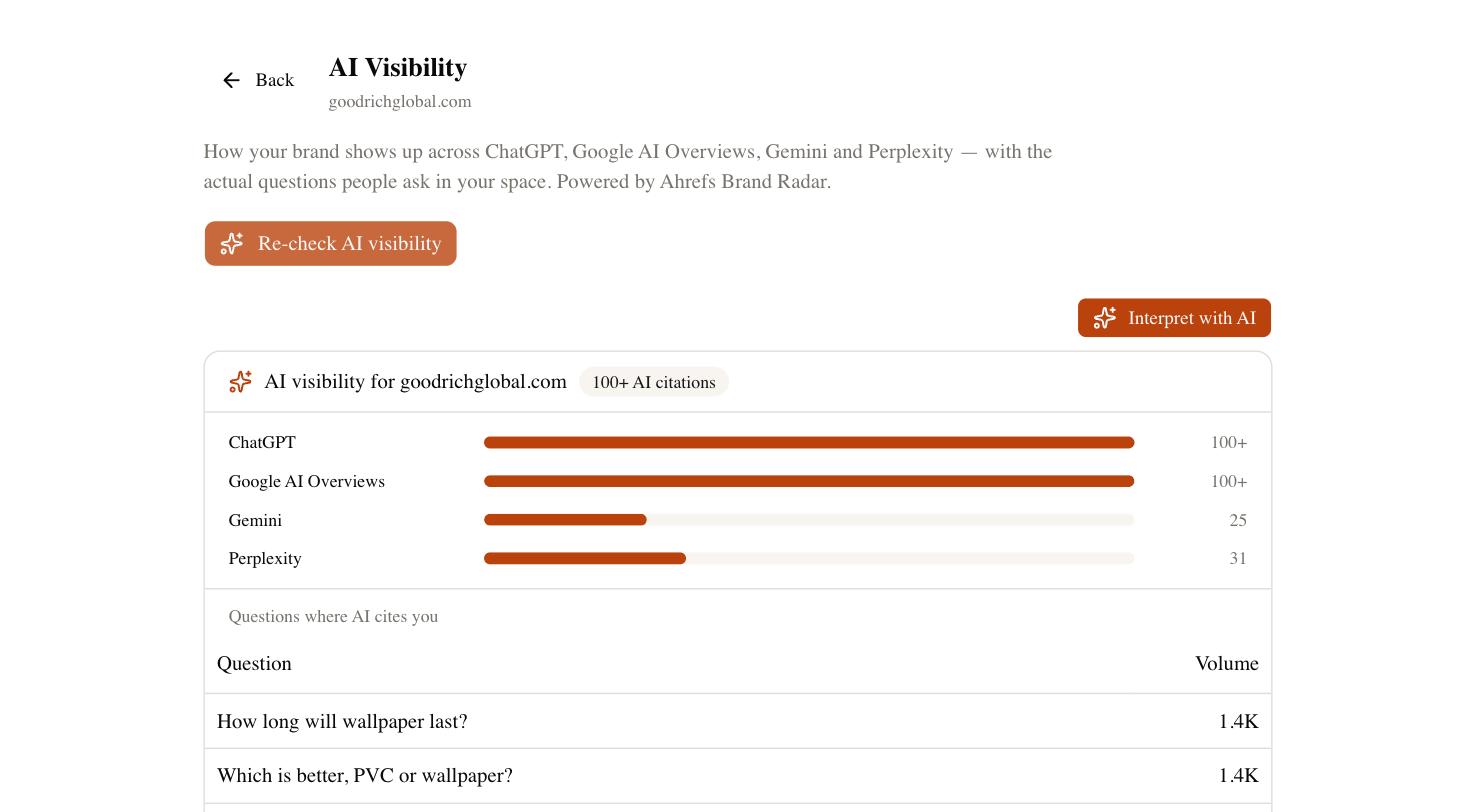
The trouble is that traditional rank trackers cannot see any of this. Your page can rank first in Google and still never get mentioned when a prospect asks ChatGPT for a recommendation. Measuring that requires watching the AI answers directly — which prompts mention you, which mention a competitor, and where the AI is pulling its facts from.
What this means for your SEO
The numbers point to one conclusion: search is splitting, and you need to measure both halves. Here is how to act on the data above without overreacting to it.
- Keep doing classic SEO. Two-thirds of US adults still had not used ChatGPT as of mid-2025 (Pew), and Google remains where most searches happen. AI visibility is additive, not a replacement.
- Start tracking AI citations now. With billions of daily prompts (The Verge), the questions are already being asked. Find out whether ChatGPT names you when someone asks for a tool, a service, or a supplier in your category.
- Write for extraction, not just clicks. Clear, factual, well-structured pages are what assistants quote. The same content quality that wins featured snippets tends to win AI citations.
- Watch your youngest audience first. With 58% of 18–29s already using ChatGPT (Pew), if you sell to a younger market, the shift is already here for you — not five years out.
This is exactly the gap SEO Rocket is built to close. Alongside normal keyword research and rank tracking, it tracks whether your brand gets cited across ChatGPT, Google’s AI Overviews, and Perplexity — so you are optimizing for the search that is actually happening, not just the one you can see in a rank tracker. You cannot improve what you cannot measure, and right now most sites have no idea whether the fastest-growing information product on earth ever says their name.
Treat every figure here as a snapshot with a date attached. These chatgpt statistics move month to month, so cite the source and the date together, and re-check the fast-moving ones — user counts and revenue especially — before you put them in front of a client.
Sources
- Backlinko — ChatGPT Statistics
- Exploding Topics — ChatGPT User Statistics
- DemandSage — ChatGPT Statistics
- Pew Research Center — 34% of US adults have used ChatGPT
- Reuters — OpenAI and ChatGPT coverage
- TechCrunch — ChatGPT weekly active user reporting
- The Verge — OpenAI 2.5 billion daily prompts
- SimilarWeb — chatgpt.com traffic and engagement
- Semrush — ChatGPT traffic and geographic data
- Statista — ChatGPT downloads and revenue
- Andreessen Horowitz (a16z) — consumer AI spending
- StatCounter — generative AI market share