
Most people hunting for Rytr alternatives aren’t disappointed with the writing — they’ve simply outgrown a short-form tool. Rytr is a genuinely good, cheap AI writer for social posts, product descriptions, and quick email copy. But the moment you need long-form articles that actually rank, you hit its ceiling: there’s no keyword research, no SERP analysis, and no way to see whether search engines or AI answers ever surface what you published.
This roundup skips the padded top-twenty lists. Below are the Rytr alternatives that hold up when your real job is ranking content, what each one is best at, and — because it’s the honest answer — when you should just keep Rytr.
Why people look past Rytr
Three reasons come up over and over. The first is scope: Rytr was built for short, snappy copy, so long articles tend to drift, repeat themselves, and need heavy editing to hold together past 800 words. The second is the missing SEO layer. Rytr writes, but it doesn’t tell you which keywords are worth targeting, what the top-ranking pages already cover, or how to structure a piece to compete. You end up pasting drafts into a separate optimization tool.
The third reason is newer. Search is splitting between Google and AI answers, and Rytr has no view of either — no rank tracking, no sense of whether ChatGPT or Perplexity ever cites you. None of this makes Rytr bad. It makes it a budget writing assistant in a job that increasingly wants research, writing, and visibility in one place.
There’s a quieter cost too. When your writing tool can’t see the SERP, every article starts as a guess about intent, and you only learn you guessed wrong weeks later when the page fails to move. Tools that fold in real data close that loop early, which is the whole reason people trade up.
What to look for in a Rytr alternative
Judge every tool here on four things a working content marketer actually cares about. First, output quality on long-form, not just clever taglines. Second, whether real SEO data — keyword volume, competitor gaps, SERP intent — is built in or missing. Third, honest total cost once you add the seats and words you’ll really use. Fourth, whether the tool has any answer to AI search, since that’s where a growing slice of your audience now asks questions.
The best Rytr alternatives at a glance
Start with the table, then read the notes on the two or three that fit your situation.
| Tool | Best for | SEO data built in? | Standout strength | Rough price band |
|---|---|---|---|---|
| SEO Rocket | Solo SEOs, consultants & agencies who want research plus writing in one flow | Yes — Ahrefs-grade | Real keyword data, AI articles, and AI-search visibility together | Low $ / entry-friendly |
| Jasper | Brand and marketing teams wanting polished, on-brand copy | Light | Brand voice control and campaign workflows | Higher $$ |
| Writesonic | Bloggers who want writing with some SEO baked in | Some | Article writer plus basic optimization | Low–mid $ |
| Copy.ai | Sales and marketing teams doing short-form at scale | No | Go-to-market copy and automation workflows | Low–mid $ |
| Frase | Writers who plan from the SERP | Yes — briefs | SERP research and content briefs | Mid $ |
| Surfer | Teams optimizing drafts against competitors | Yes — on-page | Content editor scored against top pages | Mid $$ |
SEO Rocket — the AI-native pick
SEO Rocket is the option built for how content work happens now. Instead of writing blind and optimizing later, you ask for what you need in plain language and it runs the research first — keyword volumes, competitor gaps, and SERP intent on real, Ahrefs-grade data — then drafts the article around what it found. The writing and the SEO aren’t two apps stitched together; they’re the same conversation.
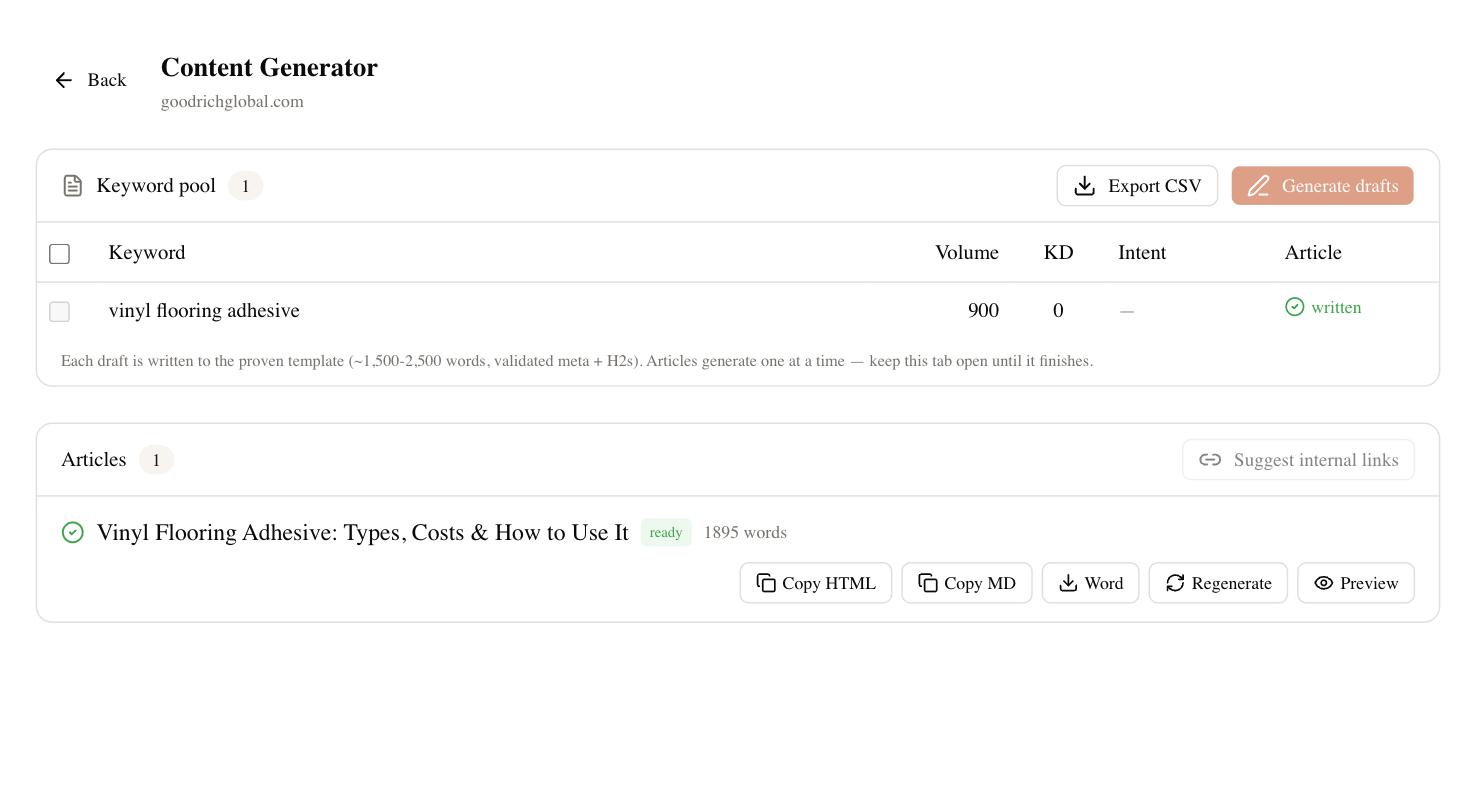
That consolidation is the real saving. A common stack of Rytr plus a keyword tool plus an optimization editor gets replaced by one subscription, and the entry pricing stays friendly for a solo operator. If you’re a consultant or agency, the client-dashboard side lets you hand a read-only report straight to a client without exporting anything.
The piece no writing tool answers is AI-search visibility, and it’s the reason SEO Rocket stands apart from the rest of this list. Some of your buyers now ask ChatGPT or Perplexity instead of Google, and a page that ranks first can still be invisible in an AI answer. SEO Rocket tracks whether and where you’re being cited across those surfaces, so you’re writing for the search that’s actually happening. For anyone whose bottleneck is producing content that ranks without juggling four tools, that combination is the strongest fit here.
Jasper, Writesonic and Copy.ai — the writing specialists
If your problem is purely the writing and you don’t need an SEO platform, three tools do it well.
- Jasper — the premium team choice. Its brand-voice controls and campaign workflows are the best going for agencies and in-house marketing teams that care about consistency, though you’ll pay a clear premium and still bolt on SEO data separately.
- Writesonic — the closest in spirit to Rytr, with more range. Its long-form article writer and light built-in optimization make it a natural step up when Rytr’s drafts feel thin, at a price that stays reasonable.
- Copy.ai — the short-form and go-to-market pick. It’s strong on ad copy, sales sequences, and repeatable workflows, less focused on ranking articles. If your week is mostly marketing copy, it fits.
Any of these will out-write Rytr on longer pieces. What none of them fully solve is the research-and-visibility gap — you’ll still run a second subscription for keyword data and a third to track AI answers.
Frase and Surfer — when optimization is the point
Two tools attack the SEO side directly rather than the writing. Frase pulls the top-ranking pages for your keyword, builds a content brief from what they cover, and helps you write against it — excellent if you plan every piece from the SERP outward. Surfer takes a finished draft and scores it against competitors on the terms and structure Google seems to reward, so it shines as an editing and optimization layer.
Both are stronger than Rytr on SEO substance and weaker on pure drafting speed. Many teams end up pairing one of them with a separate writer, which works but recreates the same tool-sprawl problem an all-in-one is meant to fix. If you already own a writer you like and only need the optimization layer, though, either is a clean, focused addition rather than a full platform switch.
When you should just keep Rytr
Honesty matters here. If most of your writing is short — social captions, product blurbs, cold-email variants, ad headlines — in a lot of languages and tones, Rytr does that cheaply and fast, and replacing it with a heavier platform would be paying for capability you never touch. Its free tier and low entry cost are genuinely hard to beat for that job. The right question isn’t “is there something more powerful,” it’s “does my week actually need SEO research and long-form.” For a high-volume short-form writer on a tight budget, sometimes the answer is no.
How to choose your Rytr alternative
Match the tool to your real constraint, not to a feature checklist. If you need keyword research, long-form drafting, and AI-search tracking without running four subscriptions, SEO Rocket is the natural move. If you only need better writing, Jasper, Writesonic, or Copy.ai will cover it. If your bottleneck is planning and optimizing, Frase or Surfer earn their place. And if you live in short-form copy, there’s no shame in staying with Rytr.
A quick way to decide: write down the last three things you actually produced. If they were long articles meant to rank, you’ve outgrown a short-form writer and want a tool with real SEO data underneath. If they were captions and product descriptions, keep the cheap, fast option. Whatever you pick, give it a full month of real work before you judge it — draft a few live pieces, watch how they perform, and let the results, not the feature page, tell you which alternative fits how you actually spend your week.