Most people hunting for Writesonic alternatives aren’t leaving because the writing is bad — they’re leaving because one AI writer can only take an SEO job so far. Writesonic is a capable content platform that has spread wide: article writing, Chatsonic, chatbots, audio, and more recently AI-search visibility. That breadth is the pitch, and for some teams it’s also the problem.
This roundup skips the padded top-twenty lists and affiliate links. Below are the Writesonic alternatives that hold up when you’re actually shipping content, what each one is genuinely best at, and — because it’s the honest answer — when you should stay with Writesonic.
Why people look past Writesonic
A few reasons come up over and over. The first is depth versus breadth: Writesonic does a bit of everything, but if your real job is ranking pages, you often want a tool that goes deeper on SEO than on chatbots and voiceovers. The second is data. Writesonic writes well, but it doesn’t run its own Ahrefs-grade keyword and backlink index, so the strategy layer — what to target, what competitors rank for, where the gaps are — leans on integrations or a second subscription.
Then there’s output at volume. AI drafts still need editing, and when you generate in bulk, the sameness shows and the word or credit limits burn faster than you expect. None of this makes Writesonic a poor tool. It makes it a broad AI-writing suite in a job that increasingly rewards one connected SEO workflow — real data, drafting, rank tracking, and AI-search visibility in the same place.
How we compared them
Every tool here was judged on the four things a working SEO actually cares about: the quality of the AI writing itself, whether it sits on real SEO data or just a text model, honest total cost once you add what you need, and who the tool genuinely suits. Where a tool leans on third-party metrics, remember those are estimates — treat cross-tool differences as directional, not gospel.
Writesonic alternatives at a glance
Start with the table, then read the notes on the two or three that fit your situation.
| Tool | Best for | Real SEO data? | Standout strength | Rough price band |
|---|---|---|---|---|
| SEO Rocket | Solo SEOs, consultants & agencies who want one AI-driven workflow | Yes — Ahrefs-grade | Real SEO data + AI writing + AI-search visibility in one chat | Low $ / entry-friendly |
| Jasper | Brand and marketing teams | No | Brand voice control and campaign templates | Mid–high $$ |
| Copy.ai | Short-form copy and go-to-market teams | No | Fast copy plus workflow automation | Low–mid $ |
| Surfer SEO | Writers optimizing against SERP data | On-page only | Content editor scored against ranking pages | Mid $$ |
| Frase | Research-led content briefs | SERP research | Fast SERP research and outline building | Low–mid $ |
| Scalenut | End-to-end AI content production | On-page only | Cruise Mode brief-to-draft flow | Low–mid $ |
SEO Rocket — the AI-native SEO pick
SEO Rocket is the option built for how the job works now. Instead of jumping between an AI writer and a separate research tool, you ask for what you need in plain language and it runs the lookup — keyword research, competitor gaps, backlink profiles, rank tracking — on real, Ahrefs-grade data underneath. The same chat then drafts the article, structured with a title, meta description, and a proper heading outline, so strategy and writing live in one place.
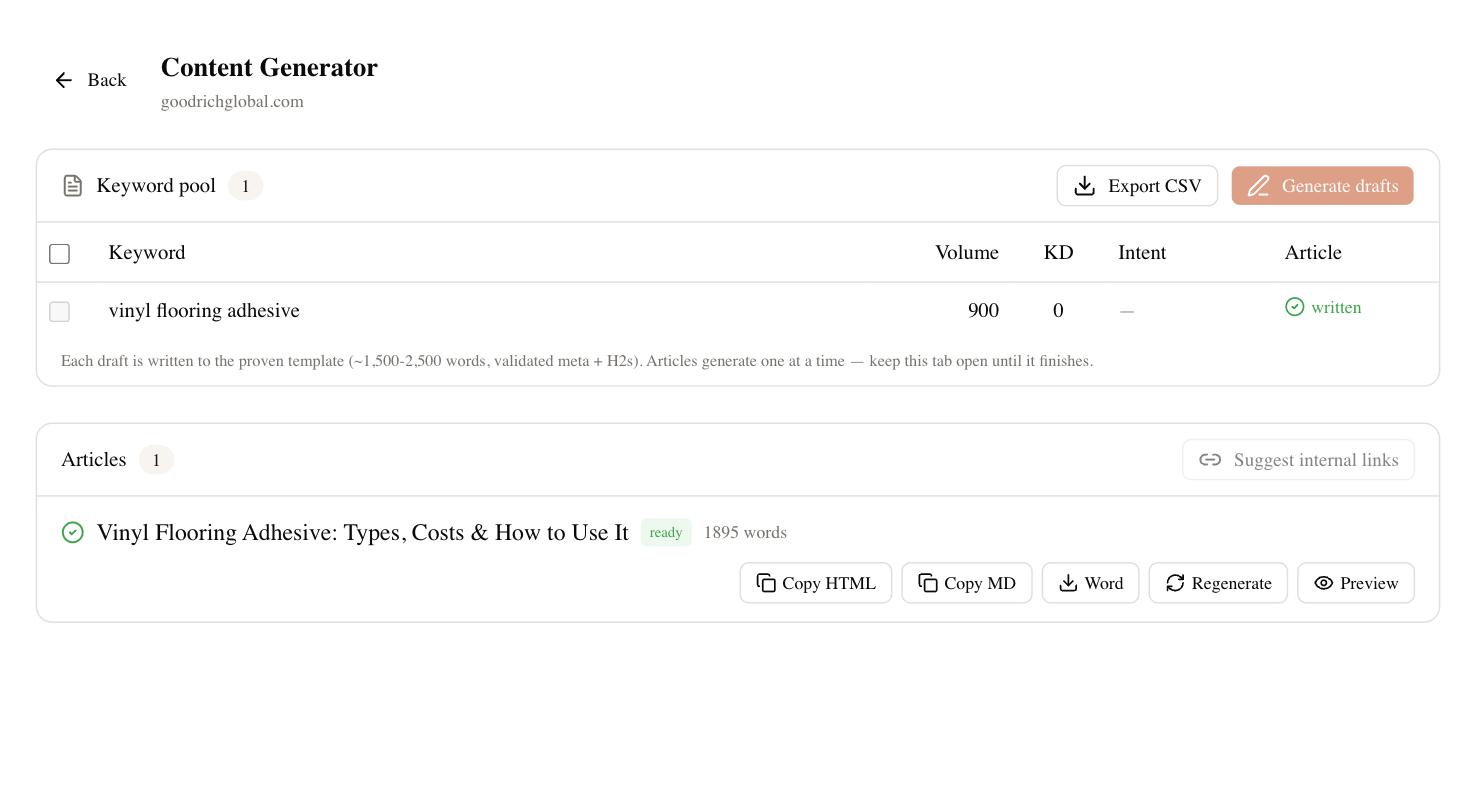
That consolidation is the real saving. A stack of Writesonic for drafting, plus a data tool for research, plus something to watch AI search, collapses into one subscription — and the entry pricing sits at the low end rather than climbing with every add-on. If you’re a consultant or agency, you can hand a client a clean report without stitching exports together from three logins.
The part no pure AI writer answers is AI-search visibility. Search is splitting: some of your buyers now ask ChatGPT or Perplexity instead of Google, and a page that ranks first can still go unmentioned in an AI answer. SEO Rocket’s Brand Radar tracks whether — and where — you’re being cited across those surfaces, so you’re optimizing for the search that’s actually happening. For anyone whose bottleneck is doing more with fewer tools, which is most people reading this, that combination is the strongest fit on the list.
Jasper and Copy.ai — the pure AI writers
If your reason for leaving Writesonic is purely the writing, these two are the obvious peers. Jasper leans into brand voice and marketing campaigns; teams that need consistent tone across a lot of assets tend to like its controls and its templates. It sits at the pricier end, and like Writesonic it’s a writer first — the SEO strategy still comes from somewhere else.
Copy.ai is quicker and cheaper for short-form work — ads, emails, product copy — and has pushed into workflow automation for go-to-market teams. Neither tool runs its own SEO data index, so if ranking is the goal you’ll still pair them with a research and tracking tool. Choose these when the draft quality is the whole problem and your data lives elsewhere.
Surfer, Frase and Scalenut — the SEO content optimizers
This trio attacks the part Writesonic treats lightly: writing that’s scored against what already ranks.
- Surfer SEO — the on-page optimizer. Its editor scores your draft against the current ranking pages for a query, which is genuinely useful for tightening a piece. It’s on-page focused, so it won’t replace a full data suite, and pricing sits in the mid range.
- Frase — the brief builder. It’s fast at pulling SERP research into an outline, so you go from keyword to a defensible structure quickly. Its AI writing is decent rather than best in class.
- Scalenut — the production line. Its Cruise Mode walks a keyword through research, brief, and draft in one flow, which suits teams shipping volume on a budget.
All three write with SERP context, which is a real step up from a blank-page AI writer. What none of them do is fold full keyword and backlink data, rank tracking, and AI-answer visibility into the same workflow — you’ll still run a second subscription for that side.
When you should keep Writesonic
Honesty matters here. If you use Writesonic for more than SEO articles — Chatsonic for research, Botsonic for a support chatbot, bulk product descriptions across a big catalog — then its breadth is the point, and pulling one thread unravels a setup that’s working. Teams that value a single vendor for many content jobs, and that already have their SEO data covered elsewhere, rarely regret staying. The right question isn’t “is there something better at writing,” it’s “does the alternative cover the range I actually use.” For a broad content team, sometimes the answer is no.
How to choose your Writesonic alternative
Match the tool to your real constraint, not to a feature grid. If tool-sprawl is the problem and you want real SEO data, AI writing, and AI-search tracking in one place, SEO Rocket is the natural move. If draft quality alone is the issue, Jasper or Copy.ai will lift it. If you want writing scored against the SERP, Surfer, Frase, or Scalenut each do that well. And if you lean on Writesonic’s full spread of content tools, staying put is a defensible call.
A quick way to decide: write down the three things you actually did in Writesonic last week. If the list is “research a keyword, draft an article, check how it’s doing,” you’re paying for a broad suite to run a narrow SEO workflow — and a leaner, AI-native tool will cover those three faster and cheaper. If instead your week spanned chatbots, audio, and catalog copy, the suite earns its keep. The best alternative is the one that matches how you spend Tuesday, not the one with the longest feature page.
Whatever you pick, give it a real project before you judge it. Run one piece end to end — research, draft, publish, and a week of tracking — and see which tool answers your actual questions with the least clicking between tabs. That’s your alternative.