
If you’re weighing Majestic vs SEO Rocket, you’re really comparing two different eras of SEO tooling. Majestic is one of the oldest and deepest backlink indexes on the market, built by link specialists for link specialists. SEO Rocket is a newer, AI-native workflow that folds Ahrefs-grade data, content writing, and AI-search visibility into a single chat interface. Neither is trying to be the other, so the Majestic vs SEO Rocket decision comes down to what your week actually looks like.
This comparison leads with where Majestic wins, because that’s the honest place to start. Then it makes the case for the AI-native approach, and ends with a straight recommendation by use case rather than a scoreboard.
Where Majestic is genuinely stronger
Majestic’s whole reason to exist is the link graph, and it’s very good at it. The company has been crawling the web and mapping links for well over a decade, and that history shows up in two ways: index size and historic depth. If you need to see how a domain’s backlink profile looked years ago, or you’re auditing a link portfolio with hundreds of thousands of referring domains, Majestic’s crawl gives you a serious amount of raw material to work with.
Its two signature metrics, Trust Flow and Citation Flow, are also well understood in the link-building world. Trust Flow estimates link quality by proximity to trusted seed sites; Citation Flow measures link volume. Plotting one against the other is a quick, familiar way to spot a profile that’s inflated with low-quality links. Plenty of experienced link builders read those two numbers faster than any competing metric. Majestic’s Topical Trust Flow, which breaks that trust score down by subject category, is another genuinely useful signal you won’t find in the same form elsewhere.
There’s also the Majestic Million and its bulk-checking tools, which let you run large lists of domains through Trust Flow and Citation Flow in one pass. For anyone qualifying link prospects at volume, that batch workflow saves real hours. Fresh Index versus Historic Index is another thoughtful touch: one shows you links found in recent crawls, the other the full multi-year picture, and being able to flip between them is genuinely useful when you’re diagnosing whether a profile is growing or decaying.
So if your job is deep link analysis, disavow work, or link-building at scale, Majestic is a specialist instrument that earns its place. That’s not a courtesy line to sound balanced — it’s the reason to keep it, and swapping it out for a generalist tool would cost you depth you actually use.
What Majestic doesn’t try to do
The flip side of being a link specialist is that Majestic stays in its lane. It is not a full SEO suite. Keyword research is thin compared with a dedicated keyword tool, rank tracking isn’t its focus, and there’s no content writing, no site audit workflow, and nothing that tells you whether your brand shows up in AI answers. Its interface is also frankly dated and dense — powerful once you learn it, but not welcoming to anyone who isn’t already fluent in link metrics.
That means most people who use Majestic pair it with at least one or two other tools to cover keywords, rankings, and content. If your entire job is links, that’s fine. If links are just one part of a broader SEO workload, you end up paying for and switching between several subscriptions.
Where SEO Rocket pulls ahead
SEO Rocket comes at the problem from the opposite direction. Instead of a deep tool for one task, it’s a connected workflow for the whole job, and you drive it by asking for what you need in plain language. Want a domain’s backlink profile, its top organic keywords, a competitor gap, or a rank-tracking snapshot? You ask, and it runs the lookup on real, Ahrefs-grade data underneath.
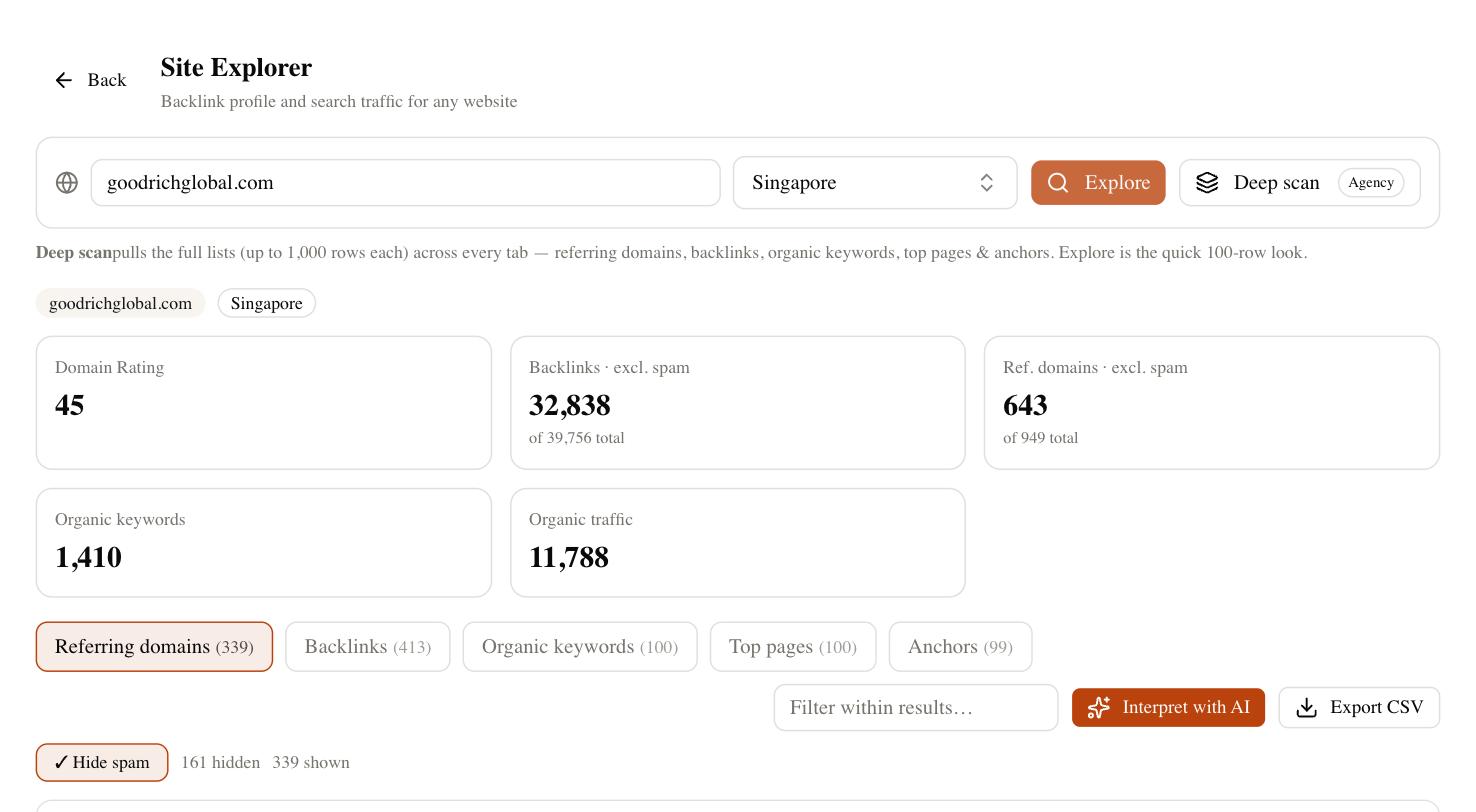
The part no traditional link tool touches is AI-search visibility. Search is splitting: some of your buyers now ask ChatGPT, Perplexity, or Google’s AI Overviews instead of typing a query and scrolling. A page that ranks first can still be invisible in an AI answer. SEO Rocket’s Brand Radar tracks whether and where you’re being cited across those surfaces, so you’re optimizing for the search that’s actually happening. Then there’s the writing side — the same tool drafts the article, on brief, using the keyword and competitor data it just pulled. Majestic does none of that, and doesn’t claim to.
Majestic vs SEO Rocket at a glance
Read this as a summary, not a verdict — the right pick depends on the use cases below the table.
| Dimension | Majestic | SEO Rocket |
|---|---|---|
| Core focus | Backlink index & link intelligence | Connected AI SEO workflow |
| Signature strength | Deep, historic link graph; Trust Flow / Citation Flow | Chat-first data + AI writing + AI-search visibility |
| Backlink data | Very large, long-running index | Ahrefs-grade referring domains & DR |
| Keyword & rank tracking | Limited | Built in |
| Content writing | No | Yes — AI drafts with Claude |
| AI-search visibility | No | Yes — Brand Radar |
| Interface | Dense, metric-heavy | Plain-language chat |
| Rough price band | Low–mid $ | Low $ / entry-friendly |
Trust Flow vs Domain Rating — read the metrics right
People often want a single number to compare a domain, and both tools give you one. Majestic hands you Trust Flow and Citation Flow; SEO Rocket surfaces Domain Rating and referring-domain counts on Ahrefs-grade data. Here’s the honest bit: every one of these is a proprietary estimate, not an absolute truth. A domain can score differently across tools because each vendor crawls a different slice of the web and weights links its own way.
So don’t treat a cross-tool difference as an error — treat it as directional. Trust Flow leans on proximity to trusted seeds and is excellent for sniffing out spammy profiles. Domain Rating leans on the strength and quantity of linking domains and pairs naturally with the keyword and traffic data sitting next to it in SEO Rocket. If link quality is the whole question, Majestic’s pair of metrics is purpose-built. If you want a link signal that sits alongside rankings, content, and AI visibility in one view, SEO Rocket keeps it in context.
Which to choose, by use case
Match the tool to your real constraint. A few clear cases:
- Dedicated link builder or link auditor — if your week is disavow files, competitive link audits, and outreach at scale, Majestic’s depth and Trust Flow are hard to beat. Keep it.
- Solo SEO, consultant, or small agency — if you check rankings, study competitors, and produce content in the same week, SEO Rocket covers all three in one place and adds AI-search tracking most tools ignore.
- Content-led team — if writing is a big part of the job, SEO Rocket’s built-in drafting and keyword data remove a separate writing subscription entirely.
- Agency serving clients — SEO Rocket’s client dashboards let you hand over a read-only report without exporting spreadsheets; Majestic has no equivalent.
You can also run both. Some link specialists keep Majestic for the deep graph and use SEO Rocket for everything around it — keywords, rankings, content, and AI visibility.
The honest recommendation
The Majestic vs SEO Rocket question almost answers itself once you write down the three tasks you actually did in an SEO tool last week. If all three were link tasks, Majestic is the specialist you want, and nothing here should talk you out of it. If your list was some mix of ranking checks, competitor research, and producing content — which is most people’s week — you’re better served by an AI-native workflow that handles the lot and shows you where you stand in AI answers too.
Whatever you pick, give it a real ranking cycle before you judge it. Positions jitter a few spots day to day, link indexes update on their own schedule, and no vendor’s metrics are precise. Run your own domain and two competitors through each for a week, then keep the one that answers your actual questions fastest.