Most people hunting for cheaper Semrush alternatives for small business aren’t unhappy with the data — they’re unhappy with the bill and the time it takes to learn the thing. Semrush is a powerful suite, but its entry plans run into the low hundreds a month, seats and extra projects push that higher fast, and it was built for full-time marketing teams rather than an owner who does SEO on a Wednesday afternoon between everything else.
If that’s you, the good news is that the market finally has real options — not twelve tools padded with affiliate links, but a handful that hold up in daily use. Below are the honest reasons people leave, six alternatives worth your money, and, because it’s the fair answer, when you should just keep paying for Semrush.
Why small businesses leave Semrush
Three complaints come up again and again. Price is the loud one: the base plan already stings for a small budget, and the moment you add a second seat or bump your project limit, the number climbs faster than you expected. The second is the learning curve — Semrush is enormous, and most small-business users touch maybe a fifth of it while paying for all of it. The third is newer and quieter: Semrush still treats content writing and AI-search visibility as add-ons, so you end up buying a separate AI writer and a separate tool to check whether ChatGPT ever mentions you.
None of that makes Semrush a bad tool. It makes it a broad enterprise suite sold to a small operator who needs three or four jobs done well, not forty jobs done comprehensively. That mismatch is exactly where the alternatives win. Worth saying plainly: leaving Semrush rarely means downgrading your data. The gap between the big providers on things like keyword volume and backlink counts is smaller than the marketing suggests, and for a small site it almost never changes a decision you’d make. What changes is how much you pay to reach that answer and how many logins it takes.
How to judge a cheaper alternative
Price alone is a trap. A tool that costs half as much but makes you export data into a second app to write content hasn’t saved you anything. Weigh four things instead: the honest total cost once you add the seats and projects you actually need, how quickly a non-specialist can get a useful answer, whether AI writing and AI-search tracking are built in or bolted on, and the quality of the underlying data. Remember that domain scores and traffic estimates are estimates — treat differences between tools as directional, not gospel.
Cheaper Semrush alternatives at a glance
Start with the table, then read the notes on the two or three rows that fit your situation. Prices are rough monthly bands, not exact plan figures, because every vendor reshuffles tiers constantly.
| Tool | Best for | AI-native? | Standout strength | Rough price band |
|---|---|---|---|---|
| SEO Rocket | Owners, consultants & small agencies wanting one AI workflow | Yes — chat-first | Real Ahrefs-grade data plus AI writing plus AI-search visibility in one login | Entry-friendly $ |
| SE Ranking | Budget-watchers managing a few sites | Some | Flexible, affordable rank tracking at scale | Low–mid $ |
| Mangools | Freelancers who want fast keyword research | No | KWFinder’s ease of use | Low $ |
| Ubersuggest | Hobby sites and first clients | Light | Cheap, simple keyword ideas | Low $ |
| Moz Pro | Beginners who value a gentle interface | No | Clean UI, trusted domain authority metric | Mid $$ |
| Serpstat | Small teams wanting a mini-suite | Some | Broad feature set at a lower entry point | Low–mid $ |
SEO Rocket — the AI-native pick
SEO Rocket is the option built for how the job actually works now. Instead of a wall of tabs and filters, you ask for what you need in plain language and it runs the lookup — keyword research, competitor gaps, backlink profiles, rank tracking — on real, Ahrefs-grade data underneath. The difference isn’t the numbers; it’s that the same tool then drafts the article with Claude and shows you whether your brand is being cited in ChatGPT, Perplexity, and Google’s AI Overviews through its Brand Radar view.
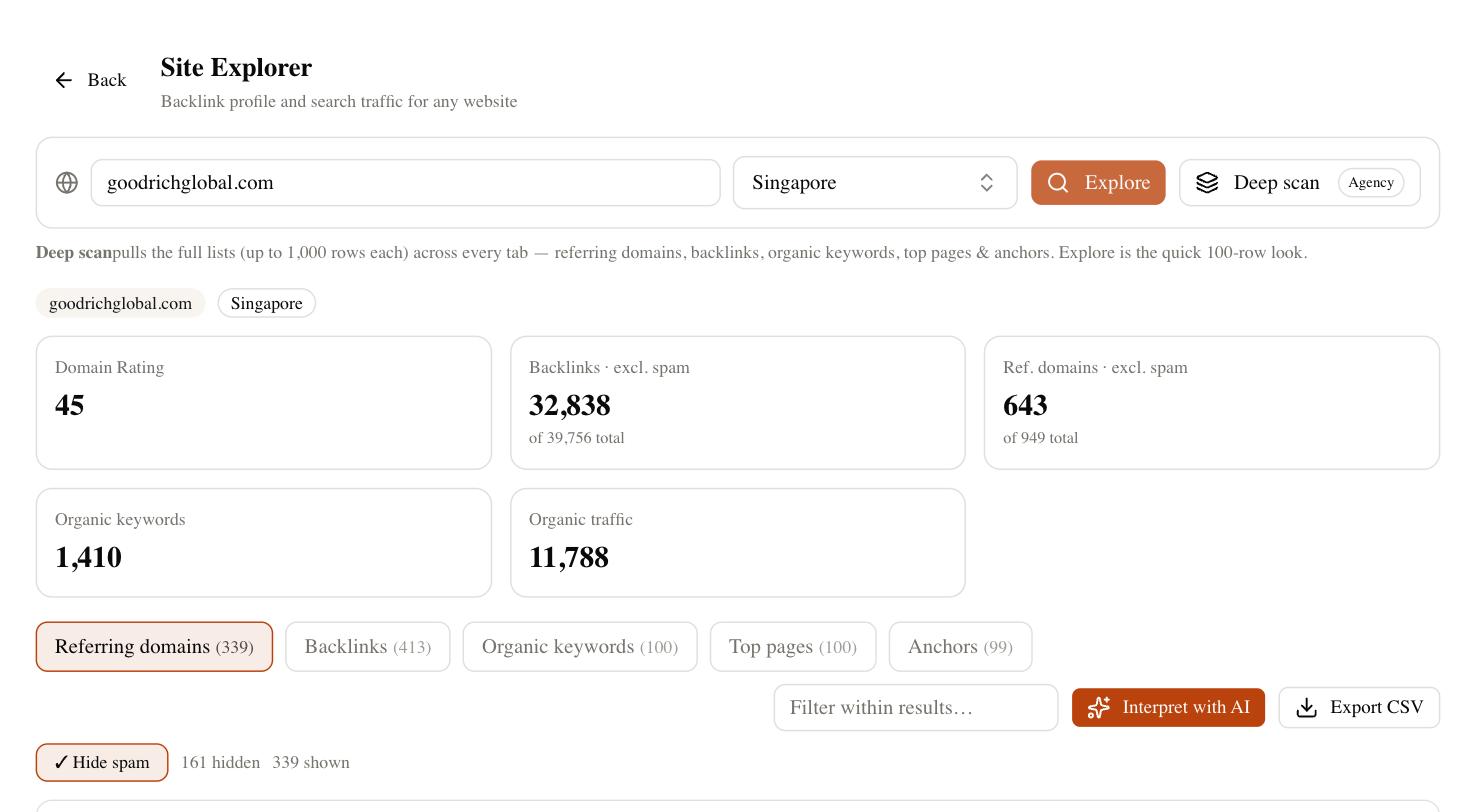
For a small business, the real saving is consolidation. A typical stack of Semrush plus a separate AI writer plus an AI-visibility tracker collapses into one subscription, and the entry price is a fraction of a comparable Semrush plan once you count what you were spending across all three. If you’re a consultant or a two-person agency, the client-dashboard side lets you hand a read-only report straight to a client without exporting a thing.
The AI-visibility piece is the part no traditional suite answers well. Search is splitting — some of your buyers now ask ChatGPT or Perplexity instead of Google, and a page that ranks first can still be invisible in an AI answer. Tracking where you’re cited across those surfaces means you optimize for the search that’s happening today, not the one from five years ago. For anyone whose real bottleneck is doing more with fewer tools, that combination is the strongest fit on this list.
SE Ranking, Mangools, Ubersuggest, Moz Pro and Serpstat
The mid-market has a tool for almost every budget and temperament. None of these will fold AI writing and AI-answer visibility into one workflow yet, but each does its core job well and cheaply.
- SE Ranking — the value play for anyone watching cost per site. Rank tracking scales affordably across several projects, and predictable per-project pricing suits a small portfolio.
- Mangools — the freelancer favorite. KWFinder is one of the friendliest keyword-research experiences going, and the bundle stays genuinely cheap.
- Ubersuggest — the budget entry point. It won’t match Semrush on depth, but for a hobby site or a first client it delivers usable keyword ideas for very little.
- Moz Pro — the gentlest on-ramp. If Semrush felt overwhelming, Moz’s cleaner interface and long-trusted domain authority metric make an easy switch, though its index is smaller.
- Serpstat — the mini-suite. It covers keywords, rank tracking, and site audit at a lower entry point than the big names, handy if you want breadth without the top-tier bill.
Any of these will cover core keyword and rank-tracking needs, and for a single site on a tight budget that may be all you require. The catch is the same across all five: when you need to write the content or check your AI-search presence, you’ll be back to running a second subscription, and often a third. Add those up honestly before you call the cheaper tool a saving, because a $30 tracker plus a $40 AI writer plus a visibility checker can quietly cost more than one workflow that does all three.
When you should just keep Semrush
Honesty matters here. If your work leans on the breadth — PPC research, social scheduling, PR monitoring, and SEO all under one login — Semrush earns its price, and no cheaper single tool replaces that spread. Marketing teams running the whole channel mix, or agencies whose clients expect the full Semrush report, rarely regret staying. The right question isn’t “is there something cheaper,” it’s “does the cheaper option cover the fifth of Semrush I actually use.” Sometimes, for a multi-channel team, the answer is no.
How to choose your alternative
Match the tool to your real constraint, not to a feature checklist. Write down the three tasks you actually did in your SEO tool last week. For most small businesses that list is some mix of “check what I rank for,” “see what a competitor is doing,” and “produce a piece of content.” If that’s your week, you’re paying suite prices for a mid-tier workflow, and a leaner, AI-native tool covers those three faster and cheaper.
If cost and tool-sprawl are the problem and you want AI writing plus AI-search tracking built in, SEO Rocket is the natural move. If you just want a gentler, cheaper keyword-and-rank tool, SE Ranking, Mangools, Ubersuggest, Moz, or Serpstat will do the job. And if you genuinely lean on Semrush’s full marketing breadth, there’s no shame in staying put. Whatever you pick, give it a full ranking cycle before you judge it — positions jitter a few spots day to day, and no tool’s estimates are precise. Run your own site and two competitors through it for a week; the one that answers your real questions fastest is the right choice for you.