If you’re weighing Semrush vs SE Ranking, you’re really deciding between breadth and budget. Semrush is the sprawling marketing suite that does a bit of everything; SE Ranking is the leaner, cheaper platform built to cover the core SEO jobs without the enterprise invoice. Both are good tools. Which one is right depends entirely on what you actually do in a normal week, not on whichever feature list is longer.
This comparison skips the affiliate-flavored praise and looks at the four things that decide the call in practice: how good the underlying data is, how quickly you can actually use the thing, what the AI features really do, and what you’ll pay once the trial ends. At the bottom, I’ll name a third option worth a look — because for a lot of readers, neither of these is quite the modern answer.
The short version
Semrush wins on depth and breadth. Its keyword database is one of the largest in the industry, its competitive research is genuinely excellent, and it reaches well beyond SEO into paid search, social, and PR. If you run a full marketing channel mix and want one login for all of it, Semrush earns its keep.
SE Ranking wins on value and simplicity. It handles keyword research, rank tracking, site audits, and competitor checks competently, and it does so at a fraction of the price — which is why agencies watching cost per client project keep coming back to it. You give up some index depth and some of the paid-media tooling, but for pure SEO work most people never miss it.
Semrush vs SE Ranking at a glance
Start with the summary, then read the segment notes below for the dimension that matters most to you.
| Dimension | Semrush | SE Ranking |
|---|---|---|
| Data quality | Very deep keyword and backlink index; strong competitive data | Solid, reliable core data; smaller index on the fringes |
| Ease of use | Powerful but dense; steeper learning curve | Cleaner, faster to learn for a small team |
| AI features | Broad AI add-ons across content and search visibility | Newer, lighter AI writing and assist tools |
| Best for | Marketing teams wanting an all-in-one suite | Agencies and freelancers watching cost per project |
| Rough price band | Higher — entry plans run roughly $120–140/mo | Lower — entry plans run roughly $50–65/mo |
Data quality and index depth
This is where Semrush pulls ahead, and it’s not close on the extremes. Its keyword database spans billions of terms across most markets, its backlink index is large and refreshes quickly, and its competitive analysis — traffic estimates, keyword gaps, position tracking for rivals — is among the best you can buy. When you’re chasing a competitor’s entire footprint or auditing links at scale, that depth shows up in the results.
SE Ranking’s data is dependable for everyday work. Rank tracking is accurate, site audits catch the issues that matter, and keyword volumes are close enough for planning. Where it trails is at the edges: obscure long-tail terms, smaller international markets, and the deepest backlink corners are thinner than Semrush’s. For most content and rank-tracking work you’ll never hit that wall. If your job lives on exhaustive competitive intelligence, you will.
One honest caveat for both: every third-party traffic and authority number is an estimate. Treat differences between tools as directional, and never build a strategy on a single vendor’s figure being precise to the visit.
Ease of use and learning curve
Semrush is powerful, and that power comes with density. There are dozens of reports, toolkits, and sub-tools, and most users touch a small slice of them. If you have the time to learn it — or a team that already knows it — the depth pays off. If you’re a solo operator who just wants to check rankings and find keywords, the interface can feel like more platform than you asked for.
SE Ranking is deliberately friendlier. The navigation is cleaner, the core workflows are quicker to reach, and a new user can be productive the same afternoon. It’s the better on-ramp for a small agency onboarding junior staff or a freelancer who values speed over surface area. The trade is that when you eventually need a report Semrush has and SE Ranking doesn’t, you’ll notice the ceiling.
AI features on each platform
Both tools have added AI, and both bolted it onto an interface designed before AI writing existed. Semrush offers the broader spread — content assistance, writing help, and tooling aimed at AI-search visibility — spread across its suite as add-ons. SE Ranking’s AI is newer and lighter: usable writing assistance and a few assist features, still maturing.
The shared limitation is worth stating plainly. On either platform, AI content and AI-answer visibility feel like features stapled to a research tool, not the center of the workflow. You research in one place, draft in another tab, and check whether ChatGPT or Perplexity ever cites you somewhere else entirely. That fragmentation is the gap a newer generation of tools is built to close.
Pricing and who each one fits
Price is usually the tiebreaker, and the two sit in different bands. Semrush’s entry plans run into the low hundreds a month, and the cost climbs as you add seats, projects, or the paid-media and social features that justify buying it in the first place. SE Ranking’s entry plans run roughly a third to a half of that, with pricing that scales more gently across projects — which is exactly why cost-conscious agencies favor it.
- Choose Semrush if you run a full marketing team, need paid-search and social tooling alongside SEO, and rely on best-in-class competitive data. The price is real, but so is the breadth.
- Choose SE Ranking if you’re a freelancer or agency doing focused SEO across many client projects and want predictable, affordable per-project costs without a steep learning curve.
- Choose neither if your real bottleneck is stitching research, writing, and AI-search tracking together across separate tools — the section below is for you.
The AI-native third option worth a look
Here’s the honest reframe. The Semrush vs SE Ranking debate is a choice between two research platforms built for a Google-only, human-only search world. Neither was designed for a workflow where you ask a question in plain language, get an article drafted from that data, and check whether AI engines are citing your brand. That’s the job SEO Rocket is built around.
SEO Rocket is chat-first: you ask for keyword research, competitor gaps, backlink profiles, or rank tracking in plain English, and it runs the lookup on real, Ahrefs-grade data underneath. The same tool then drafts the content with Claude and shows you your visibility in AI search — whether ChatGPT, Perplexity, and Google’s AI Overviews are actually mentioning you — through its Brand Radar feature. It’s one connected workflow instead of three subscriptions and a spreadsheet.
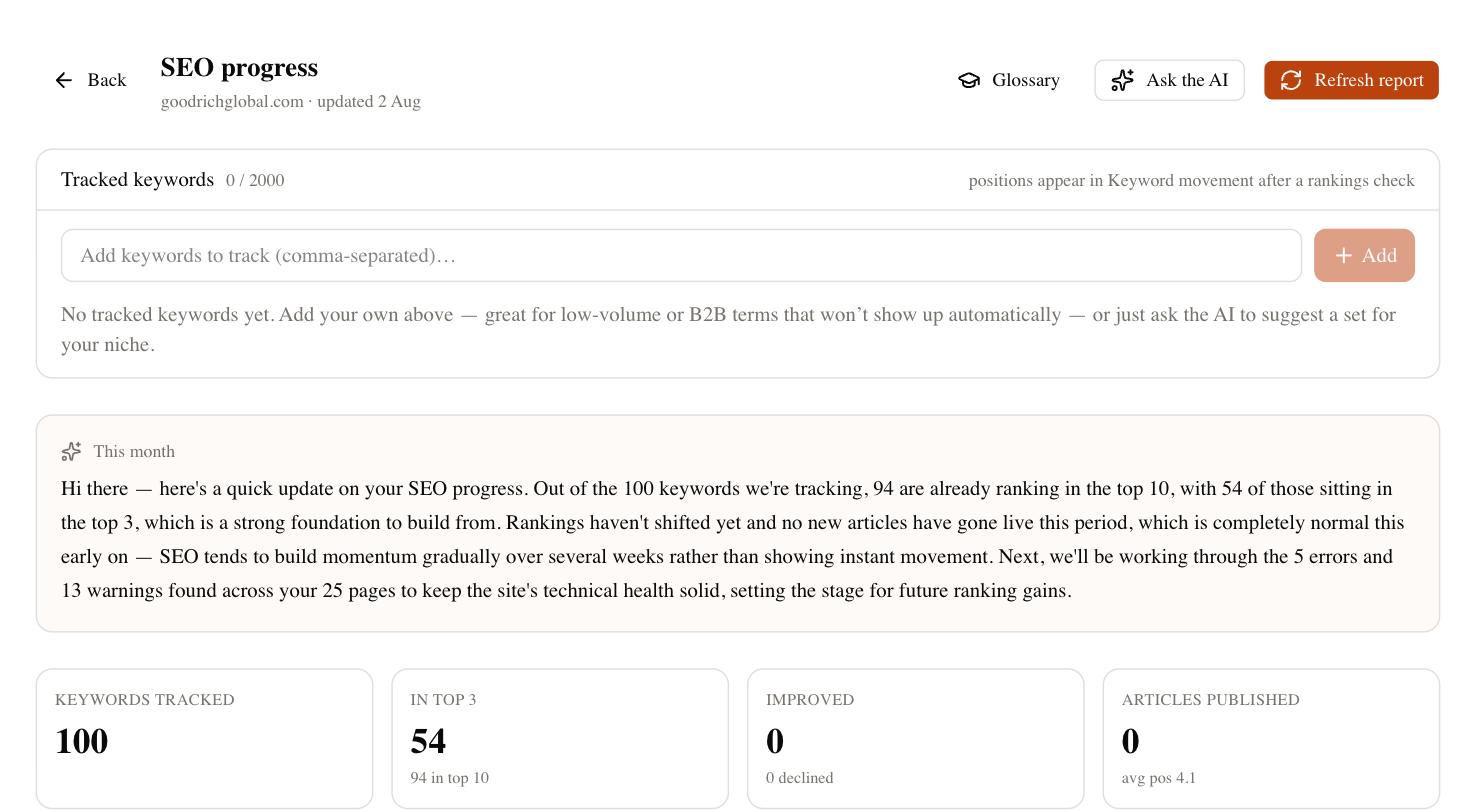
That consolidation is the point. A stack of Semrush plus a separate AI writer plus an AI-visibility tracker collapses into a single tool at entry-friendly pricing, and the agency client dashboards let you hand a read-only report straight to a client. It won’t replace Semrush for a team that needs deep paid-media tooling, and that’s fine — but if your week is research, content, and rank tracking, it covers all three in one place.
How to choose between them
Match the tool to your real constraint. If you need enterprise-grade competitive data and one platform for every marketing channel, Semrush is worth its higher price and you should buy it without apology. If you want dependable core SEO at a fraction of the cost and a gentler learning curve, SE Ranking is the smarter spend, especially across a portfolio of clients.
A quick test: list the three tasks you actually did in your SEO tool last week. If they were deep link audits, competitor teardowns, and paid-search research, Semrush fits. If they were rank checks, keyword ideas, and a site audit or two, SE Ranking does the same work for less. And if the list was “research a topic, write the piece, and see whether AI search mentions me,” you’ve outgrown the framing of this comparison — an AI-native tool like SEO Rocket will do those three faster than either. Whatever you pick, give it a full ranking cycle before you judge it; positions jitter a few spots day to day, and no tool’s estimates are exact.