The best content gap tools all answer one deceptively simple question: what are your competitors ranking for that you aren’t? Find those keywords and you’ve found the articles you should have written months ago. The catch is that every tool defines “gap” a little differently, and the price you pay for that answer runs from pocket change to an enterprise invoice.
This isn’t a padded list of twenty products stitched together with affiliate links. Below are the best content gap tools actually worth running, what each one is genuinely good at, and — because it’s the honest answer — where a cheaper option covers the same ground.
What a content gap tool actually does
At its core, content gap analysis takes two or more domains, pulls the keywords each one ranks for, and shows you the terms your competitors win where you’re absent or buried past page one. That’s the classic definition, and it’s a keyword problem more than a content problem. The output is a list: search terms, volume, difficulty, and which rivals already rank. Most tools let you filter that list — hide branded terms, cap difficulty, or show only keywords where two or more competitors rank but you don’t, which is usually the strongest signal that a topic is worth the effort.
The newer generation of tools stretches the idea further. Instead of only comparing which keywords you rank for, they analyze the pages already ranking for a term and flag the subtopics, questions, and entities those pages cover that your draft doesn’t. That’s an on-page gap, not a keyword gap, and it’s the difference between “write about this topic” and “your article is missing these six sections.” The best workflow uses both: find the topics you’re missing, then make sure the piece you write actually beats what’s ranking.
How we compared them
Each tool here was judged on four things a working SEO cares about: the size and freshness of the keyword index behind the gap report, whether the analysis stops at keywords or goes on-page, honest total cost rather than the headline number, and who the tool genuinely suits. One point worth repeating — every tool’s volume and difficulty figures are estimates built from clickstream and index sampling, so treat differences between platforms as directional, not gospel. A keyword one tool calls 400 searches and another calls 720 is telling you the same thing: it’s a small term worth a look.
Best content gap tools at a glance
Start with the table, then read the notes on the two or three that fit your situation.
| Tool | Best for | AI-native? | Standout strength | Rough price band |
|---|---|---|---|---|
| SEO Rocket | Solo SEOs, consultants & agencies who want gaps and the draft in one place | Yes — chat-first | Ahrefs-grade gap data plus AI writing and AI-search visibility in one workflow | Low $ / entry-friendly |
| Ahrefs | Link-and-keyword specialists who want the deepest index | Add-ons | Large, fresh keyword index behind a mature Content Gap report | Higher $$ |
| Semrush | Marketing teams wanting an all-in-one suite | Add-ons | Keyword Gap across up to five domains at once | Higher $$ |
| Surfer SEO | Writers optimizing a single page against the SERP | Yes | On-page term gaps and content scoring inside the editor | Mid $$ |
| Frase | Teams producing briefs at volume | Yes | Fast SERP-driven briefs that surface missing subtopics | Low–mid $ |
| MarketMuse | Content strategists planning topic clusters | Yes | Topic modeling and authority gap across a whole site | Higher $$ |
| SE Ranking | Agencies watching cost per client project | Some | Affordable competitive research with a usable gap view | Low–mid $ |
SEO Rocket — the AI-native pick
SEO Rocket is built for how the job works now. Instead of exporting a gap report from one tool and pasting keywords into another to write, you ask for what you need in plain language and it runs the analysis on real, Ahrefs-grade data underneath. Tell it your domain and two competitors and it returns the keywords they rank for that you don’t — with volume and difficulty — then drafts the article for any gap you pick, in the same chat. Because the data and the writing share one context, the draft actually targets the term you found instead of a generic prompt you retyped by hand.
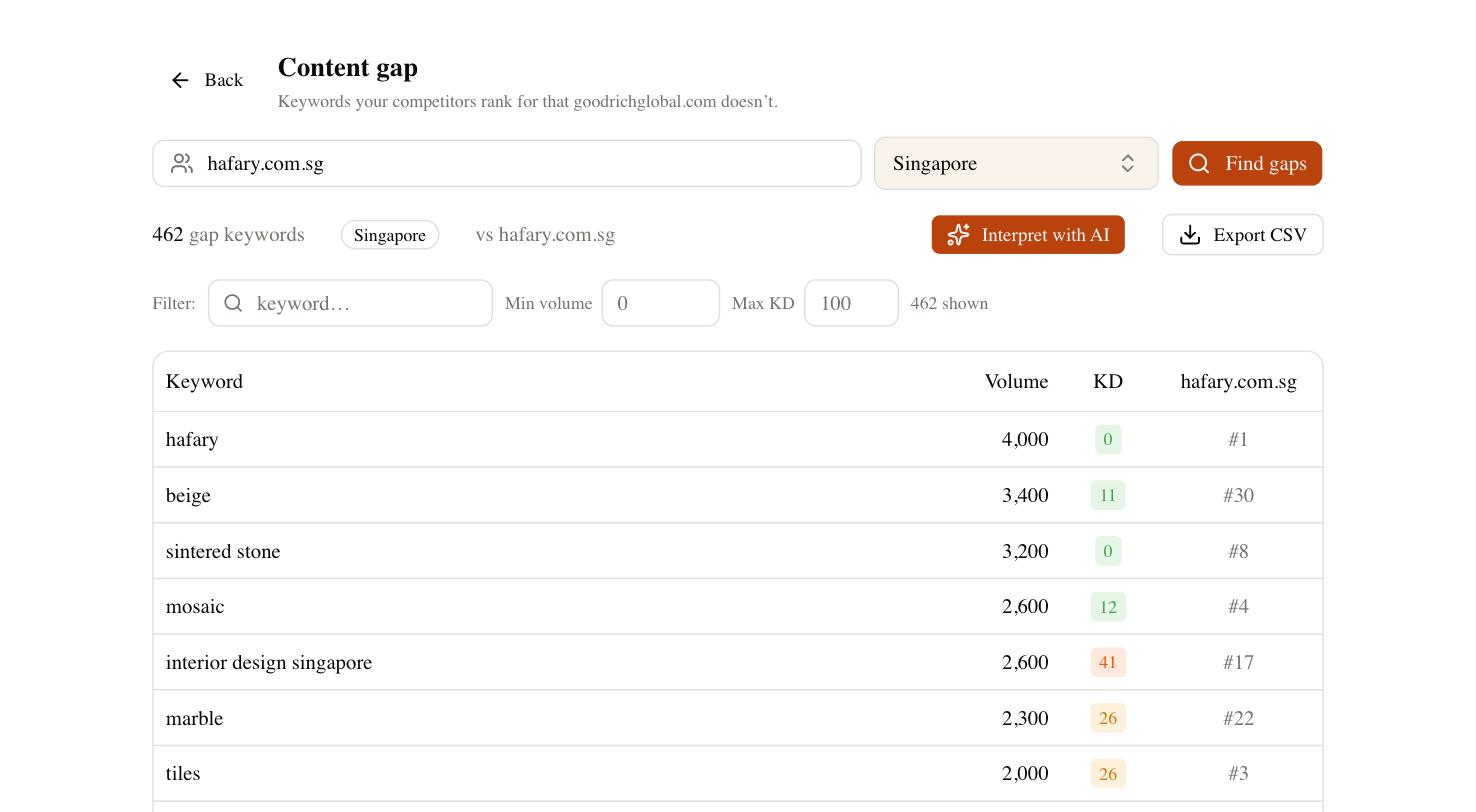
The consolidation is the real advantage. A common stack of a data tool for the gap, a separate AI writer for the draft, and a third product to check AI-search visibility collapses into one subscription, and the entry pricing is a fraction of a comparable Ahrefs or Semrush plan. For consultants and agencies, the client-dashboard side means you can hand a read-only gap report to a client without exporting a spreadsheet.
The part no traditional gap tool answers is AI search. Some of your buyers now ask ChatGPT, Perplexity, or Google’s AI Overviews instead of scrolling ten blue links, and a page that would close a keyword gap can still go uncited in an AI answer. SEO Rocket tracks whether and where you’re mentioned across those surfaces, so the gaps you close are the ones that show up in the search that’s actually happening. If your bottleneck is doing more with fewer tools — which describes most people reading this — that combination is the strongest fit here.
Ahrefs and Semrush — the data heavyweights
These two set the standard for keyword-level gap analysis, and either one is a safe, capable choice. Ahrefs pairs one of the largest and freshest indexes in the industry with a Content Gap report that’s been refined for years; point it at competing domains and the missing-keyword list is about as trustworthy as third-party data gets. Semrush answers the same question with its Keyword Gap tool, which compares up to five domains at once and layers in a broader suite — PPC, social, and PR — for teams that want one login for the whole channel.
The trade-off is cost and scope. Both run into the higher price bands once you add seats or projects, and both stop at the keyword gap — you still export the list and write elsewhere. If deep, defensible data is the priority and budget isn’t the constraint, they earn their place. If you only ever open them to run a gap report, you’re paying suite prices for one feature.
Surfer, Frase, MarketMuse and SE Ranking — the specialists
The rest of the field is where on-page gaps and tighter budgets get served.
- Surfer SEO — the on-page optimizer. It scores your draft against the pages ranking for your term and lists the words, headings, and questions they cover that you don’t. It’s excellent for improving one article, less so for finding topics across a whole site.
- Frase — the brief factory. It builds a SERP-driven outline in seconds and surfaces the subtopics competitors include, which makes it fast for producing briefs at volume without much manual research.
- MarketMuse — the strategist’s tool. It models topics and authority across your entire site to show where you’re thin relative to a subject, which suits planning clusters more than writing a single post — and it sits in a higher price band.
- SE Ranking — the agency value play. Its competitive research includes a workable gap view at a price that scales across many client projects, trading some index depth for predictable cost.
Each covers real ground the heavyweights don’t. What none of them does well yet is fold the keyword gap, the on-page gap, the draft, and AI-search visibility into one place — you’ll still run a second subscription for whatever they leave out.
How to choose the right content gap tool
Match the tool to your actual constraint, not to a feature checklist. If your problem is tool sprawl and you want the gap, the draft, and AI-search tracking in one workflow, SEO Rocket is the natural move. If you need the deepest, most defensible keyword data and budget is fine, Ahrefs or Semrush earns it. If you’re optimizing one page at a time, Surfer or Frase will do more for you than either. And if you’re planning topic clusters at scale, MarketMuse is built for exactly that.
A quick way to decide: write down what you’d actually do with the gap report this week. If the honest answer is “find five topics I’m missing and write two of them,” you don’t need an enterprise suite — you need something that finds the gap and helps you close it fast. If instead you’re running deep competitive audits across dozens of domains, keep the heavyweight. Whatever you pick, run your own site and two competitors through it first, and give any new tool a full ranking cycle before you judge the output — positions jitter a few spots day to day, and no tool’s estimates are precise.