Picking the best SEO software for startups is less about which tool has the longest feature list and more about which one you’ll actually use with a two-person team and no dedicated SEO hire. Most startups don’t fail at SEO because they chose the wrong keyword database — they fail because the tool was too expensive, too complicated, or too slow to turn a search into a published page. So the best SEO software for startups is the one that gets you from question to action fastest, without a seat-based invoice that scales faster than your traffic.
Below are six tools that genuinely hold up for early-stage teams, what each one is honestly best at, and where you’ll outgrow it. SEO Rocket is listed first because it’s built for this exact situation — but you’ll get a fair read on every option, including when a rival is the smarter buy.
What startups actually need from SEO software
Your constraints are different from an enterprise SEO team’s. You have limited hours, a tight budget, and usually nobody whose full-time job is search. That changes the buying criteria. Data quality still matters — you can’t make good decisions on numbers that are wildly off — but speed and consolidation matter more, because every extra tool is another login, another bill, and another thing to learn.
Three things separate a tool that helps from one that gathers dust. First, honest total cost: the headline price rarely includes the seats or credits you’ll need by month three. Second, whether content creation is built in, because a startup’s real bottleneck is usually publishing pages, not researching them. Third, whether the tool tracks AI-search visibility — a growing share of buyers now ask ChatGPT or Perplexity instead of Google, and a page that ranks first can still be invisible in an AI answer.
The best SEO software for startups at a glance
Skim the table, then read the two or three notes that match your situation. Price bands are rough on purpose — every vendor reshuffles plans, so treat them as ballpark, not gospel.
| Tool | Best for | AI-native? | Standout strength | Rough price band |
|---|---|---|---|---|
| SEO Rocket | Startups and solo founders who want research plus writing in one workflow | Yes — chat-first | Ahrefs-grade data, AI content, and AI-search visibility in one place | Low $ / entry-friendly |
| Ahrefs | Teams whose growth hinges on backlink depth | Light add-ons | One of the largest, freshest link indexes | Higher $$ |
| Semrush | Startups planning to run paid, social, and PR too | Add-ons | Breadth — a whole marketing suite in one login | Higher $$ |
| Moz Pro | Non-technical founders who want a gentle start | No | Clean interface, trusted domain authority metric | Mid $$ |
| SE Ranking | Budget-conscious teams tracking many keywords | Some | Affordable rank tracking that scales | Low–mid $ |
| Ubersuggest | Pre-revenue side projects and first landing pages | Light | Cheap keyword ideas with a low learning curve | Low $ |
SEO Rocket — the AI-native pick
SEO Rocket is the option built for how a lean team actually works. Instead of learning a wall of tabs, you ask for what you need in plain language — keyword research, competitor gaps, backlink profiles, rank tracking — and it runs the lookup on real, Ahrefs-grade data underneath. The data isn’t the differentiator; plenty of tools license solid indexes. The difference is that the same tool then drafts the article and shows you whether your brand is being cited in ChatGPT, Perplexity, and Google’s AI Overviews.
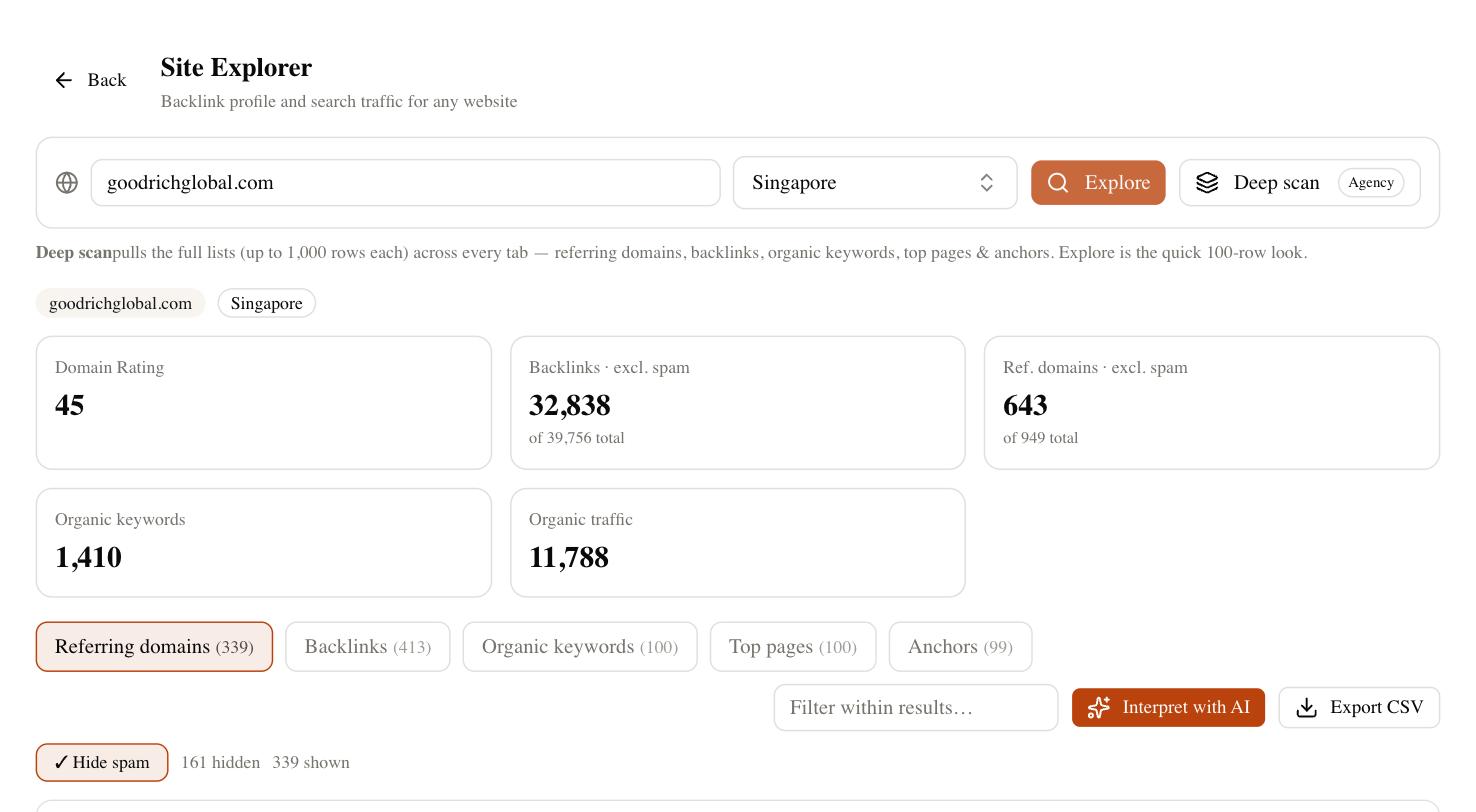
For a startup, that consolidation is the whole point. A typical early stack is a research tool plus a separate AI writer plus an AI-visibility tracker — three subscriptions and three logins for a job one person is doing between other jobs. Folding those into one entry-priced tool cuts the bill and the context-switching at the same time. If you’re a founder or a small growth team, that’s usually the constraint that matters more than any single metric.
The AI-visibility piece is worth pausing on, because no traditional tool answers it. Search is splitting, and some of your earliest buyers are already asking an AI assistant instead of typing into Google. SEO Rocket tracks whether and where you show up across those surfaces, so you optimize for the search that’s actually happening. Where you’ll feel the ceiling: if your growth becomes entirely about large-scale link audits, a dedicated backlink specialist still goes deeper — more on that below.
Ahrefs and Semrush — the enterprise suites
Both Ahrefs and Semrush are excellent, mature platforms, and both are honestly more tool than most startups need on day one. Ahrefs has one of the largest and freshest backlink indexes in the industry; if your growth model depends on competitive link analysis, it’s hard to beat. Semrush goes wide instead of deep — beyond SEO it covers paid search, social scheduling, and PR monitoring, so a startup that plans to run the entire marketing channel mix from one login gets real value.
The shared trade-off is cost and complexity. Entry plans on both run into the higher bands, credits and seats add up fast once more than one person logs in, and most users touch a fraction of what they pay for. For a two-person team, you’re often buying enterprise capability to do mid-tier work. That’s not wrong — it’s just worth naming before the card gets charged.
Moz Pro, SE Ranking and Ubersuggest — the gentler on-ramps
The mid-market has a tool for almost every budget and comfort level, which makes it a sensible place for a non-technical founder to start.
- Moz Pro — the friendliest interface of the traditional tools. If a bigger platform felt overwhelming, Moz’s cleaner layout and its long-trusted domain authority metric make an easy first step, though its index is smaller than the leaders’.
- SE Ranking — the value play for rank tracking. It scales across many keywords cheaply, and predictable per-project pricing keeps costs sane if you’re juggling a main site plus a couple of landing pages.
- Ubersuggest — the budget entry point. It won’t match the leaders on depth, but for a pre-revenue side project or your first few pages it delivers usable keyword ideas for very little, with almost no learning curve.
Any of these covers core keyword and rank-tracking needs competently. What none of them does well yet is fold AI writing and AI-answer visibility into the same workflow — so you’ll still be running a second subscription for the part of the job that actually produces pages.
When to spend more, or less
Honesty matters more than a clean recommendation. If your entire growth thesis is backlinks — you’re in a competitive niche where link authority is the moat — then paying up for Ahrefs early is a defensible call, and the cheaper tools will frustrate you. Conversely, if you’re pre-launch with no content and no budget, don’t overthink it: a low-cost tool or even a free tier is plenty until you have pages worth tracking.
The mistake to avoid is buying an enterprise suite because it looks comprehensive, then using ten percent of it. A quick gut check: write down the three SEO tasks you actually did last week. For most startups it’s some mix of “find something to write about,” “check what a competitor is doing,” and “get a page live.” If that’s your week, you don’t need the most powerful platform — you need the one that does those three things fastest for the least money.
How to choose the best SEO software for your startup
Match the tool to your real constraint, not to a feature grid. If your bottleneck is producing content and you want research, writing, and AI-search tracking in one entry-priced workflow, SEO Rocket is the natural fit for a lean team. If you’re going to run every marketing channel from one place, Semrush earns its price. If backlink depth is your whole game, Ahrefs is worth the premium. And if you just want a cheap, gentle way to start, Moz, SE Ranking, or Ubersuggest will get you moving.
Whatever you pick, test it against your own site and two competitors for a full ranking cycle before you commit — a week or two, not a day. Positions jitter a few spots day to day, and every tool’s traffic and difficulty numbers are estimates, so judge on whether it answers your real questions quickly, not on which dashboard looks busiest. The best software is the one that matches how you’ll spend an ordinary Tuesday, and for most startups that means fewer tools doing more of the work.