If you are weighing Ahrefs vs Majestic, you are really choosing between a broad SEO platform and a specialist link-intelligence engine — and the right answer depends entirely on what you do all day. Both tools are excellent at what they were built for, so the Ahrefs vs Majestic question is less about which is “better” and more about which one matches your workflow, budget, and how deep you go on links.
This is a head-to-head across the dimensions that actually decide it: data quality, ease of use, AI features, who each one suits, and rough cost. No fake winner, no affiliate padding. Where Majestic is the honest pick, that is what you will read.
What each tool is actually built for
Majestic is a link database first and almost only. It has crawled the web for backlinks longer than most tools have existed, and its whole identity is two metrics — Trust Flow and Citation Flow — plus a very large historic link index. You go to Majestic to answer one kind of question deeply: who links to this domain, how trustworthy are those links, and how has that profile changed over years.
Ahrefs started as a backlink tool too, but grew into a full suite. Alongside its link index you get keyword research, rank tracking, a site audit crawler, content explorer, and traffic estimates. It answers the whole spread of daily SEO questions in one login, where Majestic answers one question very well. That difference in scope shapes everything below.
Ahrefs vs Majestic at a glance
Start with the summary, then read the section notes for the dimension that matters most to you. Treat every third-party metric here as an estimate, not gospel — Trust Flow, Domain Rating, and traffic numbers are all modeled, and they will disagree across tools.
| Dimension | Ahrefs | Majestic |
|---|---|---|
| Core strength | All-in-one SEO suite | Deep, historic link index |
| Link data | Large, fresh, fast-updating | Very large historic + Fresh Index |
| Signature metric | Domain Rating / URL Rating | Trust Flow / Citation Flow |
| Keywords & rank tracking | Yes, built in | No — links only |
| Ease of use | Polished, denser | Simpler, more technical feel |
| AI features | Limited add-ons | None |
| Best for | SEOs wanting one broad platform | Link builders & auditors |
| Rough price band | Higher $$ (mid-hundreds at scale) | Low–mid $$ |
Data quality and the link index
This is the dimension people care about most, and it is closer than the marketing on either side suggests. Majestic’s headline advantage is history — its index reaches far back, which is genuinely useful when you are auditing a domain’s link profile over its whole life or investigating an aged expired domain. The Fresh Index keeps recent links current, and the Trust Flow topical breakdown is a real strength for judging link relevance, not just volume.
Ahrefs counters with crawl speed and freshness. It re-crawls aggressively, so new links tend to show up quickly, and its index is one of the largest in the industry. For most working SEOs chasing recently earned links or auditing a competitor’s current profile, that freshness matters more than deep history. Neither tool is “right” on raw numbers — they count links differently, so a domain will show a different backlink total in each. The verdict here splits: Majestic for historic depth and topical trust analysis, Ahrefs for fresh, fast, current link discovery.
Ease of use and interface
Ahrefs is the more polished product. Reports are visual, well-organized, and consistent across the suite, though the sheer number of features means there is more to learn and more to ignore. Most users touch a fraction of what they pay for.
Majestic feels more like a specialist instrument. The interface is plainer and more data-dense, and it assumes you already understand link metrics. That is not a flaw — for a link auditor who lives in referring-domain tables, the directness is a feature, not a barrier. But a beginner will find Ahrefs friendlier to explore, while a link specialist may prefer Majestic’s no-nonsense tables. Call this one a narrow win for Ahrefs on polish, a draw on getting real work done.
AI features and where both tools stop
Here the comparison ends quickly, because neither tool was built for the way search works now. Majestic has essentially no AI layer — it is a link database, and that is the whole point. Ahrefs has added some AI-assisted touches, but content writing and AI-search visibility are not the core of the product, and you will still reach for other tools to draft articles or to see whether ChatGPT ever cites your brand.
That gap is not a knock on either. Both are mature tools that predate AI writing and AI answers, and both do their original job well. But if part of your week is producing content or tracking whether you show up in AI-generated answers, neither Ahrefs nor Majestic closes that loop on its own. You end up running a second and sometimes third subscription to cover it.
Which one should you pick?
Match the tool to your actual constraint. If your work is broad — keyword research on Monday, a competitor teardown on Tuesday, rank tracking and a site audit on Wednesday — Ahrefs earns its higher price because it does all of that in one place, and its link data is fresh enough to satisfy most audits. Paying Ahrefs money and only using it for links is the mismatch to avoid.
If links are your whole world — competitive link audits at scale, disavow work, historic profile analysis, expired-domain vetting — Majestic is the honest pick, and often the cheaper one. Its historic index and Trust Flow topical data are hard to replace, and you are not paying for a suite of features you never open. Serious link builders frequently run Majestic alongside a broader tool rather than instead of one.
SEO Rocket — the AI-native third option
There is a third path the original question misses. SEO Rocket is built for how the job works now: instead of a wall of tabs, you ask for what you need in plain language and it runs the lookup on real, Ahrefs-grade data underneath — backlink profiles with referring domains and DR, keyword research, competitor gaps, and rank tracking. The data quality sits in the same tier you would expect from the tools above.
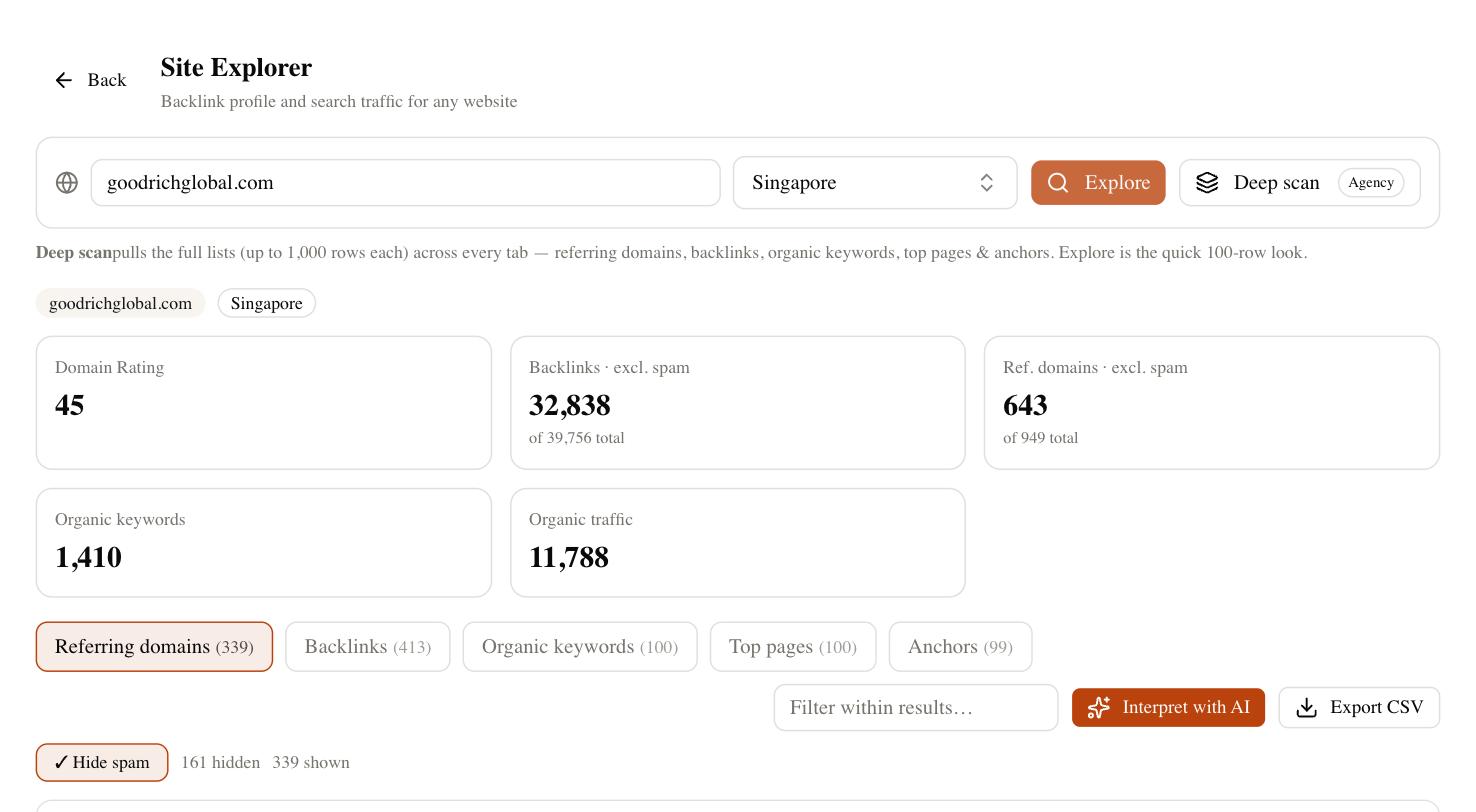
The difference is what happens next. The same tool then drafts the article and shows you whether your brand is being cited in ChatGPT, Perplexity, and Google’s AI Overviews through its Brand Radar visibility tracking. A stack that used to be a link tool plus an AI writer plus an AI-visibility tracker collapses into one subscription, and for consultants the client-dashboard side means you hand a read-only report straight to a client without exporting anything.
None of that makes Ahrefs or Majestic obsolete — if you need the deepest historic link index, Majestic still owns that ground, and Ahrefs remains a superb broad suite. But if your real bottleneck is doing more with fewer tools, an AI-native workflow answers questions those two were never designed to touch. Whichever you choose, run your own site and two competitors through it for a full ranking cycle before you judge — positions jitter a few spots day to day, and no tool’s estimates are precise. The best tool is the one that matches how you actually spend your week.