The best SERP checker tools all do the same core job — tell you where your pages actually rank on Google — so the real question is what else they give you for the money. Some are single-purpose rank trackers that refresh positions daily and nothing more. Others fold rank tracking into a wider workflow that also handles keyword research, competitor gaps, and content. This guide compares the ones worth paying for and, just as importantly, who each one is genuinely for.
You will not find twelve padded entries here. Below are the best SERP checker tools that hold up in daily use, an honest note on where each one wins, and a plain method for picking the one that fits how you actually work.
What a SERP checker actually does
A SERP checker pulls the live search results for your keywords and records exactly where your site sits — position 3, position 14, or nowhere on page one. Good ones do it from the right country and device, track the same keywords over time so you can see movement, and flag when you win or lose a featured snippet, a local pack slot, or an image result. That history is the point. A single check tells you today’s number; a tracker tells you whether your work is paying off.
The gap between tools shows up in the details. How often do positions refresh — daily, or on demand? Can it track a specific city or postcode for local SEO? Does it separate mobile from desktop, since the two results sets diverge more every year? Does it show the ranking URL and the competitors sitting above you, or just a bare number? And increasingly: does it tell you anything about AI search, where a page that ranks first on Google can still be invisible in a ChatGPT answer? Those details are what you are really paying for once the basic position number is a commodity.
How we compared them
Each tool here is judged on four things a working SEO cares about: the accuracy and freshness of position data, honest total cost rather than the headline figure, whether it does more than rank tracking or stays deliberately narrow, and who it genuinely suits. Positions jitter a few spots day to day on every platform, so treat small cross-tool differences as normal rather than a sign one is broken. No checker is perfectly precise, and any that claims to be is overselling.
The best SERP checker tools at a glance
Start with the table, then read the notes on the two or three rows that match your situation.
| Tool | Best for | AI-native? | Standout strength | Rough price band |
|---|---|---|---|---|
| SEO Rocket | Solo SEOs, consultants & agencies wanting one AI-driven workflow | Yes — chat-first | Rank tracking plus keyword, gap, content & AI-search visibility in one place | Low $ / entry-friendly |
| Ahrefs | Teams already living in Ahrefs for backlink work | Add-ons | Rank tracker backed by a huge keyword and link index | Higher $$ |
| Semrush | Marketing teams wanting an all-in-one suite | Add-ons | Position tracking inside a broad marketing platform | Higher $$ |
| AccuRanker | Agencies needing fast, large-scale daily tracking | Light | Speed — on-demand refresh across thousands of keywords | Mid–high $$ |
| SE Ranking | Agencies watching cost per project | Some | Flexible, affordable tracking at scale | Low–mid $ |
| Mangools (SERPWatcher) | Freelancers who want simple, friendly tracking | No | Clean interface, easy setup | Low $ |
| Nightwatch | Local and geo-heavy tracking needs | No | Granular location and device targeting | Mid $$ |
SEO Rocket — the AI-native pick
SEO Rocket is the option built for how the job works now. Instead of setting up a rigid tracker and hopping to other tabs for everything else, you ask for what you need in plain language and it runs the lookup on real, Ahrefs-grade data underneath. Ask which keywords you rank for and it returns positions with the ranking URL, estimated traffic, and the competitors above you — then the same tool can draft the article to close a gap or show whether you are being cited in AI answers.
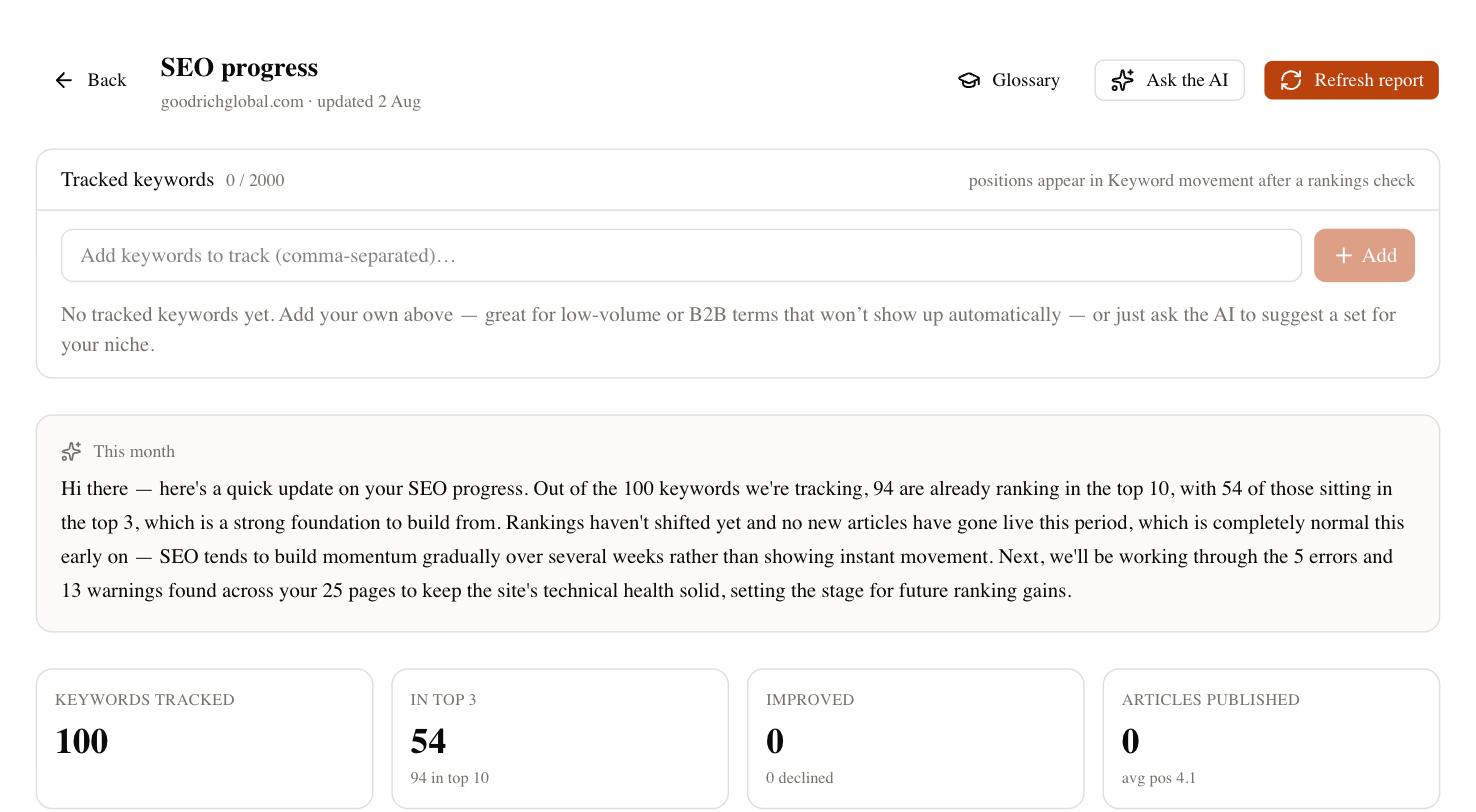
The consolidation is the real saving. A typical stack of a rank tracker plus a separate keyword tool plus an AI writer collapses into one subscription, and the entry pricing is a fraction of a comparable suite plan. For consultants and agencies, the client-dashboard side means you can hand a read-only ranking report straight to a client without exporting spreadsheets or rebuilding a slide every month.
The part no traditional checker answers is AI search. Some of your buyers now ask ChatGPT, Perplexity, or Google’s AI Overviews instead of scrolling the classic results, and a page that ranks first can still go unmentioned there. SEO Rocket’s Brand Radar tracks whether and where you show up across those surfaces alongside your normal Google positions, so you are watching the search that is actually happening. If your bottleneck is doing more with fewer tools — which is most people reading this — that combination is the strongest fit on the list.
Ahrefs and Semrush — the suite trackers
Ahrefs and Semrush both include capable rank tracking, and if you already pay for one of them for backlink or keyword work, adding your keywords to their tracker is the obvious move. Ahrefs pairs positions with one of the largest link indexes in the industry, which matters if your work leans on competitive backlink analysis. Semrush wraps position tracking inside a genuine do-everything platform covering PPC, social, and PR, so a marketing team wanting a single login gets real breadth.
The trade-off is the same for both: you are buying a large, dense suite to get a tracker, and the entry plans run into the higher bands once you add seats or projects. Most users touch a fraction of what these platforms offer, so if rank tracking is the main thing you need, you will pay for a lot of features you rarely open. But if you are already inside either tool daily for keyword or link work, there is no reason to bolt on a second one just to watch positions.
AccuRanker, SE Ranking, Mangools and Nightwatch
The focused trackers each win at one clear thing.
- AccuRanker — the speed play. If you manage thousands of keywords across many clients and need positions refreshed on demand rather than waiting a day, its refresh speed is its whole reason to exist. It costs more than the budget options, but for large agencies that is the point.
- SE Ranking — the value play. Tracking scales cheaply across many projects, and predictable per-project pricing keeps costs sane when you run a portfolio of clients.
- Mangools (SERPWatcher) — the freelancer favorite. It keeps things simple and friendly, sets up in minutes, and stays affordable as part of the Mangools bundle.
- Nightwatch — the local specialist. If you need to track rankings from specific cities, postcodes, or a long list of locations, its granular geo and device targeting handle that better than most generalist tools.
Any of these covers core position tracking well. What none of them fold in yet is AI-answer visibility or built-in content — so if that matters to you, expect to run a second subscription alongside them.
How to choose the right SERP checker
Match the tool to your real constraint, not to a feature list. If you want tracking plus keyword research, competitor gaps, content, and AI-search visibility in one AI-driven workflow, SEO Rocket is the natural move. If you already live in Ahrefs or Semrush, use their built-in tracker rather than paying twice. If you run a big agency and need fast daily refresh at scale, AccuRanker earns its price. If cost per project is the pressure, SE Ranking or Mangools will do the job, and Nightwatch is the pick when local precision is everything.
A quick way to decide: write down what you actually did with rankings last week. If it was checking positions, seeing what a competitor is doing, and producing a piece of content, you want the tool that does all three in one place, not a bare tracker plus two more subscriptions. Whatever you pick, give it a full ranking cycle before judging it — positions move a few spots day to day, and the tool that answers your real questions fastest is the right SERP checker for you.