
Most people looking for a majestic review already know one thing: Majestic is a backlink tool, not an all-in-one SEO suite. That framing matters, because judged as a link index it is one of the oldest and deepest in the industry, and judged as a modern workflow tool it is showing its age. This majestic review is written for someone deciding whether to pay for it in 2026, so it sticks to what the tool actually does in daily use rather than the marketing page.
Majestic has been crawling the web and mapping links since long before Trust Flow became a phrase SEOs throw around. If your job is link analysis and nothing else, it deserves a serious look. If you want keyword research, rank tracking, and content help in the same login, it was never built for you, and no amount of goodwill changes that.
What Majestic actually is
Majestic is a specialist backlink intelligence tool. Its entire reason to exist is a massive crawl of the web that it turns into two link indexes: a Fresh Index that covers roughly the last few months of newly discovered links, and a Historic Index that stretches back years. You point it at a domain or URL and it shows you referring domains, backlinks, anchor text, referring IPs, and its own trust metrics.
What you will not find is a keyword explorer, a rank tracker, or a content editor. Majestic made a deliberate choice decades ago to be the best at one thing rather than passable at ten, and the product still reflects that. The upside is depth. The downside is that Majestic assumes you already own other tools for everything that is not a link.
Where Majestic is genuinely strong
The link index is the headline strength. Majestic’s Historic Index is one of the few places you can study a site’s link history over a long horizon, which is invaluable for auditing an aged domain, investigating a penalty, or checking what an expired domain used to point at before you buy it. The crawl is broad, and the raw link data holds up against the other big indexes.
Bulk analysis is another quiet strength. The Bulk Backlink Checker lets you paste hundreds of URLs and get referring-domain and trust numbers back in one pass, which is exactly what you want when you are qualifying a prospect list or vetting a batch of guest-post targets. Clique Hunter, which finds sites that link to several of your competitors but not to you, remains a genuinely useful link-prospecting idea that few tools copy well.
Trust Flow and Citation Flow, explained honestly
Majestic’s signature metrics are Trust Flow and Citation Flow. Citation Flow scores how many links point at a page; Trust Flow scores how trustworthy those linking sites are, based on distance from a seed set of known-good sites. Topical Trust Flow goes further and tells you which subject areas a site earns its trust in, so you can tell a page that is trusted about finance from one that is trusted about gambling.
These are useful shorthand, and Topical Trust Flow in particular is a smart idea. Be honest about what they are, though: they are third-party estimates, not Google signals. A high Trust Flow does not guarantee a link helps you, and a low one does not prove a link is worthless. Treat them the way you should treat any vendor metric, including domain rating from rival tools, as a directional filter for a shortlist, never as a verdict.
Real weaknesses you should know
The interface is the first thing regular users notice. Majestic looks and feels like a tool built by engineers for engineers, and while power users learn to love the density, a newcomer faces a wall of tables and abbreviations with little hand-holding. There is a learning curve, and it is steeper than it needs to be in 2026.
The bigger gap is scope. Majestic gives you no organic traffic estimates, no keyword volumes, and no rank tracking, so you cannot answer “what does this site rank for” or “is my position moving” without a second subscription. Anchor text and link data are excellent; the context around whether a link is actually driving results is missing. There is also no AI-assisted content or AI-search visibility anywhere in the product, which is increasingly where SEO work is heading.
Rough pricing and what you get
Majestic prices by plan tier rather than by seat, and the tiers are built around index access and how many analysis units you burn. Entry plans land in the low tens of dollars a month, mid plans in the roughly $100 a month range, and the top API-focused tier runs into the low hundreds. Compared with a full suite like Ahrefs or Semrush, whose entry plans start around $100 to $150 a month, Majestic can look cheap, but that comparison is unfair in both directions: you are buying a link tool, not a suite, so the honest question is whether a dedicated link index is worth a line item on its own.
Majestic vs. the alternatives
Here is how Majestic sits against the tools people usually weigh it against. Price bands are approximate and change often, so confirm before you buy.
| Tool | Best for | Backlink depth | Beyond links? | Rough price band |
|---|---|---|---|---|
| Majestic | Pure link analysis & historic data | Very deep, long history | No | Low $ to mid $$ |
| Ahrefs | All-round SEO with strong links | Very deep, fresh | Yes — keywords, rank, audit | Higher $$ |
| Semrush | Marketing teams wanting breadth | Solid | Yes — PPC, content, social | Higher $$ |
| SEO Rocket | Solos & agencies wanting one AI workflow | Ahrefs-grade data | Yes — AI writing + AI-search | Low $ / entry-friendly |
Where SEO Rocket fits
If your reason for reading a link-tool review is that you want good backlink data without buying and learning a dense, single-purpose product, SEO Rocket is worth a look. You ask for a backlink profile in plain language and it returns referring domains, domain rating, anchors, and new and lost links on real, Ahrefs-grade data, then keeps going into keyword research, rank tracking, and competitor gaps in the same chat.
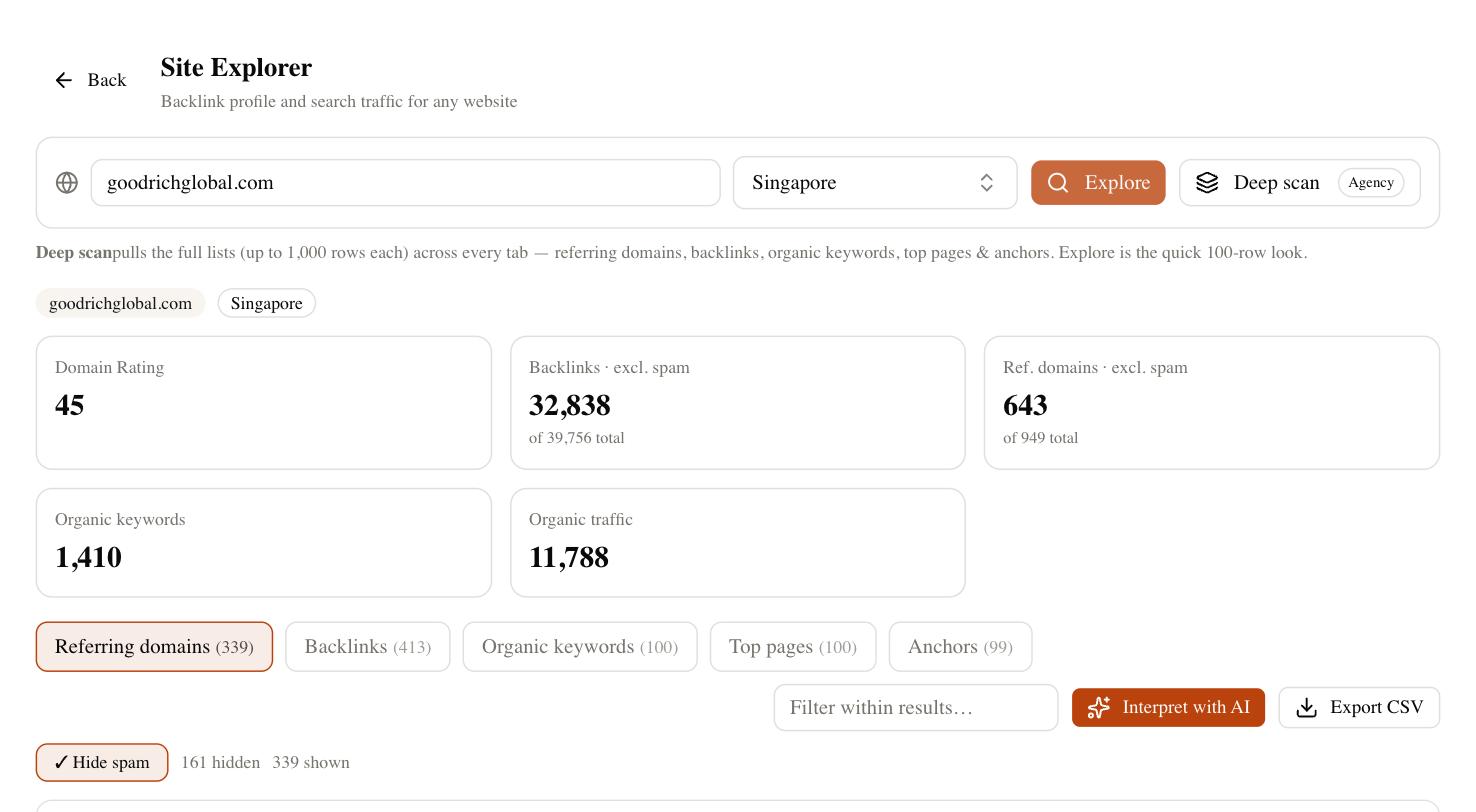
The honest distinction is this. Majestic will still beat a generalist tool on deep historic link forensics, so if you audit aged domains for a living, keep it. But if links are one part of a wider job, SEO Rocket folds link data, AI content drafting, and AI-search visibility tracking into one subscription at entry-friendly pricing, which removes the second and third tools most Majestic users end up paying for.
Who Majestic is right for
Majestic is right for the link specialist. If you build links at scale, run competitive link audits, buy and flip aged domains, or need to study a site’s link history across many years, its index depth and Historic data are hard to replace, and Topical Trust Flow gives you a lens few rivals match. For that reader, it earns its place next to whatever else you run.
Majestic is the wrong single purchase for anyone who wants one tool to cover the whole job. If your week is a mix of checking rankings, seeing what a competitor is doing, and producing content, a link-only tool leaves most of that unsolved and you will end up stacking subscriptions. Try Majestic on a single month, run one real audit through it, and judge it on the one thing it is built for. If that one thing is your job, it is still excellent. If it is a quarter of your job, a broader or AI-native tool will serve you better for less.