
The moz vs ubersuggest decision usually comes down to one thing: you want a real SEO tool, but you do not want to pay Ahrefs or Semrush money to get one. Both of these fit that brief, and both have loyal users who would tell you they picked right.
So which one actually wins? That depends entirely on what you do all week, and the honest answer in the moz vs ubersuggest matchup is that neither dominates across the board. Moz is the older, more polished platform with a metric the whole industry recognizes. Ubersuggest is the cheaper, faster-to-learn option that gives you usable ideas without a subscription that stings. Below is a segment-by-segment breakdown so you can match the tool to your situation instead of a feature list.
The two tools at a glance
Start with the summary, then read the sections that matter to you. Treat every third-party number in either tool as an estimate, not gospel.
| Dimension | Moz Pro | Ubersuggest |
|---|---|---|
| Data quality | Deeper keyword and link index; trusted Domain Authority metric | Solid keyword ideas; lighter link and index depth |
| Ease of use | Clean but feature-dense; a slight learning curve | Very fast to learn; minimal, beginner-friendly |
| AI features | Limited; largely traditional workflows | Light AI suggestions and content prompts |
| Best for | Small teams and consultants who value data depth | Hobbyists, bloggers, and very small budgets |
| Rough price band | Mid $$ monthly; lifetime option uncommon | Low $ monthly, plus a one-time lifetime tier |
Why people compare these two in the first place
These tools sit at the affordable end of the market, so they attract the same buyer: someone priced out of the enterprise suites who still needs keyword research, rank tracking, and a look at the competition. You rarely see a link-audit specialist weighing them, because that person already knows they need a bigger index. What you see instead is a blogger, a freelancer, or a small-business owner who wants to stop guessing which pages to write.
That shared audience is exactly why the comparison is tricky. On paper the feature lists overlap. In practice the two tools feel different the moment you log in, and the right pick hinges on whether you value depth or simplicity more.
Data quality: Moz has the depth
On raw data, Moz is the stronger platform. Its keyword database is larger, its crawler is mature, and its link index has been running long enough to give you a defensible picture of a site’s backlink profile. Domain Authority, Moz’s signature metric, is not a Google ranking factor and never was, but it is the number clients and prospects recognize, which makes it genuinely useful when you are pitching or reporting.
Ubersuggest holds up better than its price suggests, especially for keyword ideas and content suggestions. Where it falls short is depth. Backlink data is thinner, historical trends are shorter, and once you push past surface-level research you feel the ceiling. For a hobby site or a first client, that ceiling may never bother you. For competitive analysis on a real campaign, Moz gives you more to work with.
Ease of use: Ubersuggest wins for beginners
Ubersuggest was built by a marketer for people who are not full-time SEOs, and it shows in the best way. You type a keyword, you get ideas, difficulty scores, and content suggestions in a layout you can read without a tutorial. If you have ever felt overwhelmed by a wall of tabs, this is the calmer room.
Moz is clean by enterprise standards but still denser. There is more to click, more to configure, and more metrics competing for your attention. The payoff is that the added surface area is doing real work once you learn it. If you are brand new and want to be productive in an afternoon, Ubersuggest is the gentler start. If you expect to grow into a tool over a year, Moz’s learning curve pays you back.
AI features: neither is AI-native
This is the segment where both tools show their age. Ubersuggest layers some AI-assisted suggestions and content prompts on top of its keyword research, which is a nice touch for drafting outlines. Moz leans on its traditional strengths and has been slower to make AI central to the workflow.
Neither tool answers the question that increasingly matters: are you visible inside AI search? A growing share of buyers now ask ChatGPT, Perplexity, or Google’s AI Overviews instead of scrolling ten blue links, and a page that ranks first can still be absent from the answer they read. Neither Moz nor Ubersuggest tracks that surface in a meaningful way yet, and neither drafts full, publish-ready articles from your keyword data in the same window. You end up bolting on a separate AI writer and a separate visibility tracker, which quietly rebuilds the tool-sprawl you were trying to avoid.
Pricing and who each tool actually suits
Price is where the two diverge most clearly. Ubersuggest sits in a low monthly band and is well known for offering a one-time lifetime option, which is rare in this category and genuinely appealing if you hate recurring bills. For a blogger or a side project, paying once and owning the tool is hard to argue against.
Moz runs in a mid monthly band, more than Ubersuggest but well under the enterprise suites, and you are paying for that extra data depth and the Domain Authority ecosystem. If you are a consultant who reports to clients or a small team doing real competitive work, that spend is easy to justify. Put plainly: choose Ubersuggest when budget and simplicity lead, and choose Moz when data depth and a recognized metric matter more than saving twenty dollars a month.
The AI-native third option: SEO Rocket
Here is the honest gap the moz vs ubersuggest question exposes. Both tools were designed for a search world that is changing fast, and both leave you assembling a stack: one tool for research, another to write, a third to check whether AI engines cite you. SEO Rocket was built to collapse that stack. You ask for what you need in plain language, and it runs the lookup on Ahrefs-grade data underneath, then drafts the article and shows you whether your brand appears in ChatGPT, Perplexity, and AI Overviews through its Brand Radar view.
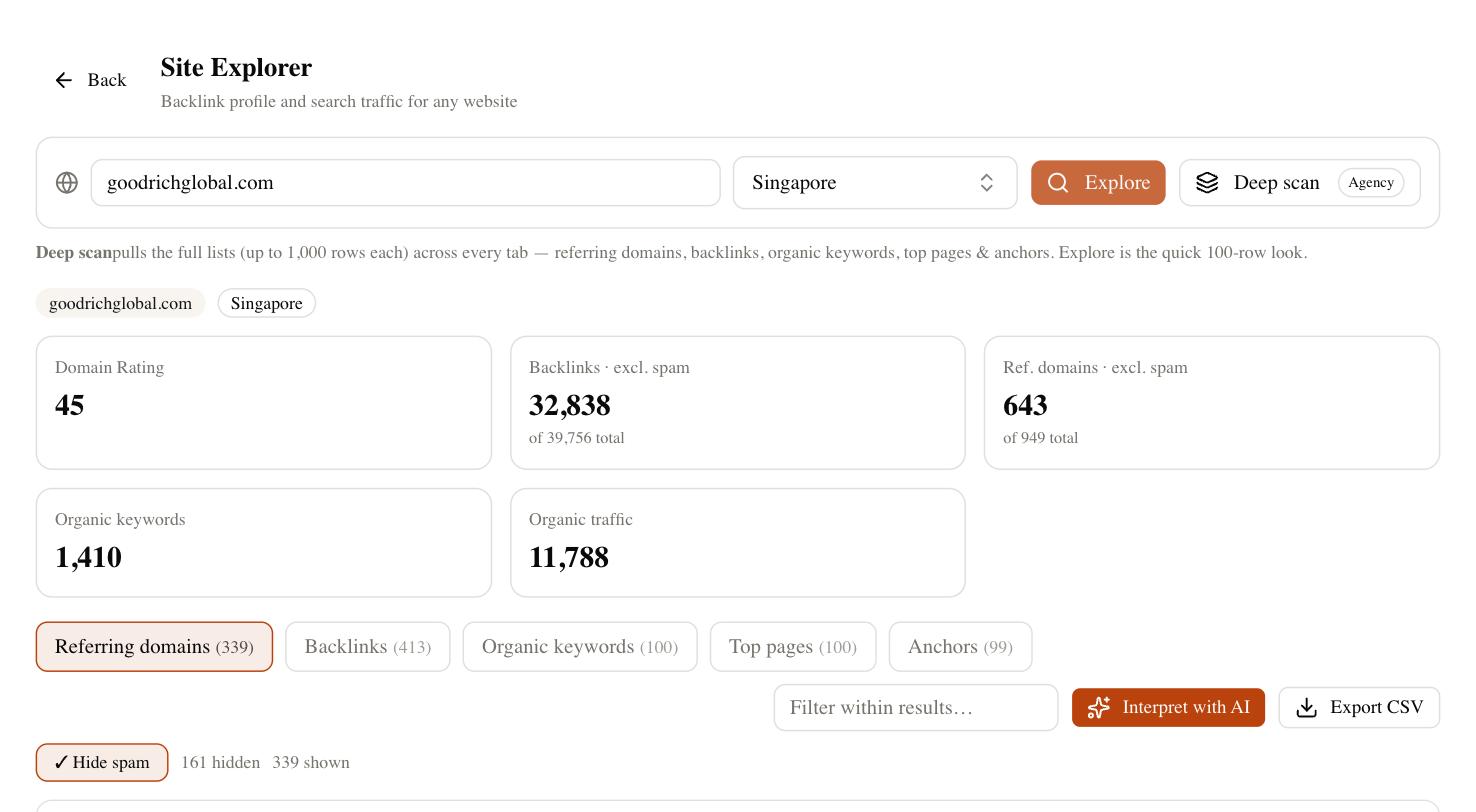
The point is not that Moz or Ubersuggest is bad. Moz still has the deeper index, and Ubersuggest is still the friendliest cheap entry point. The point is that if your real bottleneck is doing more with fewer tools, an AI-native workflow that folds research, writing, rank tracking, and AI-search visibility into one place answers a problem neither of these two was built for. For consultants and agencies, the client-dashboard side means you hand over a read-only report without exporting anything.
How to choose between them
Match the tool to your real constraint. If you are just starting out, watching every dollar, and you want ideas you can act on today, Ubersuggest is the sensible pick, and the lifetime option makes it easy to live with. If you need deeper data, a metric your clients recognize, and room to grow into more serious competitive work, Moz earns its mid-tier price. Neither choice is wrong when it fits how you actually work.
If, on the other hand, your week is a mix of researching keywords, writing content, and wondering whether AI engines ever mention you, you have outgrown the framing of this comparison. That is the case for an AI-native tool like SEO Rocket over either legacy option. Whatever you pick, run your own site and two competitors through it for a full ranking cycle before you judge it. Positions jitter a few spots day to day, estimates are never exact, and the tool that answers your real questions fastest is the one worth keeping.