
If you’re weighing NeuronWriter vs Surfer SEO, you’ve already narrowed the field to two of the better content-optimization tools on the market — so this isn’t about which one is “good,” it’s about which one fits your budget, your team, and how you actually write. Both take a target keyword, scrape the pages already ranking for it, and hand you a scoring editor that tells you which terms and entities to work in. That shared DNA is exactly why the NeuronWriter vs Surfer SEO choice trips people up: the outputs look similar until you use them for a few weeks.
Below is a head-to-head across the dimensions that decide it in practice — data quality, ease of use, AI features, who each is best for, and roughly what you’ll pay. No fake winner, no affiliate padding. Then, because content optimization is only one slice of the job now, an honest note on where an AI-native tool fits.
What each tool actually is
Surfer SEO is the more polished, more marketed of the two. It’s a browser-based content editor built around a Content Score, a keyword-and-heading planner, an AI outline generator, and an “audit” mode that grades a live URL against its competitors. It leans clean and opinionated: fewer knobs, faster to a usable brief.
NeuronWriter comes from the affiliate and lifetime-deal world, and it shows in the best way — it’s dense, flexible, and cheap for what it does. It uses NLP-style term extraction, competitor analysis, an internal-linking helper, and a content-planning module that maps out related topics. Where Surfer smooths things over, NeuronWriter gives you the raw levers and trusts you to pull them.
How we compared them
Five dimensions decide this for a working writer: the quality and freshness of the SERP data behind the score, how fast you get from keyword to a draft you can hand off, whether the built-in AI writing is usable or just a demo, who the tool genuinely suits, and honest total cost rather than the headline number. Content scores from any of these tools are guidance, not gospel — they’re correlation with what ranks, not a promise — so treat a green score as “you didn’t miss anything obvious,” not as a ranking guarantee.
NeuronWriter vs Surfer SEO at a glance
Skim the table, then read the segment notes for the two or three rows that matter to you.
| Dimension | NeuronWriter | Surfer SEO |
|---|---|---|
| Data quality | Solid SERP scraping, strong NLP term extraction; smaller polish | Broad term coverage, frequently refreshed, cleaner competitor set |
| Ease of use | Dense, flexible, steeper first hour | Clean, guided, faster to a first brief |
| AI features | Built-in AI writing plus content planning & internal-link ideas | Polished AI outlines and drafting inside the editor |
| Best for | Affiliates, freelancers & volume publishers watching cost | Agencies & teams wanting a tidy, shareable workflow |
| Rough price band | Low $ (often lifetime/entry-friendly) | Mid $$ (subscription) |
Data quality and content scoring
This is closer than either tool’s marketing admits. Both pull the current top-ranking pages for your keyword and reverse-engineer the terms, headings, and entities those pages share. In day-to-day use, Surfer tends to feel more refined — its term suggestions read a little cleaner, and its competitor selection needs less manual pruning before you trust the target ranges. NeuronWriter’s NLP extraction is genuinely strong, sometimes surfacing entity suggestions Surfer misses, but you’ll spend more time deleting noise from the recommended terms.
Neither has a monopoly on accuracy, and both occasionally build a score around a couple of off-topic outliers that happen to rank. The practical rule is the same for each: use the score to catch gaps, then apply judgment. If you optimize purely to hit a number, you’ll write bloated copy that reads like a keyword casserole — a real risk with either tool if you switch your brain off.
Ease of use and workflow
Here the tools separate. Surfer is built to get a non-technical writer productive fast — the editor is uncluttered, the guidelines panel is easy to read, and handing a brief to a freelancer rarely needs a training call. That polish is a large part of what you’re paying the mid-tier price for.
NeuronWriter rewards patience. The interface packs more onto the screen, the labels assume you know some SEO, and the first project takes longer to feel natural. But once it clicks, the density becomes an advantage: content planning, competitor analysis, and internal-link suggestions all live a click away, and power users move quickly. If you’re a solo operator producing a lot of articles, that depth-for-the-price is the whole appeal.
AI features and content generation
Both now write, not just score. Surfer’s AI drafting is tightly integrated and produces clean first passes that already respect the guidelines, which suits teams that want a consistent starting draft with minimal fuss. NeuronWriter also generates content and pairs it with planning tools, so you can go from topic map to optimized draft inside one dashboard — handy when you’re spinning up a content cluster on a budget.
Be honest with yourself about what AI drafting is for, in either tool: it’s a fast first draft, not a finished article. Both still need a human to fix the generic phrasing, add real examples, and cut the padding the models add to hit length. Neither tool tells you whether your brand ever gets cited in an AI answer engine — they optimize the page, not your visibility in ChatGPT or Perplexity. That’s simply outside what a content optimizer was built to do.
Pricing and who each one suits
On cost, NeuronWriter is the clear value play. It typically sits in a low monthly band and has been known for entry-friendly and lifetime-style deals, which is why the affiliate and volume-publishing crowd loves it. Surfer sits a tier up in a mid subscription band — you pay more, and in exchange you get the smoother workflow and the more shareable, agency-friendly interface. Content and query limits on the cheaper plans of both fill up faster than you’d expect, so price the plan against your real monthly article count, not the sticker.
The honest split is this: if you’re a freelancer, affiliate, or lean publisher optimizing lots of articles and counting every dollar, NeuronWriter usually wins on value. If you’re an agency or an in-house team that needs a clean, low-training tool to standardize how everyone writes and hands off work, Surfer’s polish justifies its price. Recommend the rival to yourself freely here — there’s no universal winner, only a fit.
Where SEO Rocket fits as the AI-native option
Both of these tools solve one problem well: optimizing a page against the current SERP. What neither does is connect that to the rest of the job — the keyword research, the competitor gap analysis, the rank tracking, and, increasingly, whether an AI answer engine ever mentions you at all. That’s the gap SEO Rocket is built for.
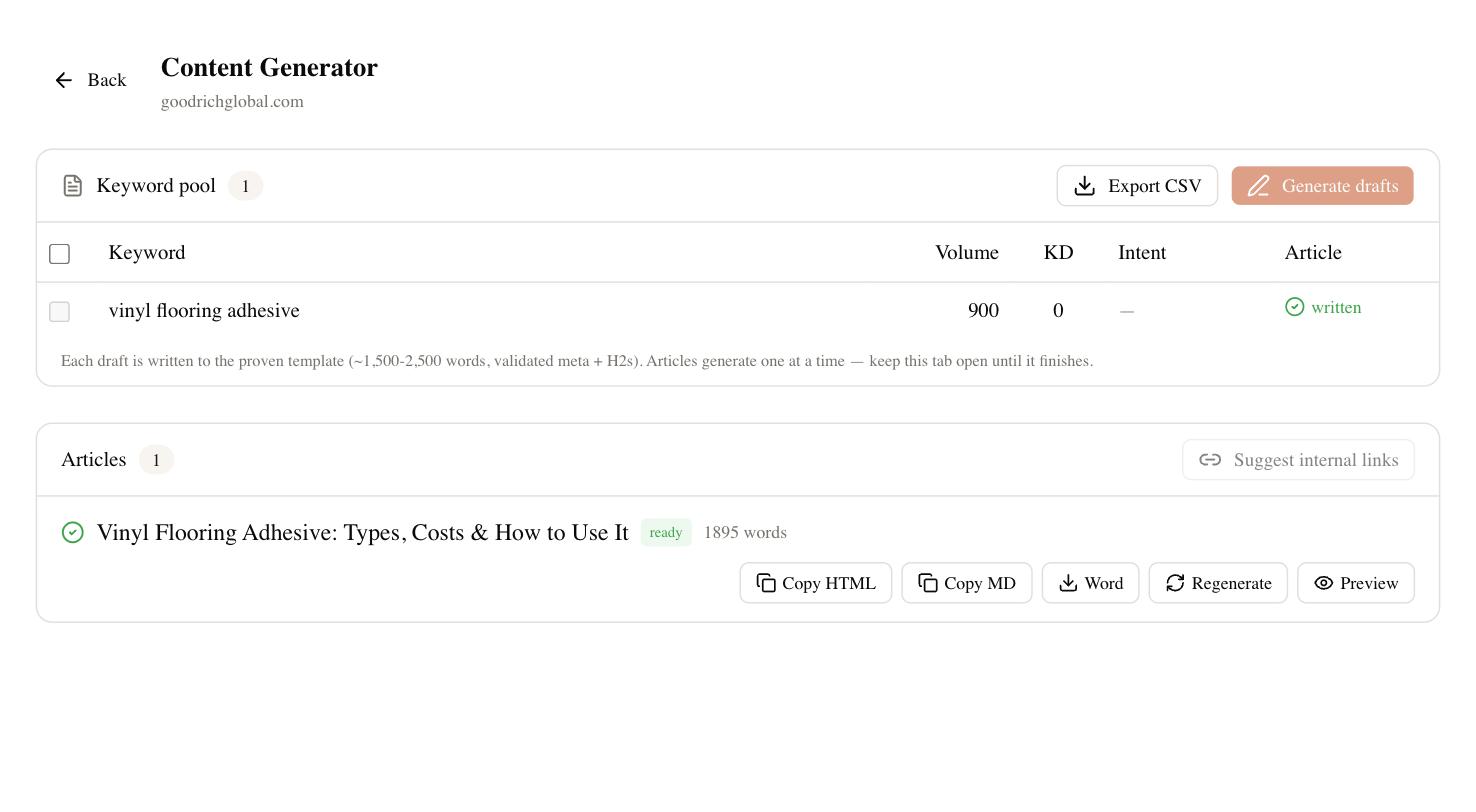
Instead of a scoring editor bolted onto a separate research stack, SEO Rocket is chat-first: you ask for a content brief or a full draft in plain language, and it writes against real, Ahrefs-grade data underneath — the same data behind its keyword research, competitor gap, rank tracking, and site audit. The part no content optimizer touches is its “Brand Radar,” which tracks whether you’re being cited across AI search surfaces like ChatGPT and Perplexity, not just where you rank on Google. For a solo SEO or agency tired of paying for an optimizer plus a separate research tool plus an AI-visibility tracker, that consolidation is the real saving.
None of this makes NeuronWriter or Surfer a bad buy. If all you need is a page-scoring editor and you already own your research and tracking tools, pick whichever of the two fits your budget and how your team writes — NeuronWriter for value and depth, Surfer for polish and handoff. But if your actual constraint is tool sprawl, and you want research, writing, rank tracking, and AI-search visibility answering to one workflow, that’s a different question than NeuronWriter vs Surfer SEO alone can settle. Run your own keyword through all three for a week; the one that answers your real questions fastest is the one worth paying for.