If you’re weighing Content at Scale vs SEO Rocket, you’re really comparing two different jobs that happen to overlap on the word “content.” Content at Scale is a dedicated long-form AI writing engine built to turn a keyword, URL, or video into a 2,000-word draft that ships with light editing. SEO Rocket is a chat-first SEO platform where writing is one output among many. Getting Content at Scale vs SEO Rocket right means being honest about which of those you actually need this quarter.
So this comparison leads with the competitor. Content at Scale is genuinely good at a thing it has spent years refining, and if that thing is your bottleneck, it may be the better buy. Then I’ll make SEO Rocket’s case, and give you a way to decide by use case rather than feature count.
What Content at Scale is built to do
Content at Scale — its core product is branded RankWell — positions itself as a long-form, SEO-focused writing platform. You feed it a keyword, an existing URL, a YouTube video, or a podcast, and it runs a research pass over the current top-ranking pages and live SERP data, then produces a structured draft that’s typically a couple of thousand words. It handles tone-of-voice matching, publishes into WordPress, supports well over a hundred languages, and bundles an AI detector and plagiarism checker so you can screen the output before it goes live.
The pitch is throughput with minimal cleanup. For an agency churning out client blogs, a publisher chasing programmatic traffic, or a lean team that needs ten posts a week rather than one, that’s a real and specific value. Pricing sits in a mid-to-higher band once you’re past the trial, which reads as expensive for a single writer but reasonable when you amortize it across dozens of published pieces a month. This is a content machine, and it’s honest about being one.
Where Content at Scale is genuinely stronger
Credit where it’s due. If your single biggest constraint is producing a high volume of long-form articles quickly, Content at Scale is purpose-built for exactly that and has more maturity in the drafting workflow than most all-in-one tools. Its research-to-draft pipeline, video and podcast repurposing, and native WordPress publishing remove real friction when you’re moving at volume.
It also leans hard into the “passes AI detection” angle, which matters to teams whose clients or editors screen for it, and it ships a plagiarism checker in the same box so you’re not paying for a separate screening tool. And its multi-language reach is deep, which is a genuine edge if you publish across markets rather than one. If you run a content operation whose success metric is words shipped per week at a consistent quality floor, this is a tool built around your workflow, not one that treats writing as a side feature.
Content at Scale vs SEO Rocket at a glance
Here’s the honest side-by-side. Notice the two tools barely fight over the same square — the overlap is narrower than the marketing suggests.
| Dimension | Content at Scale | SEO Rocket |
|---|---|---|
| Primary job | High-volume long-form AI writing | Chat-first SEO across data, writing & visibility |
| Interface | Editor + document workflow | Conversational — you ask, it runs the task |
| Keyword & backlink data | SERP research for drafting | Ahrefs-grade keyword, competitor & backlink data |
| Rank tracking | Not the focus | Built in |
| AI-search visibility | Not covered | Brand Radar — ChatGPT, Perplexity, AI Overviews |
| Content volume ceiling | Very high — its core strength | Solid, one draft at a time |
| Best for | Agencies & publishers shipping bulk content | Consultants & teams wanting data + writing in one |
| Rough price band | Mid–higher $$ | Low $ / entry-friendly |
SEO Rocket’s case: the workflow, not just the words
SEO Rocket starts from a different question — not “how do I write more,” but “what should I do next, and did it work.” It’s chat-first, so instead of a suite of tabs you ask in plain language: find the keyword gaps against a competitor, pull a domain’s backlink profile, check where a page ranks this week, then draft the article that closes the gap. The data underneath is Ahrefs-grade, so the recommendations aren’t guesses dressed up in confident prose.
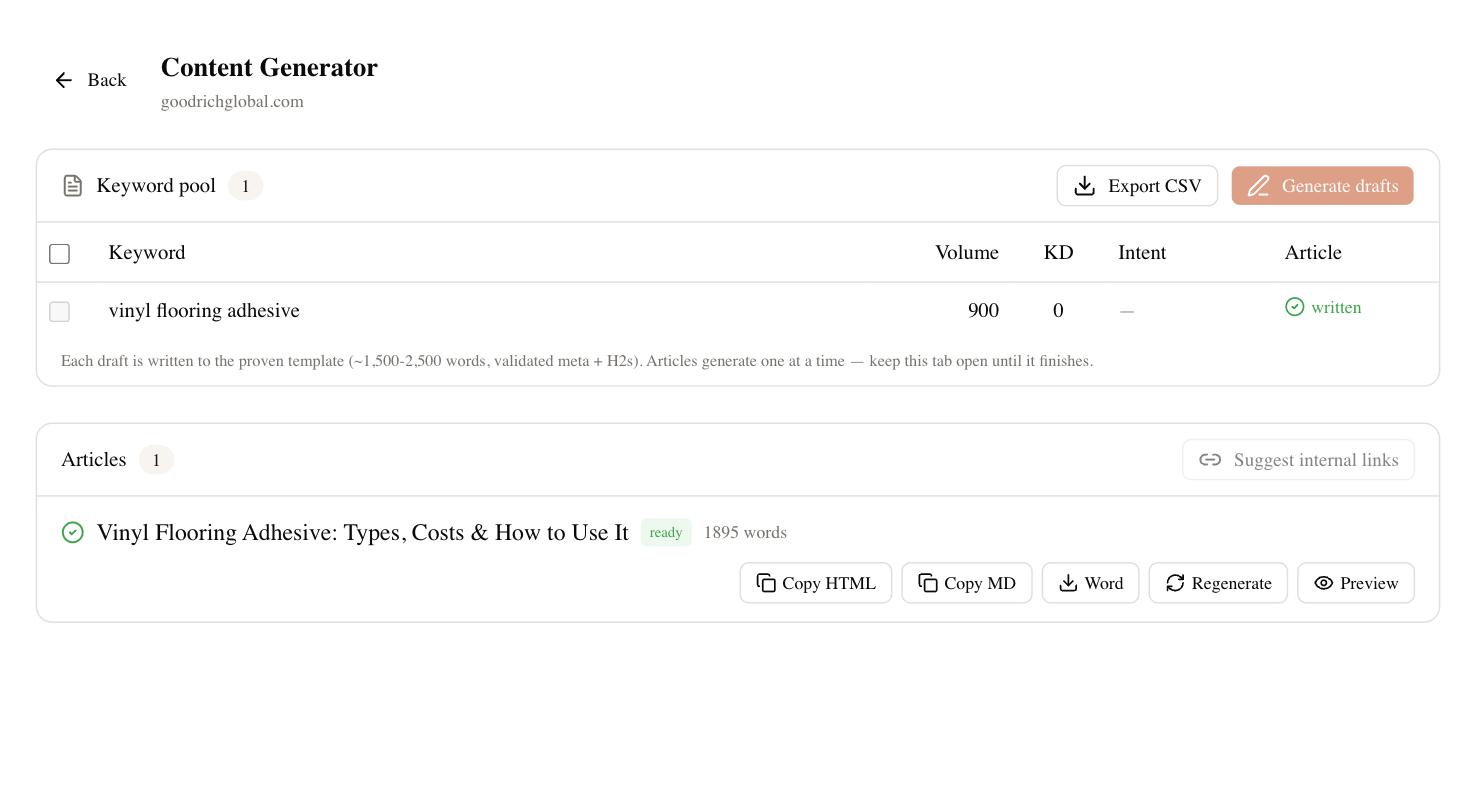
The writing is done with Claude and, crucially, it’s briefed by the same real data the rest of the tool runs on — the keywords you actually rank for, the competitors actually beating you, the gaps worth filling. A standalone writer drafts against a snapshot of the SERP; SEO Rocket drafts against your live position in it. That’s a quieter difference than “2,000 words in ninety seconds,” but over a quarter it’s the one that moves rankings.
Then there’s the part no pure writing tool touches: AI-search visibility. Brand Radar tracks whether your brand gets cited in ChatGPT, Perplexity, and Google’s AI Overviews — the surfaces where a growing share of buyers now ask their questions. A page can rank first on Google and still never surface in an AI answer. SEO Rocket shows you that gap so you’re optimizing for the search that’s actually happening.
Honest trade-offs
SEO Rocket is not trying to out-volume a dedicated content factory. If you need to publish forty near-identical location pages this month, a tool engineered around bulk drafting will get you there with less friction, and I’d rather tell you that than pretend otherwise. SEO Rocket writes one strong, data-briefed piece at a time — deliberately, because that’s what tends to rank — not a firehose of drafts.
Equally, Content at Scale won’t tell you what to write next based on your live rankings, won’t track your positions week to week, and won’t show you whether an AI assistant mentions you. Those aren’t flaws in it — they’re simply outside its job. The mistake is expecting either tool to be the other. Match the tool to the bottleneck and both look a lot more reasonable.
Which one should you pick?
Decide by your actual constraint, not the longer feature page. Choose Content at Scale if your bottleneck is raw output — you’re an agency or publisher whose growth is gated by how many quality long-form articles you can ship per week, and you already have separate tools handling keyword data, rank tracking, and visibility. In that lane it’s a strong, focused buy.
Choose SEO Rocket if your bottleneck is tool sprawl and knowing what to do next. If your week is some mix of “check what I rank for,” “see what a competitor is doing,” “draft the piece that closes the gap,” and “find out if ChatGPT ever mentions me,” you’re currently paying for three or four tools to do what one chat-first workflow covers — at an entry price that undercuts a comparable stack. For most consultants, freelancers, and small in-house teams, that consolidation is the win.
A fast gut-check: if you’d hire a writer next, lean toward the content machine. If you’d hire a strategist who also writes, lean toward the platform. Run your own site and two competitors through whichever you pick for a full ranking cycle before you judge it — positions jitter a few spots day to day, and no tool’s estimates are exact. The right answer to Content at Scale vs SEO Rocket is simply the one that clears your real bottleneck fastest.