
Most people reading a WriterZen review are trying to answer one question: is this the tool that finally connects keyword research to the article you have to write? WriterZen sells itself as an “all-in-one content solution,” and that framing is the right lens for this WriterZen review — it is a content-first workflow tool, not a full SEO suite, and judging it by the wrong yardstick is how people end up disappointed.
I have used it the way a working SEO would: pull a topic, cluster the keywords, build an outline, draft against the SERP, and run a plagiarism pass before publishing. Here is what holds up, what does not, and who should actually pay for it.
What WriterZen actually is
WriterZen is a content research and writing platform built around a handful of connected modules. Topic Discovery turns a seed keyword into clustered content ideas. Keyword Explorer pulls search volume, difficulty, and a proprietary “Golden Score” that flags low-competition, decent-volume terms. Keyword Planner groups those terms into a plan so you are not living in spreadsheets. Content Creator builds a SERP-informed outline with NLP term suggestions, an AI Assistant drafts and rewrites on top of that, and a Plagiarism Checker verifies originality before you ship.
The keyword data leans on Google’s own sources rather than a giant third-party crawl, so it feels closer to what Keyword Planner shows than to Ahrefs‘ index. That is a deliberate design choice, and it shapes everything about who the tool suits.
What WriterZen does well
The clustering is the standout. Drop in a topic and Topic Discovery hands back tight groups of related queries, which makes planning a content hub genuinely fast. If you have ever built a pillar-and-cluster map by hand, this alone saves an afternoon. The Golden Filter idea — surfacing keywords with a favorable volume-to-difficulty ratio — is a sensible way to find easy wins without staring at raw numbers.
Content Creator is the other strong piece. It reads the current top-ranking pages, pulls out the terms and entities they share, and gives you an outline scaffold with a live NLP checklist as you write. That keeps you aligned to what is actually ranking instead of guessing. The AI Assistant is competent for drafting sections and rewriting clunky paragraphs, and having a Copyscape-backed plagiarism check inside the same window is a real convenience for teams commissioning freelance work.
The workflow itself deserves credit too. Because Keyword Planner sits between research and writing, the terms you discover flow straight into a content brief without a copy-paste detour through a spreadsheet or a project board. For a small team pushing out several articles a week, that continuity is the practical value — fewer handoffs, fewer dropped keywords, and a brief a freelancer can actually follow.
Where WriterZen falls short
The gaps are just as important in an honest writerzen review. First, this is not a backlink tool — there is no meaningful link index, no referring-domain analysis, no disavow workflow. If competitive link research is part of your job, you still need Ahrefs or Semrush alongside it. Second, rank tracking is thin. The Domain Analysis module gives you a competitive snapshot, but it is not a substitute for a dedicated position tracker you check every morning.
The keyword database is narrower and less fresh than the big crawlers, so long-tail and niche terms can come back thin or missing. Credits and search limits on the lower tiers run out faster than you expect once a project gets busy, which nudges you toward a pricier plan or add-on packs. And the AI writing, while fine, is not best-in-class — it produces serviceable first drafts, not finished articles, so plan on real editing.
WriterZen features and pricing at a glance
Pricing sits in tiers, and the company has historically run lifetime deals on AppSumo, so what you pay varies a lot depending on when and how you bought in. Treat these as rough bands, not quotes.
| Area | What you get | How strong it is |
|---|---|---|
| Keyword research | Explorer, Golden Score, Google-sourced data | Good for content terms; weaker on niche long-tail |
| Topic clustering | Topic Discovery + Keyword Planner | Excellent — the core reason to buy |
| Content writing | SERP outline, NLP terms, GPT assistant | Strong workflow, average raw AI output |
| Plagiarism | Copyscape-backed checker | Genuinely useful for teams |
| Backlinks | None | Absent — use a separate tool |
| Rank tracking | Basic domain snapshot only | Not a dedicated tracker |
| Rough price band | Entry roughly low tens per month; upper tiers around $70–130/mo | Mid-market, credit-limited |
WriterZen versus an AI-native SEO tool
WriterZen was designed before AI writing and AI search became the center of gravity, and it shows in the seams. You research in one module, write in another, and still leave the platform for backlinks, rank tracking, and any sense of whether ChatGPT or Google’s AI Overviews ever mention your brand. That last gap matters more every quarter, because a page that ranks first can still be invisible in an AI answer.
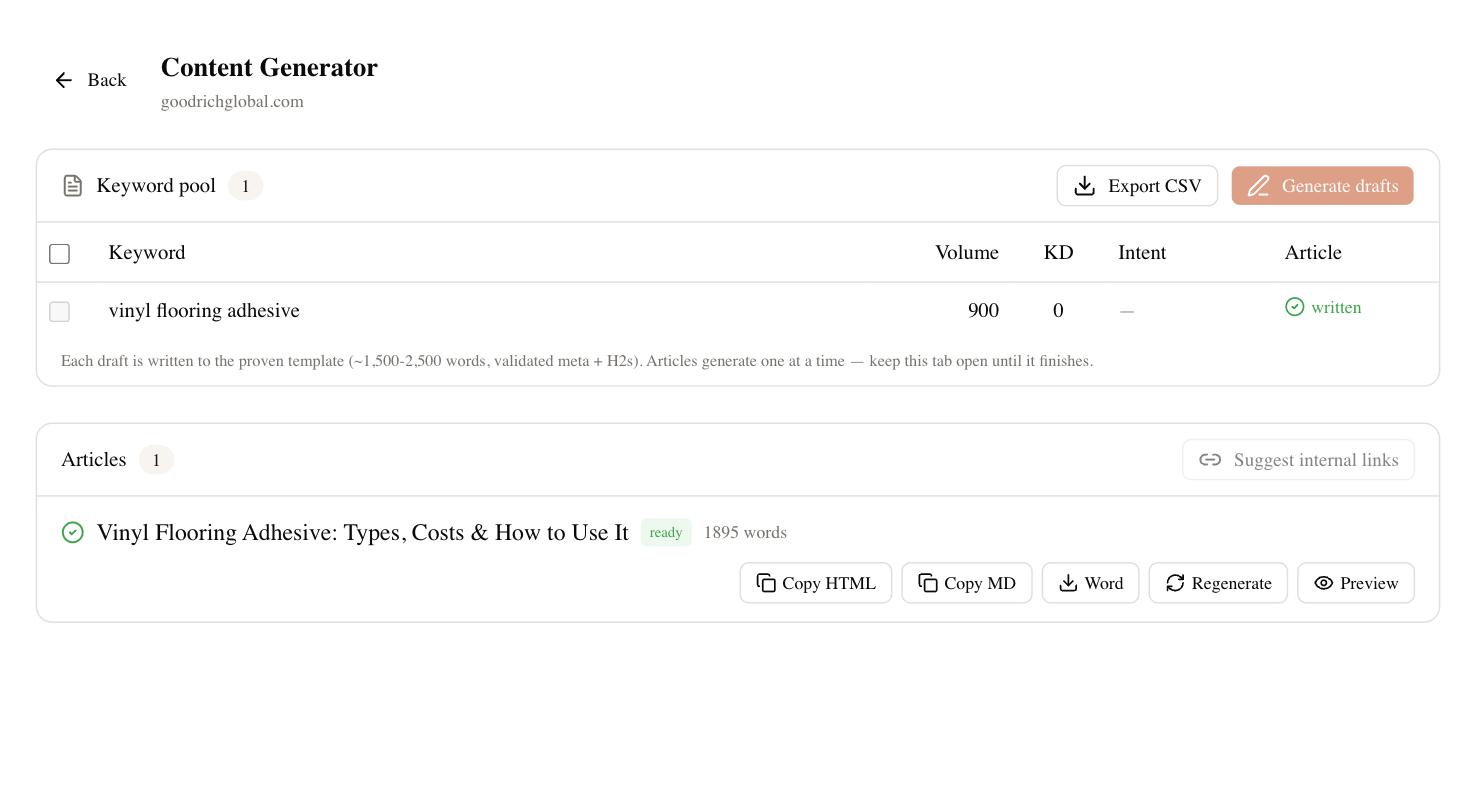
This is where a newer, AI-native option like SEO Rocket takes a different shape. Instead of hopping between modules, you ask for what you need in plain language and it runs the lookup on Ahrefs-grade data, drafts the article, and tracks your visibility across AI search surfaces in one place. If your bottleneck is tool-sprawl rather than clustering specifically, that consolidation is the honest advantage. WriterZen still wins if what you love is its topic-mapping in particular — no need to switch just for switching’s sake.
Who WriterZen is for
Match the tool to your real job. WriterZen fits content marketers, in-house blog teams, and agencies whose main pain is turning keyword research into a steady stream of on-topic articles. If you produce a lot of written content and want clustering plus SERP-guided outlines in one place, it earns its keep and the entry tiers are affordable.
It is a poor fit if backlinks or rank tracking sit at the center of your work — you will end up paying for a second and third tool anyway. It is also not the right pick if you want AI-search visibility built in, or if you need deep, fresh keyword data across niche markets. For those, look at a full suite or an AI-native alternative instead.
One more group to flag: solo consultants juggling client budgets. If you liked WriterZen from a past lifetime deal, keep using it — the clustering alone justifies the seat. But if you are pricing tools from scratch today, weigh the monthly cost of WriterZen plus a backlink tool plus a rank tracker against a single consolidated subscription. The math often favors consolidation once you count all three line items honestly.
The verdict
WriterZen is a good content tool with a clear specialty and honest limits. The clustering and SERP-driven writing workflow are genuinely strong, the plagiarism check is a nice touch for teams, and the pricing is reasonable for what it is. Just do not expect it to be your only SEO tool: it does not do backlinks, its rank tracking is a snapshot rather than a tracker, and the keyword data is narrower than the big crawlers.
Buy it if your week is mostly planning and writing content, and you want that specific loop to be faster. Look elsewhere — a full suite, or an AI-native tool that folds writing and AI-search visibility into one workflow — if your real problem is running three subscriptions to cover one job. As always, trial it on your own site and a couple of competitors for a week before committing; the tool that answers your actual Tuesday questions fastest is the one worth keeping.