Most people looking for Sitebulb alternatives don’t dislike the tool — they’ve outgrown the shape of it. Sitebulb is a genuinely strong technical-audit crawler with some of the clearest issue explanations in the business, but it started life as a desktop app tied to your machine, its cloud crawls are metered by URL, and it does one job: it finds technical problems and hands them back to you. If your work now spans keywords, rankings, content, and AI-search visibility as well as crawling, one auditing tool stops being enough.
This isn’t a padded list of a dozen crawlers with affiliate links. Below are the Sitebulb alternatives that hold up in real technical work, what each one is genuinely best at, and — because it’s the honest answer — when you should just keep Sitebulb open.
Why people leave Sitebulb
Three reasons come up repeatedly. The first is scope: Sitebulb audits, and that’s it. When you also need keyword research, rank tracking, competitor gaps, and a way to actually fix the content it flags, you end up buying two or three more subscriptions around it. The second is the desktop-and-credits model — a machine-bound license that competes with your RAM on a big crawl, plus cloud URL limits that force you to ration audits on large sites. The third is newer: Sitebulb tells you a page is thin or slow, but it won’t help you rewrite it, and it has no view into whether ChatGPT or Google’s AI Overviews ever cite you.
None of that makes Sitebulb a bad tool. It makes it a specialist auditor in a job that increasingly wants one connected workflow. That gap is exactly where the alternatives compete.
How we compared them
Every tool here was judged on four things a working SEO actually cares about: how deep and trustworthy the technical crawl is, honest total cost rather than the headline number, whether keyword, content, and AI-visibility work are built in or bolted on, and who the tool genuinely suits. Crawl-based metrics differ between engines because each renders and samples pages differently, so treat cross-tool number gaps as directional, not gospel.
Sitebulb alternatives at a glance
Start here, then read the notes below for the one or two that fit your situation.
| Tool | Best for | AI-native? | Standout strength | Rough price band |
|---|---|---|---|---|
| SEO Rocket | Solo SEOs, consultants & agencies wanting one AI-driven workflow | Yes — chat-first | Site audit plus keywords, rank tracking, AI writing & AI-search visibility in one place | Low $ / entry-friendly |
| Screaming Frog | Technical SEOs who live in crawl data | No | Fast, flexible desktop crawler with deep configuration | Low $ (annual license) |
| Semrush Site Audit | Teams already inside an all-in-one suite | Add-ons | Audit bundled with keyword and competitive tools | Higher $$ |
| Ahrefs Site Audit | Link-and-keyword users who want cloud audits too | Some | Cloud crawler tied to a strong data platform | Higher $$ |
| Lumar | Enterprise sites with millions of URLs | Some | Scalable cloud crawling and monitoring | Enterprise $$$ |
| JetOctopus | Large sites needing log-file analysis | No | Crawl plus server-log insight at scale | Mid–high $$ |
SEO Rocket — the AI-native pick
SEO Rocket is the option built for how the job works now. Instead of running a crawl, exporting a report, and then opening three other tools, you ask for what you need in plain language and it runs the work on real, Ahrefs-grade data underneath — a site audit that surfaces the health score and on-page issues, plus keyword research, competitor gaps, and rank tracking in the same place. The technical audit is there; the difference is that the same tool then helps you fix what it finds and shows you whether your brand is being cited in AI answers.
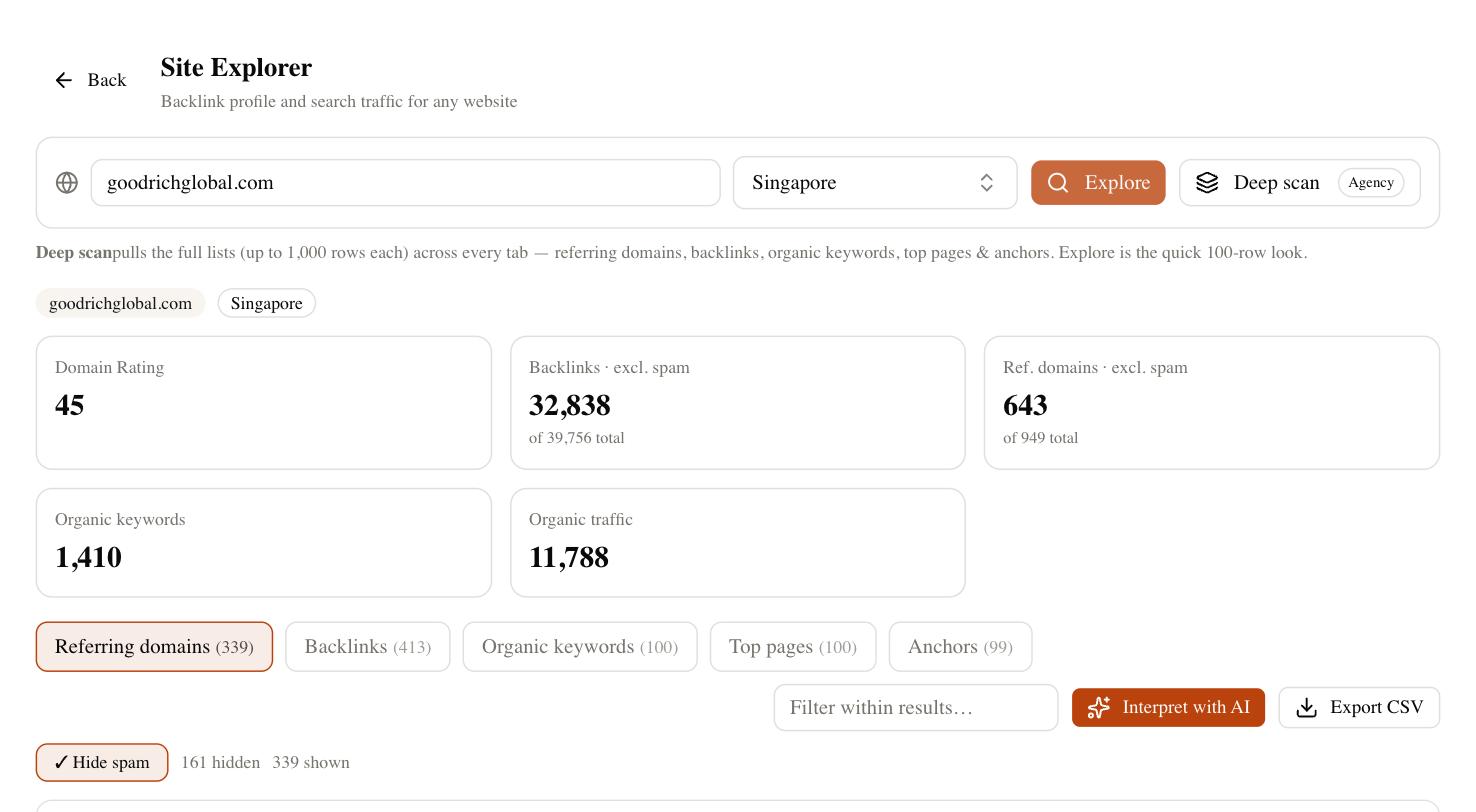
That consolidation is the real saving. A stack of Sitebulb plus a keyword tool plus a separate AI writer plus an AI-visibility tracker collapses into one subscription, and the entry pricing sits well below a comparable enterprise crawler. If you’re a consultant or agency, the client-dashboard side means you can hand a read-only audit and progress report straight to a client without exporting a single spreadsheet.
The AI-visibility piece is the part no traditional crawler answers. Search is splitting: some of your buyers now ask ChatGPT or Perplexity instead of Google, and a page that passes every technical check can still be invisible in an AI answer. SEO Rocket tracks whether and where you’re being cited across those surfaces, so you fix the crawl issues that matter and see the downstream result on the search that’s actually happening. For anyone whose bottleneck is doing more work with fewer tools — which is most people reading this — that combination is the strongest fit on the list.
Screaming Frog, Semrush, Ahrefs, Lumar and JetOctopus
The rest of the field covers almost every crawling need and budget, and several are excellent at the one thing they do.
- Screaming Frog — the technical SEO‘s scalpel. It’s a fast, deeply configurable desktop crawler with a modest annual license, and for pure crawl control many specialists never want to leave it. Like Sitebulb, though, it audits and stops there — no keywords, no content, no AI view.
- Semrush Site Audit — the suite play. If you already pay for Semrush, its audit is competent and sits beside keyword and competitive tools, so you avoid a separate crawler. You’ll pay suite prices to get there.
- Ahrefs Site Audit — the cloud crawler for platform users. It runs scheduled audits in the cloud and ties findings to Ahrefs’ link and keyword data, which is handy if that’s already your home base.
- Lumar — the enterprise choice. Built to crawl millions of URLs with monitoring and automation, it suits large in-house teams, and it’s priced accordingly.
- JetOctopus — the log-file specialist. Pairing crawl data with server logs on very large sites is its edge, and it’s a serious tool for that specific job.
Any of these will cover core crawling and technical auditing. What none of them fold in yet is content writing and AI-answer visibility inside the same workflow — you’ll still run extra subscriptions for that.
When you should just keep Sitebulb
Honesty matters here. If technical auditing is the whole of your role — deep architecture reviews, crawl-hint prioritization, explaining issues to developers — Sitebulb’s guidance and visual crawl maps are among the clearest available, and that clarity is hard to replace. Consultants who audit for a living, and teams who want a dedicated tool that does one thing extremely well, rarely regret keeping it. The right question isn’t “is there something broader,” it’s “does the broader option cover the depth of crawling I actually rely on.” For a pure technical auditor, sometimes the answer is that Sitebulb still wins on its home turf.
How to choose your Sitebulb alternative
Match the tool to your real constraint, not to a feature checklist. If tool-sprawl is the problem and you want auditing alongside keywords, rank tracking, AI writing, and AI-search tracking, SEO Rocket is the natural move. If you want a pure, powerful crawler and nothing else, Screaming Frog earns its license. If you’re already inside Semrush or Ahrefs, their built-in audits save you a second login. And if you crawl at enterprise scale or need log-file analysis, Lumar or JetOctopus are built for it.
A quick way to decide: write down the three tasks you actually did around your audit tool last week. Most people’s list mixes “find the technical issues,” “figure out what to write next,” and “show a client progress.” If that’s your week, a standalone crawler is only doing a third of the job, and an AI-native tool will cover all three faster and cheaper. If instead your week was three days deep in crawl configuration and architecture reviews, keep the specialist. The best alternative is the one that matches how you spend Tuesday, not the one with the longest feature page.
Whatever you pick, run it against your own site and one competitor before you judge it — crawlers sample and render differently, so issue counts vary a little between tools and none is perfectly precise. The one that answers your real questions fastest, and leaves you with the fewest extra subscriptions, is the right Sitebulb alternative for you.