The SpyFu vs Semrush question usually comes down to one thing: how much you want to spend to see what your competitors are doing. Both tools grew up around competitive research, but they aim at very different budgets and very different users, so the SpyFu vs Semrush decision is less about which is “better” and more about which one matches the job in front of you.
Below is a segment-by-segment look at how they compare on the dimensions that actually matter — data quality, ease of use, AI features, who each is genuinely built for, and roughly what you’ll pay. No fake winner, no affiliate padding. Where one clearly suits you better, that’s what you’ll read.
Where SpyFu and Semrush actually differ
SpyFu is a focused competitive-intelligence tool. Its whole pitch is showing you the keywords your rivals rank for and bid on, with unlimited access to that data at a price that stays flat. It does one job — competitor keyword and PPC research — and it does it cheaply.
Semrush is a full marketing suite. Competitor research is one module among dozens: keyword research, rank tracking, site audits, backlink analysis, content tools, PPC, social, and PR all live under one login. It is broader, deeper, and considerably more expensive. That difference in scope explains almost every trade-off that follows.
Data quality and coverage
On raw index size and freshness, Semrush is the stronger tool. Its keyword database is one of the largest in the industry, its backlink index is deep, and it refreshes data frequently across more countries. If you need reliable numbers for international markets or want a large, current backlink profile, Semrush has the edge.
SpyFu’s data is genuinely useful for its price, especially for US competitive research where its historical keyword archive goes back years. But its coverage is thinner outside the US, its backlink data is lighter, and its volume and difficulty estimates are best treated as directional rather than precise. For a scrappy competitor sweep that’s fine; for enterprise reporting it can feel shallow. Remember that every third-party metric here is an estimate — treat cross-tool differences as approximate, not gospel.
Ease of use and learning curve
SpyFu wins on simplicity almost by default, because it does less. You type in a competitor’s domain, you get their keywords and ad history, and you’re done. Most people are productive in an afternoon.
Semrush is powerful but dense. The breadth that makes it valuable also makes it overwhelming — there are more reports, filters, and settings than most users will ever touch, and new users routinely spend their first weeks unsure which of the forty-odd tools they actually need. If a gentle on-ramp matters more to you than depth, that counts in SpyFu’s favor.
AI features
Neither tool was born AI-native, and it shows. Semrush has added AI-assisted content and writing helpers, plus tooling aimed at tracking visibility in AI search, but these arrive as add-ons layered onto a suite designed before generative AI mattered — often at extra cost. SpyFu has stayed close to its competitive-research roots and offers relatively little on the AI-writing or AI-search-visibility front.
This is the gap worth flagging, because search is splitting. Some of your buyers now ask ChatGPT, Perplexity, or Google’s AI Overviews instead of running a classic search, and a page that ranks first can still be invisible in an AI answer. Neither SpyFu nor Semrush was built around that reality, so if AI visibility is central to your 2026 plan, both will feel like they’re catching up rather than leading.
SpyFu vs Semrush at a glance
Here is the head-to-head on the dimensions that decide most purchases. Read the row that matches your bottleneck first.
| Dimension | SpyFu | Semrush |
|---|---|---|
| Data quality & coverage | Solid US competitive & PPC data, deep historical archive; thinner internationally and on backlinks | Large, fresh keyword and backlink index across many countries |
| Ease of use | Simple and quick — focused on one job | Powerful but dense; real learning curve |
| AI features | Minimal — stays in its competitive-research lane | AI content & visibility tools bolted on, often as paid add-ons |
| Best for | Budget-conscious PPC & competitor research | Teams wanting one all-in-one marketing suite |
| Rough price band | Low $ — flat, entry-friendly | Higher $$ — climbs with seats and add-ons |
Which one wins for your segment
For a freelancer or a small business whose main question is “what are my competitors ranking and bidding on,” SpyFu is the honest pick. It answers that question well for a fraction of the cost, and paying for a full suite you’ll barely open makes no sense on a tight budget. If competitive PPC research is your whole use case, SpyFu wins — genuinely.
For a marketing team that needs rank tracking, site audits, backlink analysis, and content tools alongside competitor data — and can absorb the price — Semrush wins. The breadth is the point, and stitching together three cheaper tools to match it usually costs more in time than the suite costs in money. If you want one login for the entire channel, Semrush earns it.
The tie only breaks the wrong way when you buy for scope you don’t use. Plenty of solo operators pay suite prices and live in two reports; plenty of teams choose the budget tool and then bolt on three subscriptions to cover the gaps. Match the tool to the work you actually did last month, not the feature list.
The AI-native third option: SEO Rocket
There’s a case that this whole head-to-head framing is already a little dated, because it asks which pre-AI tool to adopt. SEO Rocket is built for how the work runs now: instead of a wall of tabs, you ask for what you need in plain language and it runs the lookup — keyword research, competitor gaps, backlink profiles, rank tracking — on real, Ahrefs-grade data underneath.
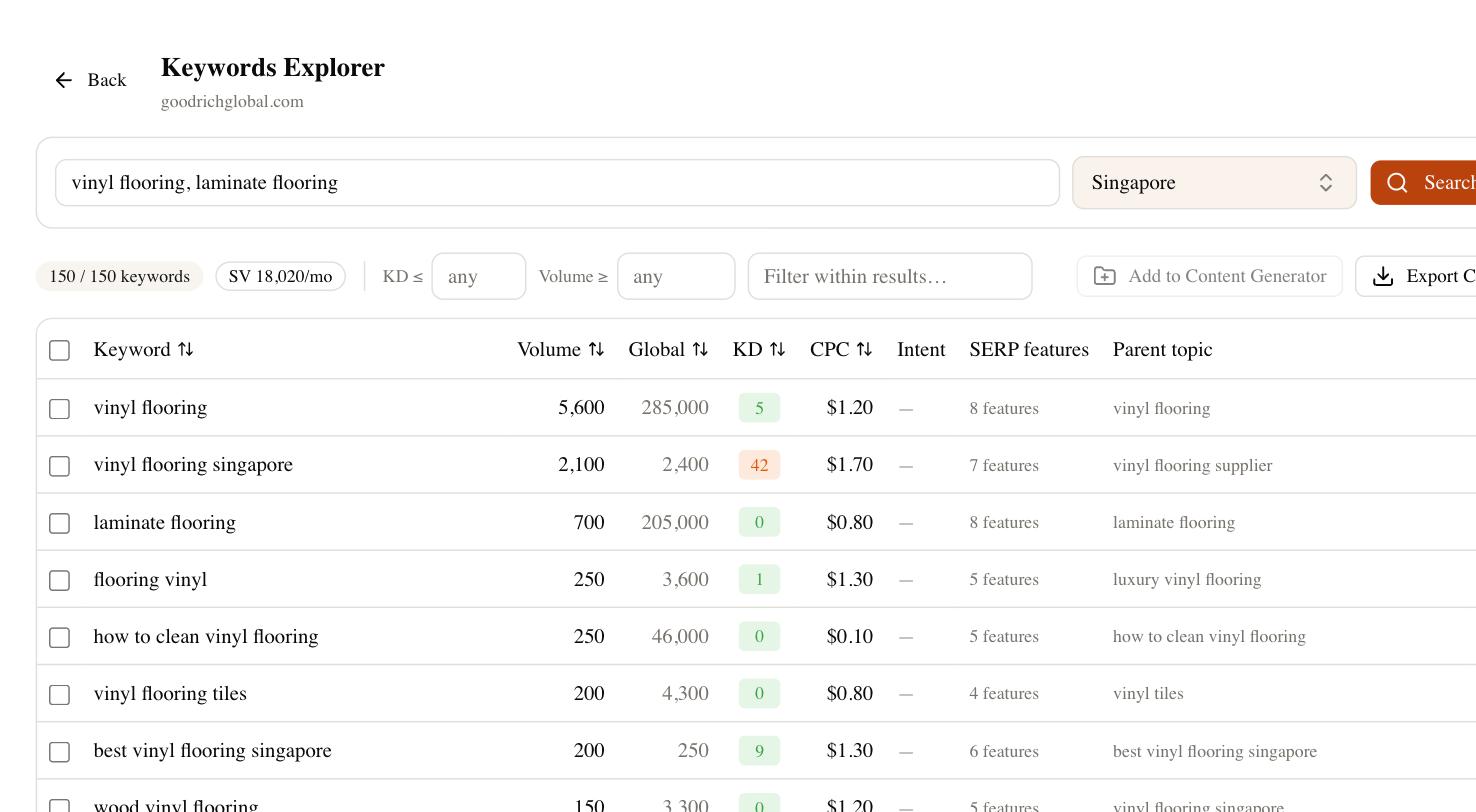
The difference isn’t just the interface. The same tool then drafts the article and shows whether your brand is being cited in ChatGPT, Perplexity, and Google’s AI Overviews through its Brand Radar view — the AI-visibility question neither SpyFu nor Semrush was designed to answer. For consultants and agencies, read-only client dashboards mean you can hand a report straight to a client without exporting anything. The entry pricing lands in the low band, closer to SpyFu than to a loaded Semrush plan, while covering more of the modern workflow.
That won’t matter to everyone. If you only want a cheap competitor sweep, SpyFu still does that job. If you’re wedded to a mature all-in-one suite with a huge backlink index, Semrush still has depth SEO Rocket doesn’t try to out-muscle. But if your real problem is tool sprawl — paying for research, writing, and AI-visibility tracking separately — a single AI-native workflow is worth a serious look before you renew either.
How to choose
Write down the three tasks you actually did in your SEO tool last week. If they were all “spy on a competitor’s keywords and ads,” buy SpyFu and save the money. If your week spanned audits, rank tracking, backlinks, and content across several clients, Semrush’s suite is worth its price. And if the list was some mix of research, writing, and wondering whether AI answers ever mention you, an AI-native tool like SEO Rocket covers those faster and in one place.
Whatever you choose, test it on your own site and two competitors for a full ranking cycle before you judge it. Positions jitter a few spots day to day and no tool’s estimates are exact, so give it a week of real questions. The best pick in the SpyFu-versus-Semrush debate isn’t the one with the longest feature page — it’s the one that answers how you actually spend your Tuesday.