
Picking from the best AI content optimization tools used to mean choosing a fancier spell-checker. Now it means choosing what actually sits between your keyword research and a page that ranks. The best AI content optimization tools read the SERP, tell you which terms and questions a topic needs, score your draft against the pages already winning, and increasingly write the thing with you. The gap between them is no longer the word count target — it is how much of the workflow they cover and how good the data underneath is.
This is not a padded list of twenty products. Below are the tools that hold up in real use, what each is genuinely best at, and where a cheaper or more specialized rival is the smarter buy. You will not agree with every pick, and that is fine — the point is to match the tool to how you actually work.
What content optimization actually means now
Five years ago, “optimization” meant hitting a keyword density and stuffing in a few related terms. That era is over. Modern tools model the topic the way a search engine does: they pull the top-ranking pages for your query, extract the entities, subtopics, and questions those pages cover, and grade your draft on how completely it addresses the topic — not how many times you repeated the phrase.
The second shift is AI. Most of these tools now draft as well as grade, so the loop tightens from “research, write elsewhere, paste back, fix” into one place. The third shift is quieter but bigger: some of your readers now ask ChatGPT or Perplexity instead of Google, and a well-optimized page that never gets cited in an AI answer is invisible to them. Very few optimization tools touch that yet, which is worth remembering as you compare.
The best AI content optimization tools at a glance
Start here, then read the notes on the two or three that fit your situation. Price bands are rough tiers, not quotes — check current pricing before you buy.
| Tool | Best for | Standout strength | Rough price band |
|---|---|---|---|
| SEO Rocket | Solo SEOs, consultants & agencies wanting one AI workflow | Real SEO data + AI writing + AI-search visibility in one chat | Low $ / entry-friendly |
| Surfer SEO | Writers who want a live optimization score | Real-time SERP-based content editor | Mid $$ |
| Clearscope | Editorial teams that value clean, trusted grades | Simple, accurate content grading | Premium $$$ |
| Frase | Small teams on a budget | Fast SERP research plus drafting | Low $ |
| MarketMuse | Content strategists planning at scale | Topic modeling and content briefs | Higher $$$ / free tier |
| Scalenut | High-volume publishers | Guided article production from brief to draft | Low–mid $ |
| NeuronWriter | Freelancers watching every dollar | Semantic optimization for very little | Low $ |
SEO Rocket — the connected-workflow pick
Most tools on this list optimize one draft at a time. SEO Rocket is built for the whole job around the draft. You ask for what you need in plain language, and it runs the lookup — keyword research, competitor content gaps, rank tracking — on real, Ahrefs-grade data, then drafts the article with Claude against what is actually ranking. The optimization and the research live in the same conversation, so you are not exporting a term list from one tab and pasting it into another.
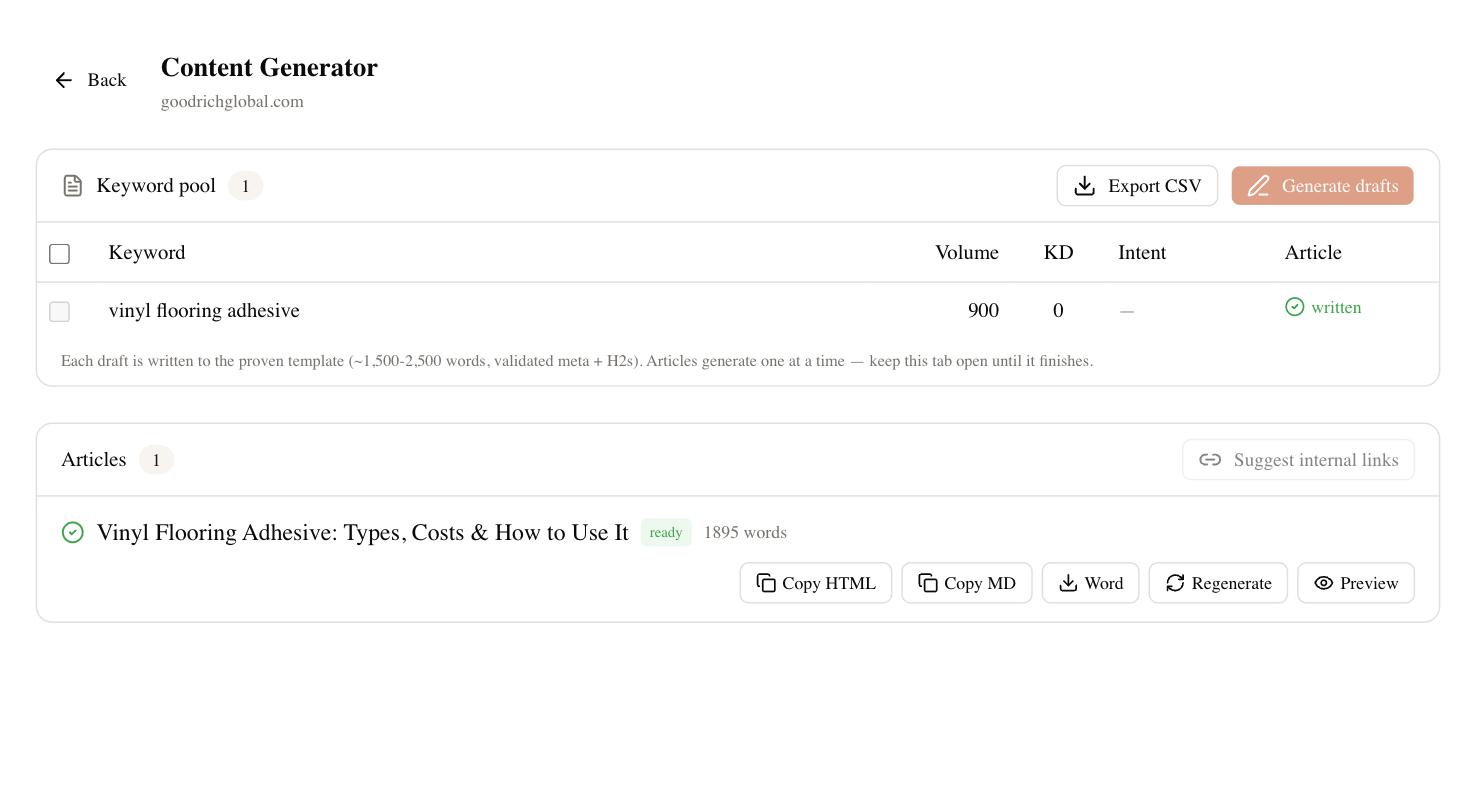
The part no traditional optimizer answers is AI-search visibility. SEO Rocket’s Brand Radar tracks whether your brand is being cited across ChatGPT, Perplexity, and Google’s AI Overviews, so you are optimizing for the search that is happening now, not only the ten blue links. For a consultant or a lean team, folding data, writing, rank tracking, and AI-visibility into one subscription is the real saving — it replaces a stack of three or four tools, and the entry pricing sits at the bottom of this table. If your bottleneck is doing more with fewer logins, it is the strongest fit here.
Surfer SEO — the real-time editor
Surfer is the tool most writers picture when they hear “content optimization.” Its editor gives you a live score that climbs as you add the terms, headings, and length its SERP analysis says the topic needs. Watching that number move is genuinely motivating, and for a writer who just wants clear, immediate guidance while drafting, few tools feel as natural.
The trade-offs are honest ones. The score can tempt you to chase term coverage over readability, so you still need editorial judgment to know when “good enough” beats “green.” Pricing lands in the mid tier, and Surfer is an optimization layer — you will pair it with a separate keyword and backlink tool. If a live editor is the one feature you want, though, Surfer does it about as well as anyone.
Clearscope — the premium grader
Clearscope earns its reputation by doing less, cleanly. It grades your content against a topic with an A-plus scale that editors trust, surfaces the terms you are missing, and gets out of the way. Teams with a real editorial process — where a writer drafts and an editor signs off on a target grade — love how little friction it adds.
That polish comes at a price. Clearscope sits at the premium end of this list, and it deliberately stays narrow: it optimizes and reports, it does not do deep keyword research or backlink analysis. If your budget is tight or you want one tool to do more, look elsewhere. If content quality is your whole game and you want a metric your team will actually respect, it is worth the money.
Frase, Scalenut and NeuronWriter — the value tier
The middle of the market is crowded with capable, affordable tools that pair SERP research with AI drafting.
- Frase — the fast all-rounder. It builds a brief from the top results, drafts against it, and optimizes, all at a low entry price. Depth is shallower than the premium tools, but for small teams shipping steady content it covers the core loop well.
- Scalenut — the volume play. Its guided flow walks you from brief to full draft quickly, which suits publishers producing a lot of articles. You trade some finesse for throughput.
- NeuronWriter — the budget semantic optimizer. It handles term and entity coverage competently for very little, making it a favorite for freelancers and side projects where every dollar counts.
None of these will match a specialist on any single axis, but each delivers most of the value for a fraction of the cost. If you are optimizing on a small budget, one of these three is usually where to start.
MarketMuse — content strategy at scale
MarketMuse aims a level above the single draft. Its topic modeling maps the full territory around a subject, so you can see which pages you should build, how they interlink, and where your existing library is thin. For a strategist planning a content program rather than editing one post, that planning layer is the draw, and a limited free tier lets you try the approach before committing.
The cost climbs fast once you need serious usage, and the interface rewards people who think in topic clusters and briefs rather than live editor scores. If you are a solo writer who just wants a green light on today’s article, MarketMuse is more machine than you need. If you own a roadmap, it is one of the few tools built for that job.
How to choose the right tool
Match the tool to your real constraint, not to a feature checklist. If you want optimization, real SEO data, AI writing, and AI-search tracking in one place, SEO Rocket is the natural move. If you just want a live editor score while you write, Surfer is the specialist. If editorial quality is everything and budget is not the worry, Clearscope’s grade is worth paying for. On a tight budget, Frase, Scalenut, or NeuronWriter cover the core loop cheaply. And if you are planning a whole content program, MarketMuse is built for the map, not the draft.
A quick test: write down the last three content tasks you actually did. If they were “find a topic, draft it, make sure it ranks,” a connected tool will beat a stack of point solutions on both time and cost. If instead you spent the week grading finished drafts against a house standard, buy the best grader and skip the rest. Whatever you choose, run one real article through it end to end before you commit — the tool that answers your questions fastest, not the one with the longest feature page, is the best content optimization tool for you.