Most roundups of the best AI tools for content marketing are really lists of everything with an affiliate link attached. This one isn’t. Below are seven tools that earn a place in a real content workflow, what each is genuinely best at, and where each one falls short — because no single tool wins every job, and pretending otherwise wastes your budget.
The category has split into three jobs: generating drafts and campaign copy, optimizing content against what already ranks, and — newer — checking whether AI search engines cite you at all. The best AI tools for content marketing now tend to be strong at one of those, and a couple try to cover more. Here’s who does what.
What “best” actually means here
A content tool is only worth paying for if it removes work you’d otherwise do by hand. That splits into three questions. Does it help you produce a draft faster without producing obvious slop? Does it tell you what a page needs to compete — headings, entities, depth — against the pages already ranking? And does it show you whether your content is landing where buyers now look, including AI answers from ChatGPT, Perplexity, and Google’s AI Overviews?
Very few tools answer all three. So the honest way to shop is to name your bottleneck first. If you can’t write fast enough, you want a generator. If you write plenty but it doesn’t rank, you want an optimizer. If you rank but nobody cites you in AI search, you want visibility tracking. Buy for the gap you actually have.
The tools at a glance
Start with the table, then read the notes for the two or three that fit your situation. Price bands are rough and change often — treat them as tiers, not quotes.
| Tool | Best for | Standout strength | Rough price band |
|---|---|---|---|
| SEO Rocket | Solo SEOs, consultants & small teams wanting one connected workflow | Real SEO data + AI writing + AI-search visibility in one chat | Low $ / entry-friendly |
| Jasper | Marketing teams producing lots of on-brand copy | Brand voice controls and campaign templates | Mid–high $$ |
| Copy.ai | Sales and marketing teams automating go-to-market copy | Workflow automation across many short-copy tasks | Low–mid $ |
| Surfer SEO | Writers who need content to rank on Google | SERP-based on-page optimization scoring | Mid $$ |
| Frase | Freelancers building briefs and first drafts fast | Affordable research-to-brief workflow | Low–mid $ |
| Clearscope | Teams that treat content quality as non-negotiable | Clean, rigorous content grading | Higher $$ |
| Writesonic | Very small budgets and high-volume short copy | Cheap, broad AI writing at scale | Low $ |
SEO Rocket — data, writing and AI visibility in one place
SEO Rocket is the pick when your problem is tool sprawl. Instead of a research tab, a writing tab, and a tracker, you ask in plain language and it runs the work on real, Ahrefs-grade data underneath — keyword research, competitor gaps, rank tracking — then drafts the article and checks whether AI engines mention your brand. It’s chat-first, so the workflow is a conversation rather than a dozen dashboards.
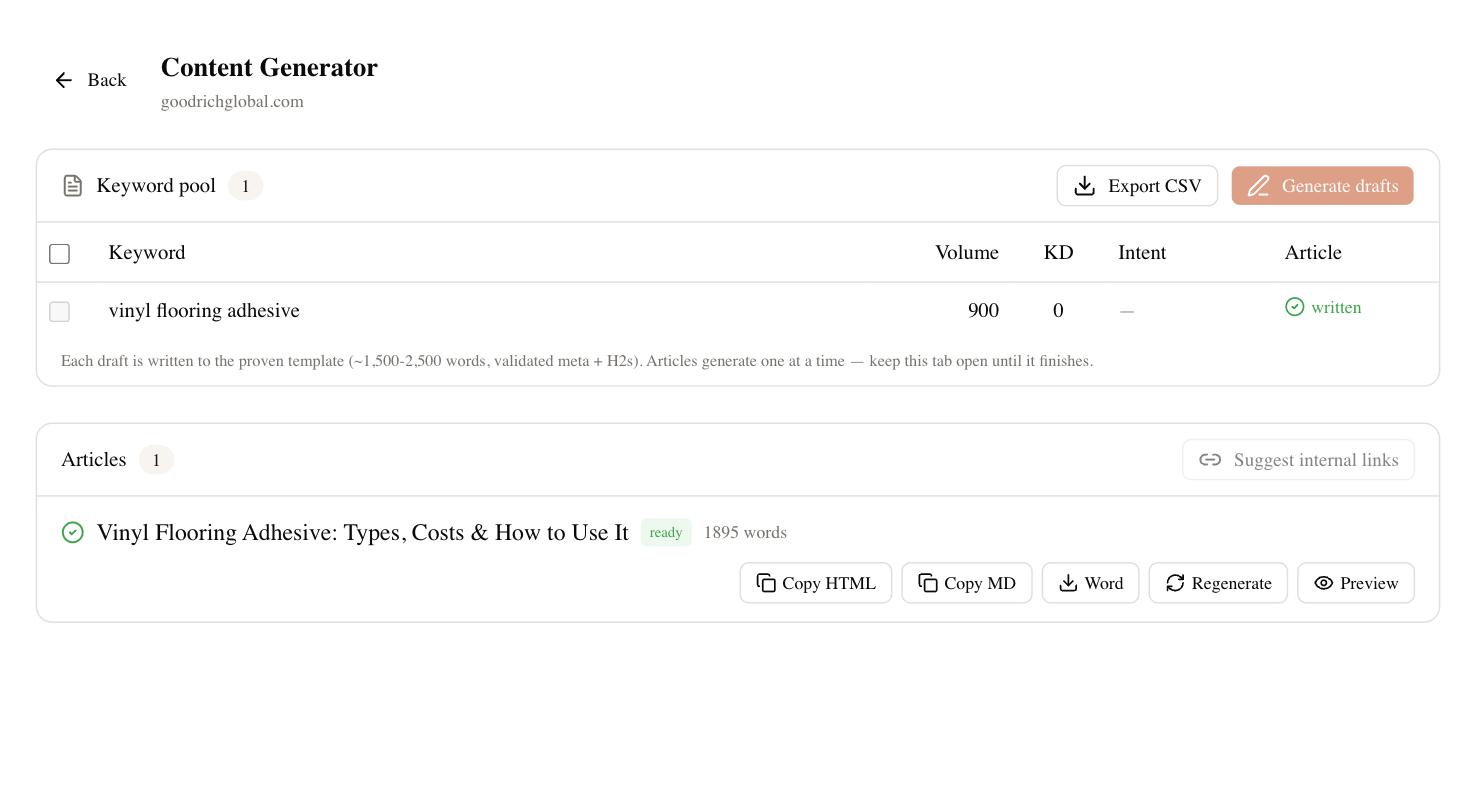
The real saving is consolidation. A common stack is a generator like Jasper, an optimizer like Surfer, and a separate rank tracker — three subscriptions and three logins. SEO Rocket folds those into one, and the AI-visibility piece is the part traditional tools skip entirely: search is splitting, and a page that ranks first on Google can still be invisible when a buyer asks ChatGPT. If you’re a consultant or a small team, that combination and the entry pricing make it the strongest fit here. If you only need to bulk-generate short social copy, though, a dedicated generator will feel lighter.
It’s worth being clear about the trade-off. Because SEO Rocket covers the whole workflow, it doesn’t go as deep on any single feature as a specialist does — Surfer has more granular on-page controls, and Jasper has more polished brand-voice tuning. What you get instead is one context: the keyword research, the draft, and the visibility check all share the same project, so nothing gets copy-pasted between tools and lost. For most people that continuity beats a marginally deeper feature they use twice a month.
Jasper and Copy.ai — the generators
When your bottleneck is output volume, these two lead. Jasper is built for marketing teams that need a lot of on-brand copy fast — its brand-voice controls and campaign templates keep a team’s output consistent, which matters once several people are writing. It sits in the mid-to-high band, and the value shows up at team scale rather than for a solo user.
Copy.ai leans toward go-to-market workflows — sales emails, landing copy, repeatable short-form tasks you can automate across a team. It’s friendlier on price and strong at breadth of short copy. Neither tool is built to make a page rank on its own; they generate well but don’t tell you what the SERP demands. Pair either with an optimizer, or you’re guessing.
One honest caution applies to every generator, these two included: raw AI output still needs an editor. The draft gets you to 70 percent fast, but the last 30 percent — the specific example, the number, the point of view — is what separates a page that ranks from filler that a reader bounces off. Treat these tools as a fast first draft, not a publish button, and they pay for themselves.
Surfer SEO, Frase and Clearscope — the optimizers
If you write plenty but it stalls on page two, the fix is an optimization layer that reads the current SERP and tells you what winning pages contain.
- Surfer SEO — the popular default. Its content editor scores a draft in real time against ranking pages for terms, headings, and length. Best for writers who want a clear on-page target, sitting in the mid band.
- Frase — the value play. It turns a SERP into a research brief and a first draft quickly, which makes it a favorite for freelancers who need to move fast without a big subscription.
- Clearscope — the premium option. It does fewer things but grades content rigorously and cleanly, which is why quality-obsessed teams pay its higher price. If content standards are non-negotiable, it earns the spend.
All three make good content better. What none of them do is generate at scale or track AI-search citations — they optimize the words you bring them, so you’ll still run a writer alongside. A word of realism on the scores these tools produce: chasing a perfect optimization grade past a point is diminishing returns. Hit the target, then spend your remaining time on the parts a SERP scorer can’t measure — a sharper angle, a real example, a reason for someone to link to you. The number is a floor, not the goal.
Writesonic and the budget end
For a first client, a side project, or high-volume short copy on almost no budget, Writesonic covers a lot of ground cheaply — blog drafts, ads, product descriptions. It won’t match Jasper’s brand controls or Surfer’s SERP rigor, and you’ll feel that on anything competitive. But for getting usable words on the page for very little, it does the job. Just don’t expect budget generation alone to rank against pages backed by real research.
How to choose the best AI tools for content marketing
Match the tool to your real constraint, not to a feature grid. If your problem is running too many tools and you want writing plus SEO data plus AI-search visibility in one place, SEO Rocket is the natural move. If you’re a team drowning in copy requests, Jasper or Copy.ai clears the queue. If your content is fine but won’t rank, add Surfer, Frase, or Clearscope. And if budget is the whole story, Writesonic gets you started.
A quick test: write down the last three content tasks you actually did this week. If they were “research a topic,” “draft the piece,” and “check if it’s working,” you want one connected workflow, not three tabs. If they were all “generate ten variants of an ad,” you want a pure generator. Whatever you pick, run it on one real piece before you commit — the right tool is the one that fixes your Tuesday, not the one with the longest feature page.