Search for the best ChatGPT SEO tools and you get two very different lists mashed into one. Half the results are tools that use AI to do SEO work faster — keyword research, briefs, drafting. The other half are tools that track whether ChatGPT itself ever mentions your brand when someone asks it a question. Both are legitimate, and you probably need a bit of each, so this roundup covers both jobs and is honest about which tool wins which one.
Below are the best ChatGPT SEO tools worth paying for in 2026, what each is genuinely best at, and — because it’s the useful answer — where a rival beats the one I’d otherwise recommend. No affiliate padding, no invented review scores.
What “ChatGPT SEO tools” actually means
The phrase splits into two distinct problems. The first is visibility: a growing share of buyers now ask ChatGPT, Perplexity, or Google’s AI Overviews instead of typing a query and scanning ten blue links. You can rank first on Google and still be completely absent from the answer an AI hands your customer. Tracking that gap is a new discipline, sometimes called answer-engine optimization or generative-engine optimization.
The second problem is production: using large language models to research topics, build outlines, and draft content at a pace no human matches alone. Most people shopping for these tools want help with both, which is why the cleanest setups fold visibility and production into one workflow instead of three logins. A tool that only writes leaves you blind to whether the AI ever cites you; a tool that only tracks mentions leaves you doing the writing somewhere else. The category is still young, so expect overlap, half-finished features, and pricing that shifts as vendors figure out what AI search is worth.
How I compared them
Every tool here was judged on four things a working SEO actually cares about: what it’s genuinely best at, its one standout feature, honest total cost as a price band rather than a headline number, and who it truly suits. AI-visibility metrics are early and noisy — models reword answers run to run, so treat any single citation score as directional, not gospel. The same caution applies to traffic and keyword estimates from any tool: they’re informed guesses, not meter readings.
The best ChatGPT SEO tools at a glance
Start with the table, then read the notes on the two or three that fit your situation. Price bands are relative — entry-friendly to enterprise — because exact numbers move every quarter.
| Tool | Best for | Standout | Rough price band |
|---|---|---|---|
| SEO Rocket | Solo SEOs, consultants & agencies wanting one AI workflow | Ahrefs-grade data + AI writing + AI-search visibility in one chat | Low $ / entry-friendly |
| Profound | Enterprise brands treating AI search as a channel | Deep answer-engine analytics across many AI surfaces | Enterprise $$$ |
| Otterly.AI | Small teams wanting affordable AI-mention monitoring | Simple prompt tracking across ChatGPT & Perplexity | Low $ |
| Semrush | Marketing teams wanting an all-in-one suite | Huge database plus a bolt-on AI/AEO toolkit | Higher $$ |
| Surfer SEO | Writers optimizing pages against the SERP | On-page content scoring with AI drafting | Mid $$ |
| Writesonic | Teams publishing AI content at volume | Fast bulk generation, now with GEO tracking | Low–mid $ |
| Ahrefs | Backlink specialists who also want AI tracking | One of the largest link indexes, plus AI-mention data | Higher $$ |
SEO Rocket — the all-in-one AI-native pick
SEO Rocket is built for how the work happens now. Instead of a wall of tabs, you ask for what you need in plain language and it runs the lookup on real, Ahrefs-grade data underneath — keyword research, competitor gaps, backlink profiles, rank tracking. The difference isn’t the raw numbers; it’s that the same tool then drafts the article with Claude and shows you whether your brand is being cited across ChatGPT, Perplexity, and Google’s AI Overviews.
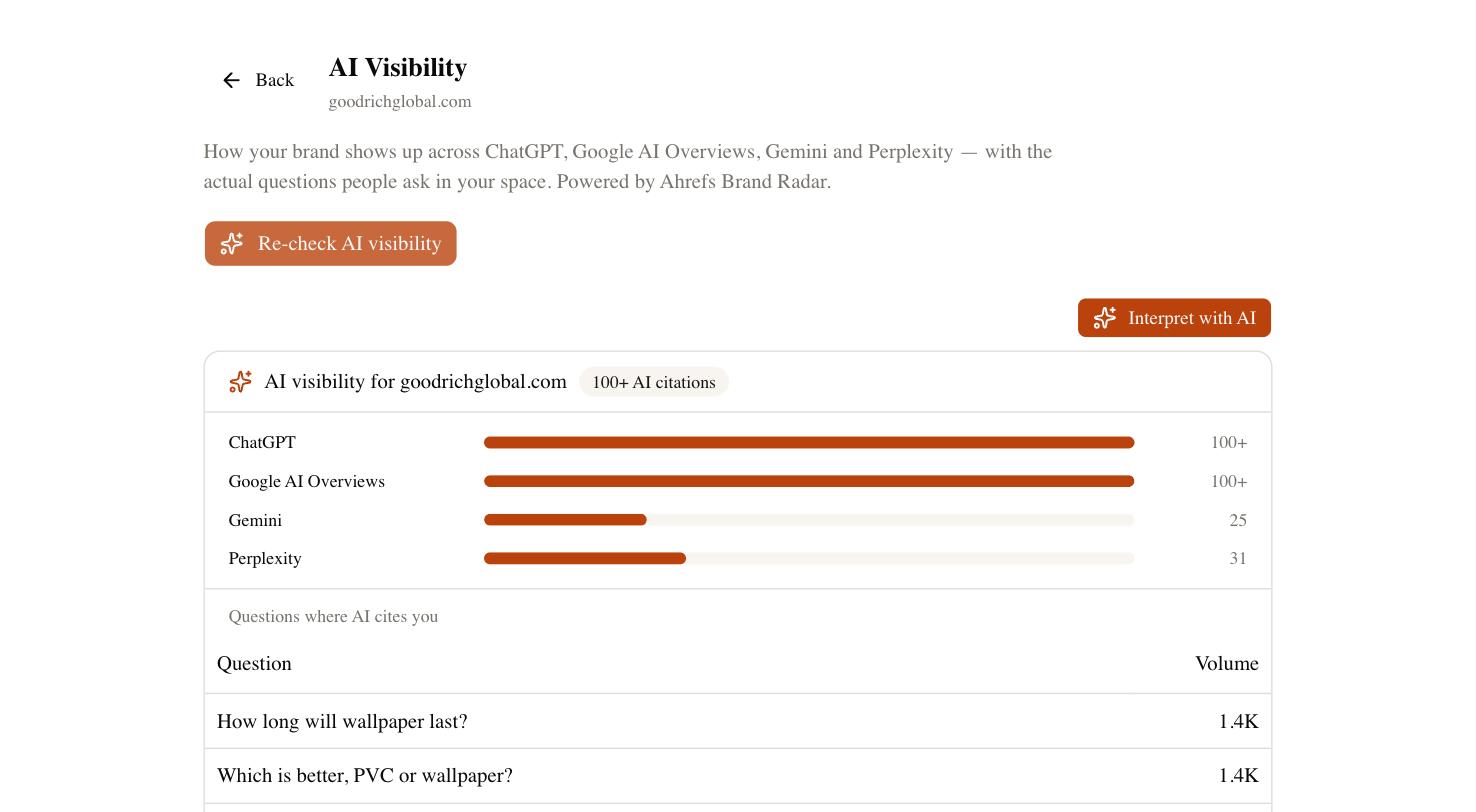
That consolidation is the real saving. A typical stack — a data tool, a separate AI writer, and a standalone AI-visibility tracker — collapses into one subscription, and the entry pricing lands a fraction below a comparable enterprise plan. For consultants and agencies, the read-only client view means you hand a report straight over without exporting anything. If your bottleneck is doing more with fewer tools, which describes most people reading this, it’s the strongest fit on the list. Where it won’t beat a specialist: if you need per-region enterprise dashboards for a global brand, read on.
Profound and Otterly.AI — the dedicated visibility trackers
If your only job is measuring AI search, two purpose-built tools stand out at opposite ends of the market. Profound is the enterprise choice: it monitors how answer engines describe your brand across a wide set of AI surfaces, breaks down which sources the models cite, and gives large teams the depth to treat AI search as a reportable channel. It’s priced for that audience — expect an enterprise band and a sales call, not a self-serve signup.
Otterly.AI comes at the same problem for a fraction of the cost. It tracks a set of prompts across ChatGPT and other engines and tells you when and how your brand shows up, along with the sources those answers lean on. It’s lighter than Profound and won’t replace a full SEO stack, but for a small team that just wants to watch its AI mentions without an enterprise contract, it’s an honest, affordable starting point. The catch with both is that neither does your keyword research or writes your pages — they measure, they don’t produce, so you’ll pair them with something else.
Semrush, Surfer and Writesonic — suites and content engines
These three cover the production side and the traditional-SEO side, and each is strong at a narrower slice of the job. None of them is a full AI-visibility platform, but two have started tracking AI answers, and all three earn their place for a specific kind of user.
- Semrush — the do-everything suite. Beyond SEO it handles PPC, social, and PR research, and it has added an AI/AEO toolkit for tracking AI answers. A marketing team that wants one login for the whole channel mix gets real value, but you’ll pay a higher band and touch maybe a fifth of what you’re buying.
- Surfer SEO — the on-page optimizer. It scores your draft against what’s already ranking and now writes with AI too. If your weak spot is turning a keyword into a page that actually competes, Surfer is a focused, mid-band tool that does that one thing very well.
- Writesonic — the volume play. It’s built to generate content fast and has bolted on GEO tracking to watch AI visibility. If you publish at scale and cost per article matters more than deep data, it earns its low-to-mid band — just keep a human editing pass in the loop.
Ahrefs — deep data with AI tracking bolted on
Ahrefs belongs here for one honest reason: if your work lives on backlink analysis — competitive link audits, disavow files, link building at scale — it still runs one of the largest and freshest link indexes in the industry, and it has added AI-mention tracking to the mix. That depth is hard to replace. The trade-offs are the familiar ones: entry plans sit in the higher band, credits burn fast on a busy account, and the AI-visibility and content pieces feel added-on rather than native. For a pure backlink specialist, that’s a fair deal. For a generalist who mostly checks rankings and ships content, it’s a lot of instrument for the job.
How to choose the best ChatGPT SEO tool
Match the tool to your real constraint, not to a feature grid. Write down the three tasks you actually did last week. If they were some mix of “check what I rank for,” “see what a competitor is doing,” and “produce a piece of content,” you want one AI-native workflow, and SEO Rocket covers all three plus AI-search visibility for less than a stack of three tools. If you’re a global brand that needs enterprise AI-search reporting, Profound is the specialist. If you just want cheap AI-mention monitoring, Otterly.AI does it. And if deep backlink data is your whole world, Ahrefs is worth staying for.
One more filter: count how many separate subscriptions your shortlist would leave you paying for. A data tool plus a writer plus a visibility tracker is three bills, three logins, and three places for work to fall through the cracks. Consolidation isn’t just cheaper; it’s fewer context switches on a Tuesday afternoon.
Whatever you pick, give it a real trial before you judge it. Run your own site and two competitors through it for a week, ask the AI engines the questions your buyers actually ask, and watch how the citations move. The right tool is the one that answers your real questions fastest — not the one with the longest feature page.