GEO stands for generative engine optimization, and the best geo tools answer one question your old rank tracker cannot: when someone asks ChatGPT, Perplexity, or Google’s AI Overviews about your market, does your brand get named? Ranking first on a blue-link results page means less every quarter, because a growing share of buyers never scroll to it. The best geo tools track where you show up inside AI answers, why, and which sources those engines cite.
This is not a padded list of twenty products with affiliate links. Below are the GEO tools that actually hold up in daily use, what each one is genuinely best at, and who should pick it — including cases where a rival fits you better than we do.
What GEO tools actually do
A GEO tool runs a set of prompts against the major AI engines on a schedule and records how you appear in the answers. The good ones measure three things: visibility (how often you’re mentioned at all), position or share of voice (how you stack up against competitors in the same answer), and citations (which pages the model pulled from). Some go further and recommend content changes so you become the source an engine quotes.
The category is young — most of these products are two or three years old — so feature sets move fast and pricing is often demo-led. Treat every visibility score as directional, not gospel. AI answers vary run to run, so what you want is a trend line over weeks, not a single snapshot you over-read on day one.
Why bother at all? Because the buying journey is quietly moving upstream. Someone comparing options increasingly asks an AI assistant for a shortlist before they ever type a query into Google, and if you’re not in that shortlist, you never enter the consideration set. Traditional rank tracking is blind to this — you can hold position one for a term and still be absent from the answer that shaped the buyer’s opinion. A GEO tool is how you see that gap and close it before a competitor does.
How we compared them
Each tool was judged on four things a working marketer cares about: which engines it actually monitors (ChatGPT and Google AI Overviews at minimum, ideally Perplexity, Gemini, and Copilot too), whether it only reports or also helps you fix the gap, honest total cost rather than the headline number, and who it genuinely fits. A solo consultant and a 50-person brand team have different problems, and no single tool wins for both.
The best GEO tools at a glance
Start with the table, then read the notes on the two or three that match your situation.
| Tool | Best for | Standout | Rough price band |
|---|---|---|---|
| SEO Rocket | Solo SEOs, consultants & agencies wanting one workflow | Ahrefs-grade data + AI writing + AI-visibility (Brand Radar) in one chat | Low $ / entry-friendly |
| Profound | Enterprise brand & PR teams | Deep answer-engine analytics and prompt-volume data | Enterprise $$$ |
| Otterly.ai | Small teams & agencies on a budget | Wide engine coverage at a low entry price | Low $ |
| Peec AI | Agencies managing multiple clients | Visibility, position & sentiment tracking | Mid $$ (sales-led) |
| Ahrefs (Brand Radar) | Teams already living in Ahrefs | AI mentions bolted onto a deep SEO suite | Higher $$ |
| Semrush (AI Toolkit) | Marketing teams on Semrush already | AI visibility inside a full marketing platform | Higher $$ |
SEO Rocket — the all-in-one pick
SEO Rocket is built for how the job works now. Instead of juggling a rank tracker, a separate AI writer, and a standalone AI-visibility monitor, you ask for what you need in plain language and it runs the lookup on real, Ahrefs-grade data underneath — keyword research, competitor gaps, backlink profiles, rank tracking. The part that matters for GEO is Brand Radar: it tracks whether and where you’re cited across ChatGPT, Google AI Overviews, and Perplexity, then the same tool drafts the content designed to earn those citations.
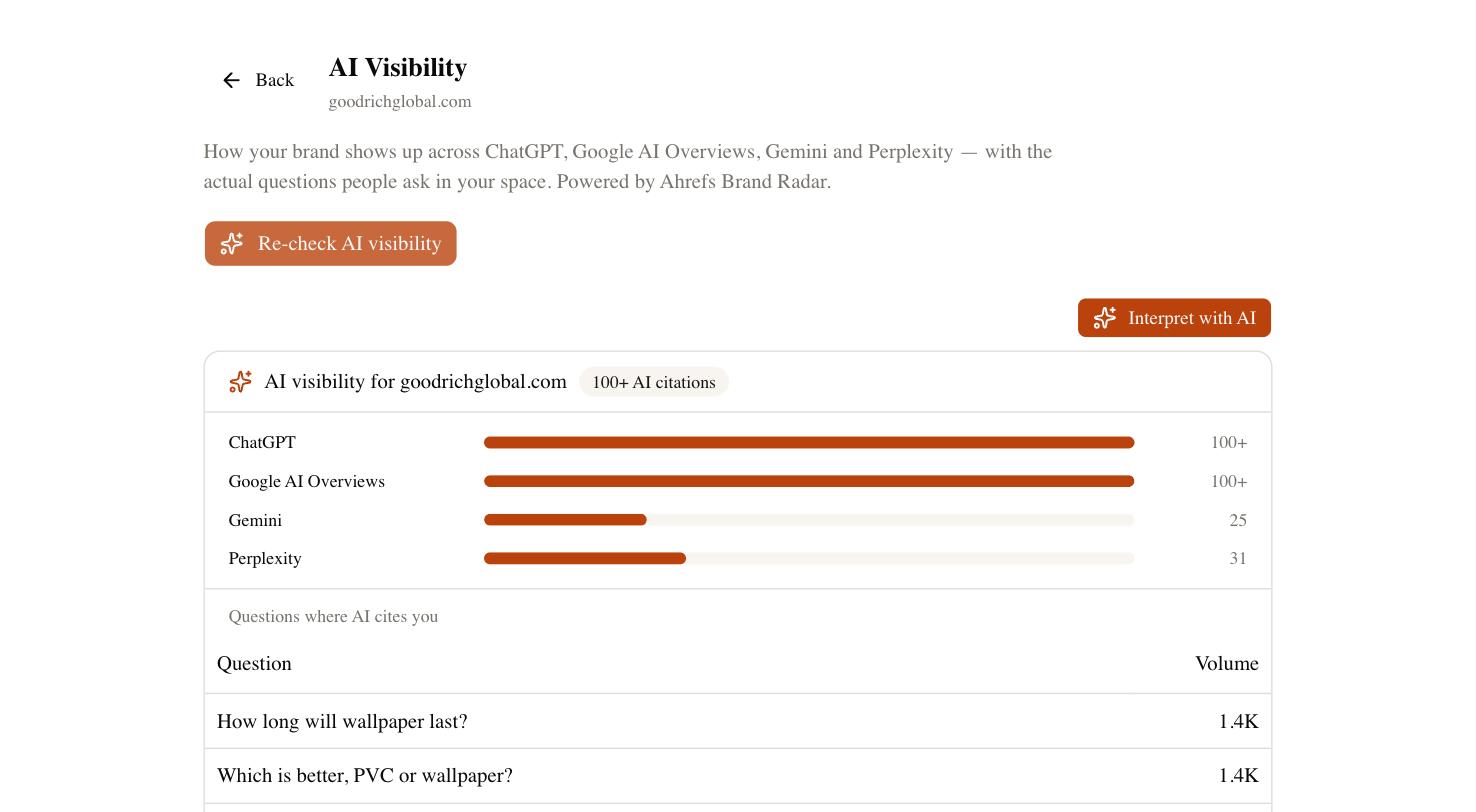
That consolidation is the real saving. Most people currently pay for three subscriptions to cover data, writing, and AI visibility; here it’s one, and the entry pricing sits well below an enterprise GEO platform. For a consultant or agency, the client-dashboard side means you can hand a read-only visibility report straight to a client without exporting a thing. If your bottleneck is doing more with fewer tools — which describes most people reading this — it’s the strongest fit on the list. If you only ever need pure AI-answer monitoring and nothing else, a focused tracker below may be lighter.
Profound — the enterprise answer engine
Profound is the most serious dedicated platform in the category, and it’s honest about who it serves: brand, demand-gen, and PR teams at companies with budget. It reports prompt-volume analytics (what millions of people actually ask AI systems), tracks how each engine represents your brand, and layers in agent-style features that flag high-impact work and monitor how AI bots crawl your site.
The depth is real, and so is the price. Profound is demo-led and sits firmly in the enterprise band, so it’s overkill for a solo operator or a small site. But if AI search is a board-level concern and you have a team to act on the data, it’s the tool that will satisfy them.
Otterly.ai and Peec AI — focused visibility trackers
These two do one job well: monitor your AI-answer presence without the rest of an SEO suite attached.
- Otterly.ai — the budget-friendly monitor. It covers an unusually wide set of engines, including ChatGPT, Google AI Overviews and AI Mode, Gemini, Perplexity, Copilot, and Claude, and its entry plans sit in the low band. If you want broad coverage and clean reporting for a single brand or a couple of clients, it’s an easy, affordable start.
- Peec AI — the agency tracker. It leans into visibility, position, and sentiment across ChatGPT, Perplexity, and Gemini, and shows which sources the models cite. Pricing is sales-led and lands in the mid band, and the multi-client framing makes it a natural pick for agencies reporting AI presence across a roster.
Neither writes content nor covers traditional SEO data — you’ll still run a separate tool for that. That’s the trade-off for staying lightweight and specialist. If a single dashboard of AI-answer numbers is all you need, that focus is a feature, not a gap; if you also want the keyword data and drafting to act on what you find, you’ll feel the missing pieces within a week.
Ahrefs and Semrush — GEO inside your existing suite
If you already pay for a full SEO platform, you may not need a new login at all. Ahrefs added Brand Radar to surface AI mentions and Overview appearances alongside its industry-leading backlink and keyword data. Semrush folded AI-visibility tracking into its broader toolkit, so a team living in Semrush can watch AI answers next to their PPC and content work.
Both sit in the higher price band because you’re buying the whole suite, and both treat GEO as one module rather than the main event. That’s fine if the suite is already your home base. If you’re shopping for GEO first and foremost, a purpose-built tracker or an all-in-one like SEO Rocket will feel more focused for less.
How to choose the best GEO tool
Match the tool to your real constraint, not a feature checklist. If you want AI-visibility tracking plus the SEO data and content writing to act on it, in one place and at an entry-friendly price, SEO Rocket is the natural move. If AI search is an enterprise priority with a team behind it, Profound earns its cost. Want a cheap, focused monitor? Otterly.ai. Running client accounts? Peec AI. Already deep in Ahrefs or Semrush? Turn on the GEO module you’re probably already paying for.
A quick test before you commit: run your own brand and two competitors through any tool for two full weeks. Watch the trend, not the first reading, because AI answers jitter day to day. The best geo tool is the one that answers your real question — “am I in the answer, and if not, why” — fastest, and hands you something you can actually fix. Start there, and let the data, not the feature page, make the call.