Most people looking for a content at scale review arrive with one question: can this thing actually replace the hours you spend turning a keyword into a publishable article? The honest answer is “partly,” and the rest of this content at scale review is about where that line falls. Content at Scale built its name on long-form AI drafts that read less like a robot than most, and it has since pushed hard toward a more hands-off, agent-driven content operation. That shift is the whole story of whether it fits you.
This is not an affiliate puff piece. Below is what the tool is genuinely good at, the weaknesses you’ll hit in real use, the rough price band to expect, and who should look elsewhere. Where a leaner AI-native workflow makes more sense, I say so.
What Content at Scale actually is
At its core, Content at Scale is a long-form AI writing platform. You feed it a keyword, an existing URL, a YouTube video, or a podcast, and it produces a full blog post — usually a couple of thousand words, with headings, a meta description, and internal structure already in place. That “one input, one finished draft” flow is the pitch, and it’s what separated the tool early on from generic chat-style writers that make you assemble a post paragraph by paragraph.
Over the last couple of years the product has moved upmarket. Instead of positioning purely as a self-serve writer, Content at Scale now leans on an agentic model — an AI “marketing employee” that handles keyword research, briefs, drafting, and publishing as a connected loop rather than a single button. The company also runs a widely used free AI-content detector, which is how a lot of people first encounter the brand. Treat any detector result, theirs included, as a rough signal and not a verdict.
Where it’s genuinely good
The long-form output is the real strength. For informational, top-of-funnel articles — the “what is,” “how to,” and listicle posts that make up most content calendars — a first draft lands in minutes with the on-page basics handled. Headings are sensible, the keyword shows up where it should, and the meta and title are filled in rather than left for you. If your bottleneck is producing volume on a predictable schedule, that’s a real time save.
It also handles repurposing well. Point it at a webinar recording or a long video and it will pull a structured article out of the transcript, which is genuinely useful if you produce audio or video and want the written version without transcribing by hand. The WordPress publishing path is smooth too, so the draft-to-live gap is short.
The real weaknesses
Every AI writer has the same tax, and Content at Scale is no exception: the draft is a starting point, not a finished article. You still need to fact-check claims, kill the occasional hallucinated statistic, add real examples, and cut the formulaic phrasing that AI slides into. Skip that editing pass and you publish thin, generic content that Google increasingly ignores — links or no links. The tool speeds the first 70%; the last 30% is still human work.
The bigger limitation is scope. Content at Scale writes content; it is not an SEO data platform. There’s no serious backlink index underneath it, no competitor link auditing, and no rank tracking of the kind you’d open Ahrefs or Semrush for. Its on-page scoring is helpful, but it’s grading the words, not telling you whether the keyword is winnable or who already owns the SERP. You’ll still need a separate research tool for that decision, which is the part that actually determines whether an article ranks.
The move upmarket is the third thing to weigh. As the product leaned into the agentic, done-more-for-you model, the cheap entry tiers thinned out, and the sticker price sits well above a plain chat-based writer. For a solo blogger that math can stop making sense fast.
Feature and trade-off snapshot
Here’s the honest at-a-glance. Read it as directional — features and tiers on tools like this move around, so verify the current specifics before you buy.
| Area | Strength | Weakness |
|---|---|---|
| Long-form drafts | Fast, structured, on-page basics handled | Needs a real editing and fact-check pass |
| Repurposing | Turns video/podcast/URL into an article well | Output still reads generic without human input |
| SEO data | Solid on-page scoring per article | No backlink index, competitor gaps, or rank tracking |
| Workflow | Agentic, hands-off content operation | Complexity and price aimed above solo users |
| AI-search visibility | Focused on traditional blog SEO | Doesn’t track brand citations in ChatGPT or Perplexity |
| Price band | Predictable for high-volume teams | High entry cost; cheap self-serve tiers have thinned |
Rough pricing and who it’s for
Content at Scale sits in the premium band for AI content. Historically its self-serve plans opened in the low-to-mid hundreds of dollars a month and climbed steeply with volume; the agentic, agency-style tiers run higher still, often into custom four-figure territory. Don’t anchor on any single number you see quoted — check the live pricing page, because this is exactly the kind of product that reshuffles plans regularly.
Who does that suit? Content teams and agencies producing serious volume, where a faster first draft across dozens of posts a month pays back the subscription and the higher price buys the hands-off workflow. If you’re publishing a handful of posts and already own a research tool, the value gets thin quickly, and a cheaper general-purpose writer will cover you. For a pure solo blogger, this is probably more platform than you need.
SEO Rocket as an AI-native alternative
If your real problem is tool sprawl — an AI writer here, a keyword-and-backlink tool there, and nothing watching AI search — it’s worth knowing the categories are converging. SEO Rocket is built as one chat-first workflow: Ahrefs-grade keyword and backlink data, AI article drafting with Claude, and rank tracking sit under a single login, so the research that decides whether a topic is winnable happens in the same place you draft the piece.
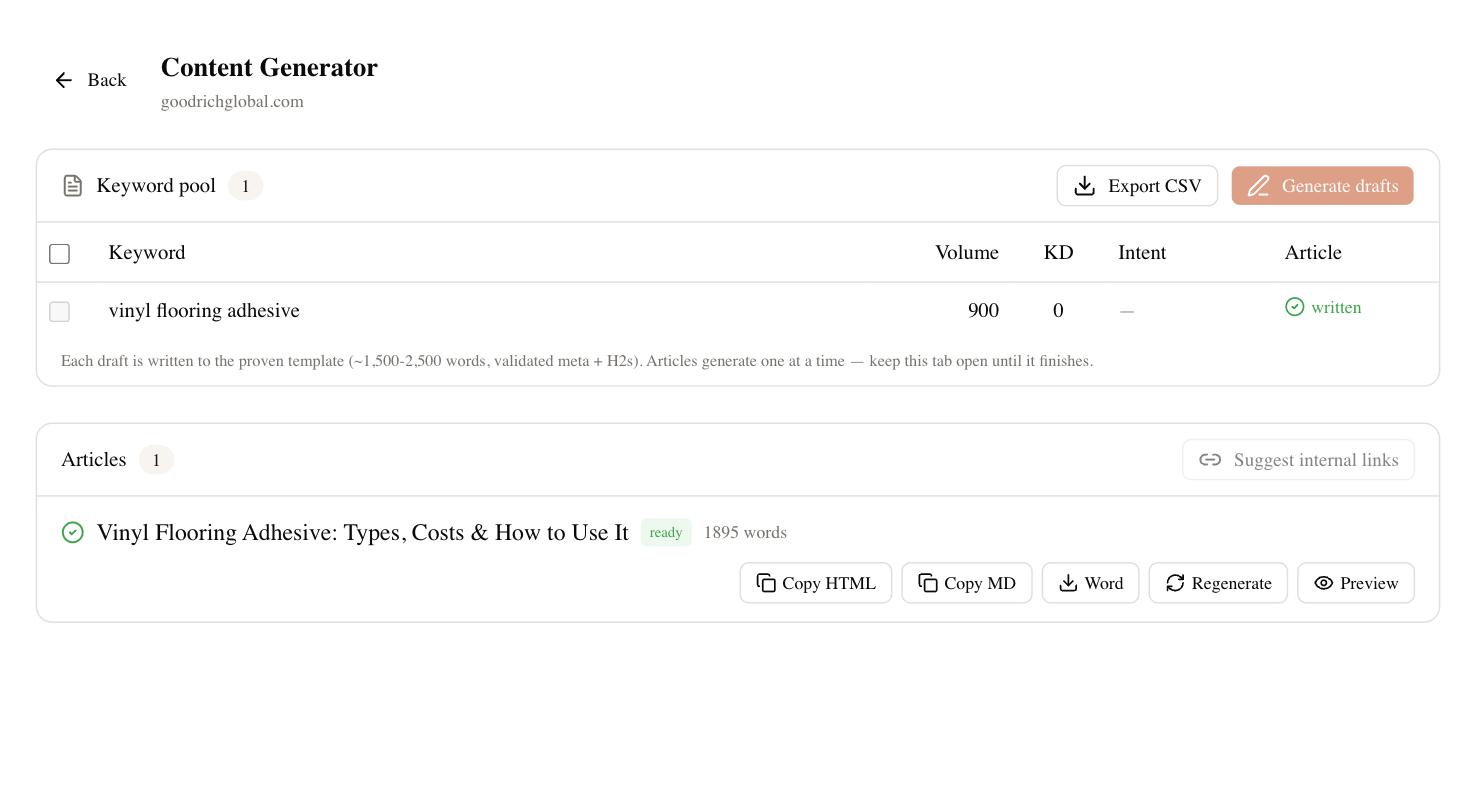
The piece Content at Scale doesn’t touch is AI-search visibility. A growing share of buyers now ask ChatGPT or Perplexity instead of Google, and an article that ranks first can still go unmentioned in an AI answer. SEO Rocket’s Brand Radar tracks whether and where you’re being cited across those surfaces, which is the newer half of the job. To be fair to Content at Scale: if your only need is high-volume long-form drafting and you already have your data and tracking sorted, its writer is more specialized at that one task, and specialization can be the right call.
The verdict
Content at Scale is a capable long-form writer that has grown into a premium, agent-driven content platform. It earns its place for teams pushing real volume who want structured drafts fast and don’t mind paying for a hands-off operation. It’s a weaker fit for solo users on a budget, and it was never built to be your keyword-research, backlink, or AI-visibility tool — you’ll still bolt those on.
Decide by writing down what you actually did last week. If it was “produce ten articles and publish them,” a dedicated writer like this can carry that load. If it was some mix of “find winnable keywords, check a competitor, draft a post, and see whether AI search mentions me,” you’re better served by one connected, AI-native workflow than by stacking a premium writer on top of everything else. Either way, run your own topics through a trial before you commit, and judge the drafts after you’ve edited them — not before.