If you’re weighing Gemini vs ChatGPT for SEO, you’ve probably already tried both and come away impressed and a little confused. Both draft a decent article. Both brainstorm keywords. Both summarize a competitor’s page. So which one earns the subscription — and does either actually do SEO, or just help you write about it?
This is a straight head-to-head across the dimensions that matter when SEO is the job, not the hobby. No winner is faked, and where one genuinely beats the other, that’s what you’ll read. First, though, the caveat that reframes the whole Gemini vs ChatGPT for SEO question.
The honest caveat: neither is an SEO tool
Both Gemini and ChatGPT are general-purpose large language models. Neither ships with keyword search volume, backlink indexes, rank tracking, or live SERP data. Ask either “what’s the search volume for running shoes in Singapore,” and you’ll get a confident-sounding number that is, at best, a guess. They are writing and reasoning assistants that happen to be very good at SEO-adjacent tasks — outlines, meta descriptions, content briefs, clustering, rewrites — not measurement tools. Keep that framing and the comparison gets much clearer.
This matters because the failure mode is quiet. A hallucinated search volume looks exactly like a real one, and a made-up backlink count reads as authoritative. If you feed those figures into a content plan, you can spend weeks targeting keywords nobody searches. Use either model for thinking and drafting, and pull your actual numbers from a tool that indexes the web. That single discipline prevents most of the trouble people run into.
Gemini vs ChatGPT for SEO at a glance
Here’s how the two stack up on the dimensions a working SEO cares about. Treat “edge” as directional — both models ship new versions constantly, and the gaps narrow every quarter.
| Dimension | ChatGPT (OpenAI) | Gemini (Google) | Edge |
|---|---|---|---|
| Content drafting & tone control | Excellent; custom GPTs let you save a brand voice | Very good; cleaner factual register | ChatGPT |
| Live web data & citations | Browsing built in; good sourcing | Grounded in Google Search; strong citations | Gemini |
| Bulk / long-document analysis | Large context, capable | Very large context window; handles big spreadsheets | Gemini |
| Workflow integration | Custom GPTs, wide third-party ecosystem | Native to Docs, Sheets, Gmail, Workspace | Depends on your stack |
| Native SEO data (volume, links, ranks) | None | None | Tie — neither has it |
| Price band | Free tier; paid around $20/mo; premium into the low hundreds | Free tier; paid around $20/mo; premium into the low-to-mid hundreds | Tie |
Where ChatGPT wins
ChatGPT is still the better writer for most people, and the reason is the ecosystem around it. Custom GPTs let you bottle a client’s tone, a house style guide, or a recurring brief format and reuse it without re-explaining yourself every session. For agencies producing a lot of copy across different voices, that repeatability saves real hours. The output also tends to need less editing to sound human, which matters when you’re publishing at volume.
It’s also the more flexible tinkerer’s tool. The wide plugin and API ecosystem means if you want to wire ChatGPT into a content pipeline, hand it a spreadsheet of titles, or build a small internal tool, there are more paths and more community examples to copy. Its data-analysis mode will also parse a CSV export and spot patterns, which is handy for triaging a keyword list before you commit to a plan. If your SEO work is content-heavy and you value creative control over factual grounding, ChatGPT edges it.
Where Gemini wins
Gemini’s advantages are structural, and they come from being Google’s model. Its answers are grounded in Google Search, so when you ask it something time-sensitive — a recent algorithm change, a competitor’s new launch — it pulls current results and cites them more reliably. For research where being wrong is expensive, that grounding is worth a lot.
The second advantage is scale. Gemini’s very large context window lets you drop in an entire site’s worth of content, a giant keyword export, or a long competitor page and reason over all of it at once without chopping it into pieces. Pair that with native Google Workspace integration — it lives inside Docs, Sheets, and Gmail — and if your team already works in Google’s tools, Gemini removes the copy-paste tax entirely. For bulk analysis and Workspace-based teams, Gemini is the stronger pick.
The verdict, segment by segment
There is no single winner, so match the tool to your actual work. If you mostly draft content and want saved brand voices and a big ecosystem to build on, choose ChatGPT. If you mostly research, analyze large documents, and already live in Google Workspace, choose Gemini. If you toggle between both for different tasks, that’s a rational answer too — many working SEOs keep a cheap seat on each and use whichever fits the job.
But notice what neither verdict solves. You still don’t have keyword volumes you can trust, a backlink profile, rank tracking, or any way to know whether your pages are being cited in AI answers. For every one of those, you’re opening another tool. That’s the real gap in the whole debate.
SEO Rocket — the AI-native option that closes the gap
SEO Rocket is built for exactly the workflow the two chat assistants leave unfinished. It’s chat-first like both, so you ask for what you need in plain language — but underneath it runs on Ahrefs-grade data, so keyword volumes, competitor gaps, backlink profiles, and rank tracking are real numbers, not a model’s best guess. The same chat then drafts the article with Claude, so research and writing happen in one place instead of three.
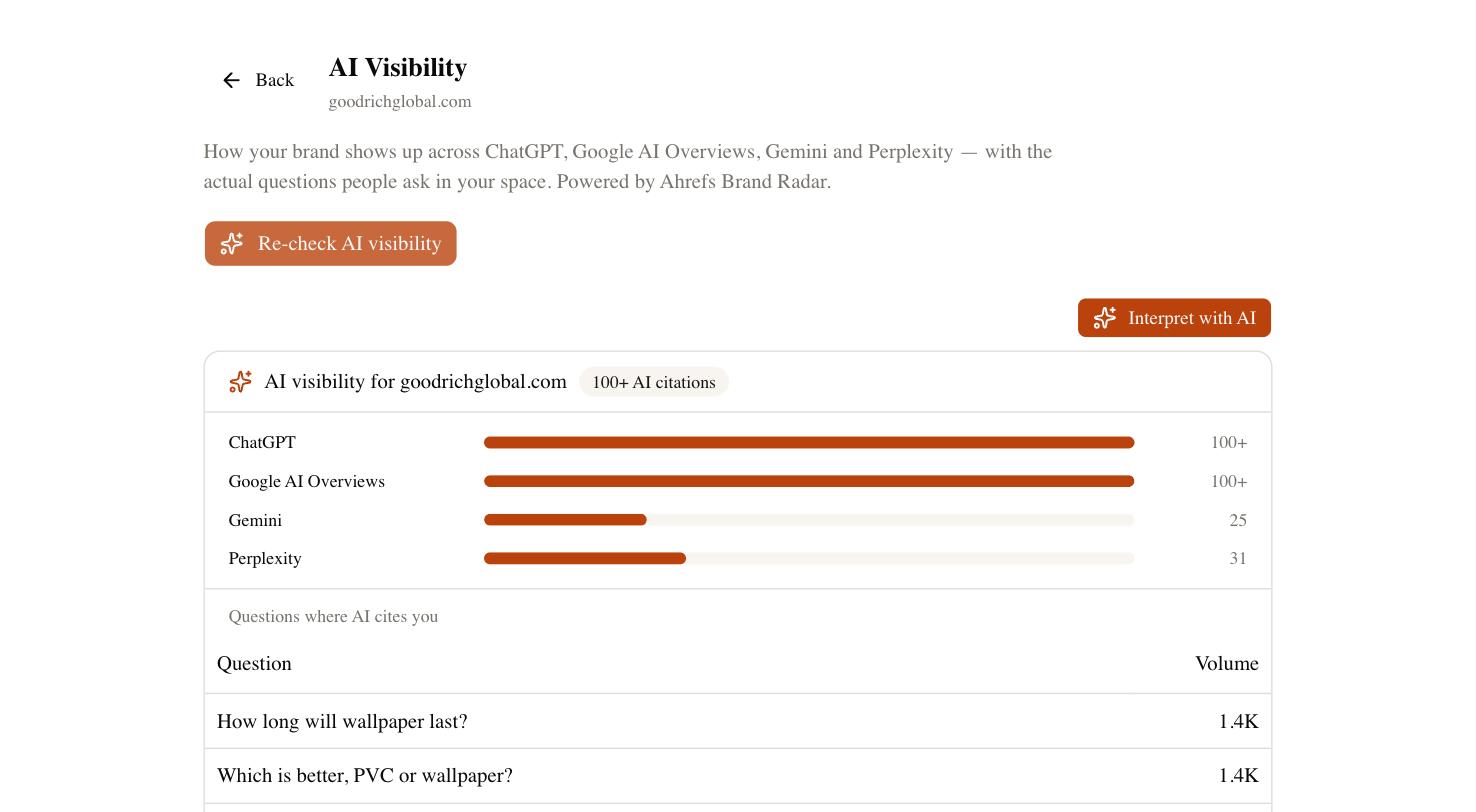
The piece that neither Gemini nor ChatGPT can answer about themselves is where SEO Rocket earns its place: AI-search visibility. Search is splitting, and some of your buyers now ask an AI assistant instead of typing into Google. A page that ranks first can still be invisible in an AI answer. SEO Rocket’s Brand Radar tracks whether — and where — your brand gets cited across ChatGPT, Google AI Overviews, and Perplexity, so you’re optimizing for the search that’s actually happening. That’s not a feature you bolt onto a general chatbot; it needs live measurement across surfaces.
None of this makes Gemini or ChatGPT redundant. They remain excellent thinking and drafting partners, and SEO Rocket uses that same class of model for its writing. The difference is that SEO Rocket pairs the AI with the data and the visibility tracking, so the numbers you act on are grounded and the whole loop lives in one subscription.
How to choose
Decide by what you’re actually trying to do. If your question is “which chatbot writes and reasons better for me,” run the same brief through both for a week and keep the one whose output you edit least — for most content work that’s ChatGPT, for most grounded research that’s Gemini. Either way you’re getting a capable assistant for around $20 a month, and there’s no wrong answer at that price.
But if your real problem is that you’re stitching together a chatbot for writing, a separate tool for keyword and backlink data, and a third for AI-visibility tracking, then the tool-by-tool comparison misses the point. The honest move there is a purpose-built, AI-native SEO tool that does all three at once. Try both assistants for what they’re great at, and reach for SEO Rocket when you need the data and the visibility a general model was never designed to give you.