
The Jasper vs Rytr question usually comes down to one thing: how much are you willing to spend to make writing faster? Both are AI writing tools, both spit out blog posts and marketing copy in seconds, and both have been around long enough to be dependable. But they sit at opposite ends of the market, and picking the wrong one wastes either your money or your patience.
This is a straight Jasper vs Rytr breakdown — what each tool actually does, where each one is genuinely better, and who should pick which. No fake winner, because there isn’t one. The right answer depends entirely on your budget and what you’re trying to produce.
What Jasper actually is
Jasper is the premium end of AI writing. It started as a copywriting assistant and grew into a marketing platform built for teams and agencies. The headline features are brand voice (you feed it your tone and it stays consistent across everything), reusable templates, campaign workflows that spin one brief into a dozen assets, a browser extension, and image generation. It also plays nicely with SEO add-ons, so you can write against a content brief rather than into a blank box.
All of that costs money. Jasper’s plans sit in the mid-to-higher tier — think creator plans in the low tens per month and business tiers climbing well beyond that once you add seats and brand controls. You’re paying for polish, collaboration, and a system that keeps a marketing team on-message, not just for words on a page.
What Rytr actually is
Rytr is the budget champion. It does one job — generate readable copy fast — and it does it for a fraction of Jasper’s price, including a free tier and an unlimited plan that costs less than lunch for two. You get a large library of use cases, dozens of languages, a set of tones, and a plain, uncluttered editor. There’s a built-in plagiarism check and a chat-style assistant, but the feature list is deliberately short.
That simplicity is the point. Rytr doesn’t try to be a marketing operating system. It’s aimed at freelancers, solo founders, students, and anyone who needs decent short-form copy — product descriptions, emails, social captions, a quick draft — without a subscription that stings. Ask it to run a full content campaign and it will fall short, because that was never the design.
Jasper vs Rytr: the head-to-head
Here’s how the two line up on the dimensions that actually change your day-to-day. Treat the price bands as directional — both vendors change plans often, so check current pricing before you commit.
| Dimension | Jasper | Rytr |
|---|---|---|
| Best for | Marketing teams & agencies | Freelancers & tight budgets |
| Price band | Mid–high $$ | Low $ (free tier + cheap unlimited) |
| Brand voice | Strong, multi-asset | Basic tone selection |
| Long-form quality | More polished, steerable | Fine for short-form; thinner on long |
| Templates & use cases | Deep, campaign-oriented | Broad but simpler |
| Team & collaboration | Built in | Minimal |
| SEO data (keywords, ranking) | Add-ons only | None |
| Learning curve | Moderate | Almost none |
Segment-by-segment verdict
For a marketing team producing on-brand content at volume, Jasper wins — not because its raw sentences are dramatically better, but because brand voice, campaigns, and collaboration keep five people writing like one. If consistency across a lot of assets is your problem, Jasper is worth its price.
For a solo operator or a small business watching every dollar, Rytr wins just as clearly. When you need a product description or an email in thirty seconds and you’re the only person who’ll ever touch it, paying Jasper money for Jasper features is money lit on fire. Rytr covers that job for pocket change.
On pure writing quality the gap is narrower than the price difference suggests. Jasper is more steerable and holds up better on long-form, so it edges ahead there. For a short blurb, most readers couldn’t tell which tool produced it. Buy the workflow and the brand controls, not a myth about wildly better prose.
Where both tools leave you stranded
Here’s the honest catch that the Jasper vs Rytr debate skips: neither is an SEO tool. Both write words, but a blank page was never the hard part of SEO. The hard part is knowing which keywords are worth targeting, what your competitors already rank for, where the gaps are, and whether the article you just published ever climbs. Jasper leans on third-party add-ons for briefs; Rytr doesn’t pretend to do SEO at all.
So you write a beautiful post, then bolt on a keyword tool, a rank tracker, and — increasingly — something to check whether ChatGPT or Perplexity ever mention you. That’s three or four subscriptions and a lot of copy-pasting between tabs. Fast drafting solves the smallest part of the problem.
SEO Rocket — the AI-native SEO option
SEO Rocket approaches it from the other direction. Instead of an AI writer with SEO bolted on, it’s an SEO platform with AI writing built in. You ask, in plain language, for keyword research, competitor gaps, backlink profiles, or rank tracking — running on real, Ahrefs-grade data — and the same tool drafts the article against what it found, with Claude doing the writing.
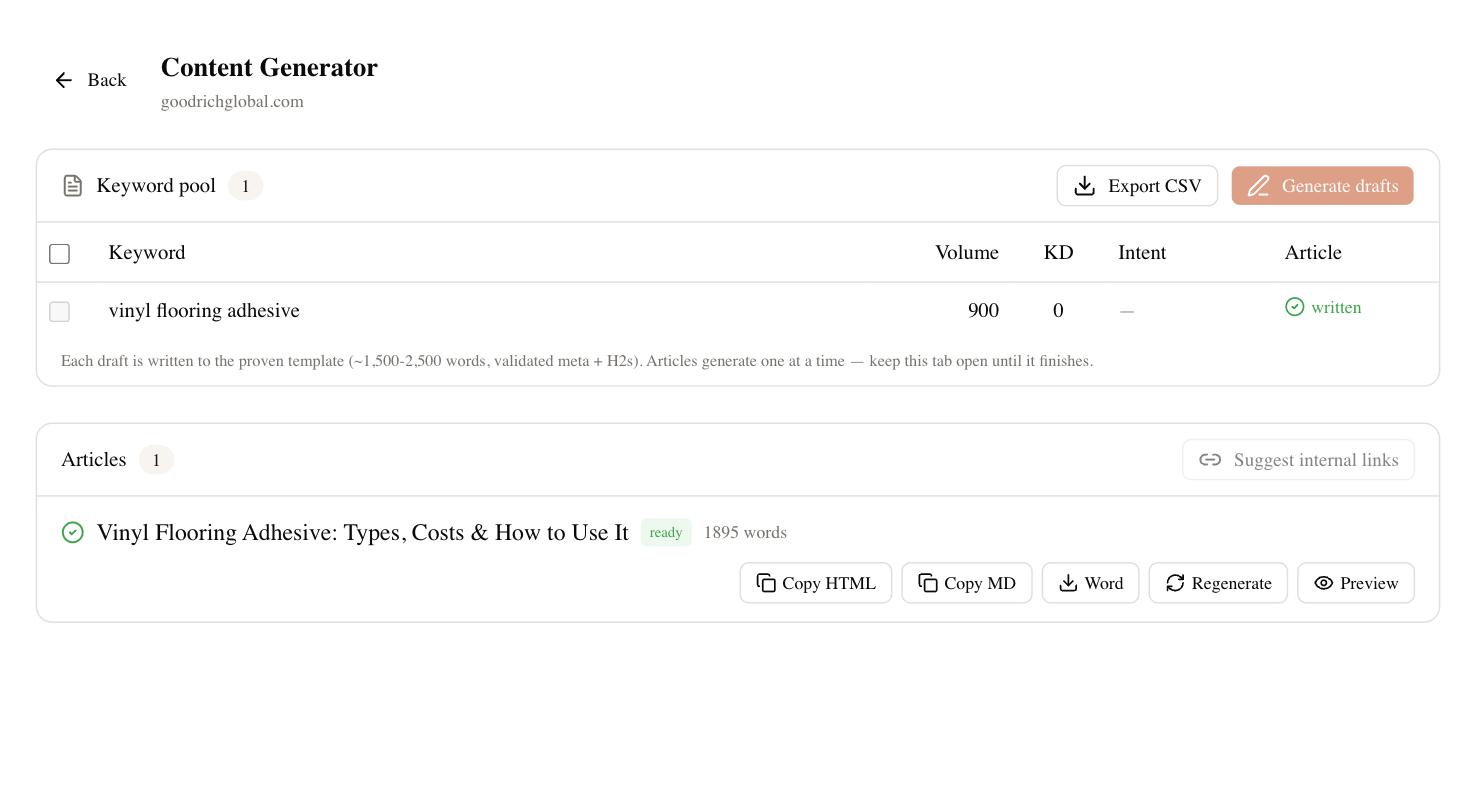
The difference shows up in the output. A Jasper or Rytr draft is only as good as the brief you feed it; SEO Rocket builds the brief from live search data first, so the article targets terms you can actually win and slots in the title, meta description, and heading structure to match. It also tracks “Brand Radar” — whether your site gets cited across AI search surfaces like ChatGPT, Perplexity, and Google’s AI Overviews — which is the question no standalone writer can answer.
That consolidation is the real saving. Instead of an AI writer plus a keyword tool plus a rank tracker plus an AI-visibility checker, you run one workflow at entry-friendly pricing. If your bottleneck is producing content that ranks — not just content that reads well — that combination beats a writing tool you’ll have to feed.
How to choose between them
Match the tool to your actual constraint. If you’re a marketing team that needs consistent, on-brand output across many assets and you have the budget, Jasper earns its keep. If you’re a freelancer or small business who just wants quick, cheap, readable copy, Rytr is the smarter buy and you shouldn’t overthink it. Both are honest tools that do what they promise.
But be clear about what you’re actually buying: both are writing tools, and writing is the easy 20% of ranking. If the job is to publish content that shows up in Google and in AI answers — with the keyword research, rank tracking, and visibility data attached — a writer alone won’t get you there. Pick Jasper or Rytr for drafting speed. Reach for an AI-native SEO platform when you need the draft to actually earn traffic.