If you’re weighing Serpstat vs SEO Rocket, you’re really comparing two different eras of SEO tooling. Serpstat is a mature, well-priced all-in-one platform that has spent years building a broad suite — keyword research, rank tracking, site audit, backlink analysis, and competitor intelligence under one login. SEO Rocket is younger, narrower in some places, and built around a different bet: that the daily work of SEO is moving into a chat window and toward AI search. This comparison is written competitor-first on purpose, because Serpstat earns an honest hearing before we make the case for the newer approach.
The Serpstat vs SEO Rocket decision usually comes down to one question: do you want the widest possible set of classic SEO modules at a friendly price, or do you want fewer, deeper workflows that fold AI writing and AI-answer visibility into the same place you check your rankings? Both are legitimate. Below is where each tool genuinely wins, and who should pick which.
Why people compare these two
Serpstat has a loyal following for a good reason: it delivers a lot of platform for the money. Teams that outgrew a single-purpose keyword tool but blanched at enterprise suite pricing tend to land on it. So when someone starts shopping around, Serpstat is often the incumbent they’re measuring everything else against.
People start looking past it for two reasons. The first is that classic suites were designed for a Google-only world, and search is no longer Google-only — a growing share of buyers now ask ChatGPT, Perplexity, or Google’s AI Overviews, and traditional rank trackers say nothing about those surfaces. The second is workflow: even a strong suite still leaves you jumping between a keyword module, an export, and a separate AI writer to actually produce content. That gap between “here’s the data” and “here’s the finished article” is exactly where a chat-first tool competes.
Where Serpstat is genuinely stronger
Let’s be fair, because this matters. Serpstat’s breadth is real. It bundles more distinct classic-SEO modules than SEO Rocket does today — things like a dedicated site audit crawler, PPC and advertising research, and a mature project-management layer that agencies have used for years. If your process depends on those specific tools existing as polished, standalone modules, Serpstat has a head start.
Serpstat is also battle-tested in a way any newer product simply cannot claim yet. Its rank-tracking and keyword databases have years of accumulated coverage across many regions, and its reporting has been refined by a large existing user base. For a team that wants a dependable, do-most-things platform at a mid-range price — and doesn’t need AI writing or AI-search tracking built in — Serpstat is a sensible, cost-effective choice, and you should not feel talked out of it.
Serpstat vs SEO Rocket at a glance
Read the table for the shape of the trade-off, then the sections below for the detail that actually decides it.
| Dimension | Serpstat | SEO Rocket |
|---|---|---|
| Core model | Classic all-in-one dashboard suite | Chat-first — ask in plain language |
| Breadth of classic modules | Wider (audit, PPC, project tools) | Focused on the high-use workflows |
| Keyword & backlink data | Own databases, broad regional coverage | Ahrefs-grade data underneath |
| AI content writing | Add-on / limited | Built in — drafts with Claude |
| AI-search visibility | Not a focus | Brand Radar tracks ChatGPT, Perplexity, AI Overviews |
| Client dashboards | Established reporting | Read-only client dashboards built in |
| Rough price band | Mid $$ — good value for the breadth | Low $ — entry-friendly |
| Best for | Teams wanting the widest classic suite | Solo SEOs & agencies wanting one AI-native workflow |
Where SEO Rocket pulls ahead
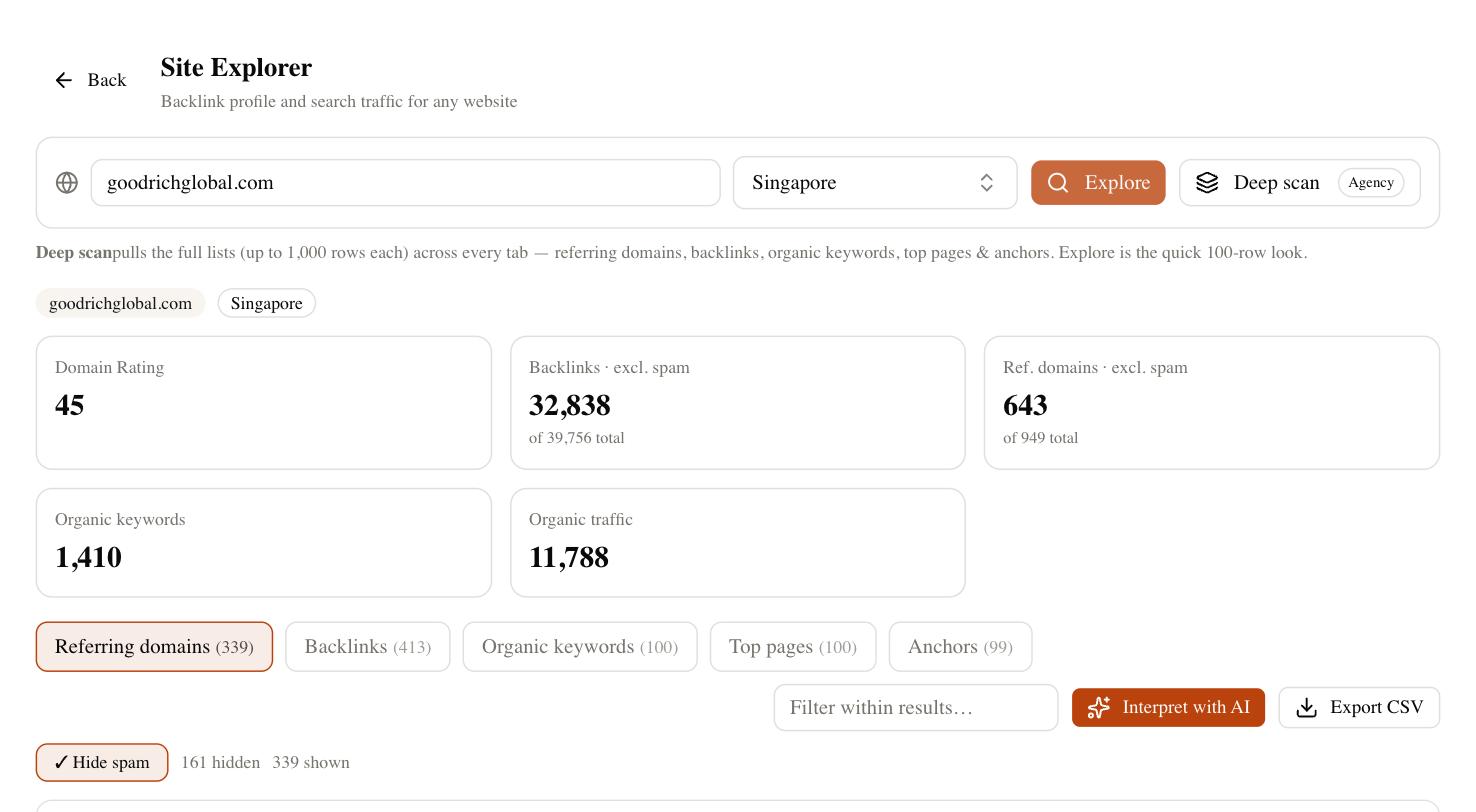
SEO Rocket’s advantage is not that it has more modules — Serpstat wins on raw breadth. Its advantage is that the pieces you use most are connected and driven by conversation. Instead of opening a keyword module, running an export, and pasting the result somewhere else, you ask for what you need in plain language and it runs the lookup: keyword research, competitor gap analysis, backlink profiles, rank tracking, all on real, Ahrefs-grade data underneath.
Then it keeps going where a classic suite stops. The same tool drafts the article — using Claude, not a generic template engine — so the path from “find the keyword gap” to “publish the page” happens without leaving the chat. For a consultant or a lean agency, that consolidation is the whole point. A typical stack of a data suite plus a separate AI writer plus an AI-visibility tracker collapses into one subscription, and the entry pricing sits below a comparable suite plan rather than above it.
Data quality: the honest picture
Data is where comparisons get overstated, so here’s the measured version. Serpstat runs its own keyword and backlink databases with genuinely broad regional coverage, and for many markets that depth is excellent. SEO Rocket leans on Ahrefs-grade data for its core metrics — one of the largest and freshest link indexes in the industry — which tends to show up in backlink depth and traffic estimates.
The honest caveat applies to both: domain rating, traffic figures, and difficulty scores are estimates, not measurements. Any two tools will disagree, sometimes by a wide margin, and neither is “the truth.” Treat cross-tool differences as directional. If precise backlink depth is the single thing your work lives on, test both against a domain you know cold before you commit — that is the only comparison that settles it for your niche.
AI-search visibility — the real divide
This is the part no classic suite answers, and it’s increasingly the reason people switch. Search is splitting. Some of your buyers now get their answer from ChatGPT or Perplexity or an AI Overview and never click a blue link, which means a page that ranks first on Google can still be completely invisible in the answer your customer actually reads.
SEO Rocket’s Brand Radar tracks whether — and where — your brand gets cited across those AI surfaces, so you’re optimizing for the search that’s happening now rather than the one that happened five years ago. Serpstat, like most traditional suites, isn’t built around that question yet. If AI-search visibility is a live concern for your business, this is the clearest, most concrete difference between the two, and it’s hard to retrofit onto a Google-only toolset.
Which one should you choose
Match the tool to your real constraint, not to a feature checklist. Choose Serpstat if you want the widest set of classic SEO modules — dedicated site audit, PPC research, mature project tooling — at a mid-range price, and you don’t need AI writing or AI-search tracking in the same place. It’s a proven, good-value suite, and for that buyer it’s the right call.
Choose SEO Rocket if your week is mostly “check what I rank for, see what a competitor is doing, and produce a piece of content” — and you want AI drafting plus AI-search visibility built in rather than bolted on from a second subscription. Write down the three tasks you actually did in your SEO tool last week. If they’re the classic-research mix and you love having many modules, Serpstat fits. If they end in publishing content and worrying about whether ChatGPT ever mentions you, the AI-native workflow will cover them faster and cheaper. Whichever you pick, run your own site and two competitors through it for a full ranking cycle before you judge it — positions jitter a few spots day to day, and the tool that answers your real questions fastest is the right one for you.