Most people reading a Serpstat review are trying to answer one question: can a cheaper all-in-one tool really replace the big names without leaving you blind on the data that matters? Serpstat has spent years positioning itself as exactly that — a keyword, rank-tracking, backlink, and site-audit suite at a fraction of what Ahrefs or Semrush charge. The short answer is that it delivers a lot for the money, with some real caveats you should know before you commit.
This Serpstat review is written from the perspective of a working SEO, not a features page. Below is what the tool genuinely does well, where it quietly falls short, roughly what you’ll pay, and the type of user who gets the most out of it. Where a different tool is the honest answer, you’ll hear that too.
What Serpstat actually is
Serpstat is a growth-hacking and SEO platform that bundles the core jobs most people run separate tools for: keyword research, competitor analysis, rank tracking, backlink data, site auditing, and some basic content and PPC research. It’s been around since the mid-2010s, and its pitch has always been breadth at a low price rather than best-in-class depth on any single feature.
In practice that means you log in and can do almost everything from one dashboard. You paste a domain, get an overview of its organic keywords and estimated traffic, drill into a competitor’s top pages, then jump to rank tracking or a technical audit without opening a second subscription. For a small team, that consolidation is genuinely useful.
What Serpstat does well
The clearest strength is value. You get a wide feature set for a price that undercuts most of the market, which makes Serpstat a sensible on-ramp for freelancers, small agencies, and in-house marketers who can’t justify a triple-digit monthly bill. For the money, the coverage is hard to fault.
Keyword research is the area it handles best. The keyword database is large enough for real work, the clustering and difficulty features help you group topics quickly, and the “missing keywords” and competitor gap views are legitimately useful for finding terms your rivals rank for and you don’t. Rank tracking is flexible, supports plenty of keywords per project, and updates on a reasonable schedule.
The site audit is another honest win. It crawls your site, flags technical issues by severity, and gives you a prioritized list you can actually work through. It won’t replace a dedicated crawler for very large sites, but for a typical business site it’s more than adequate. The API access on higher tiers is also a quiet advantage if you want to pull data into your own reports.
Where Serpstat falls short
The trade-off for that breadth is depth, and it shows most in the backlink index. Serpstat’s link database is smaller and less fresh than what Ahrefs offers, so if serious backlink analysis — competitive link audits, disavow work, link-building at scale — is your core job, you’ll feel the gap. Treat its link numbers as directional, and cross-check anything you’re about to make a decision on.
Data accuracy in general is “good enough” rather than authoritative. Traffic and keyword estimates can drift from what you see in Ahrefs, Semrush, or your own Search Console, which is normal for any third-party tool but worth remembering before you quote a number to a client. The interface, while capable, feels dated and occasionally clunky compared with newer tools, and some reports take more clicks than they should.
The bigger structural weakness is that Serpstat was built for a pre-AI workflow. It doesn’t write content for you in any serious way, and it has no real answer for AI-search visibility — whether your brand gets cited in ChatGPT, Perplexity, or Google’s AI Overviews. That’s not a knock unique to Serpstat, but it means you’ll likely be paying for a second and third tool to cover work that increasingly matters.
Serpstat pricing — the rough band
Serpstat sits firmly in the budget tier. Entry plans land in the low tens of dollars a month, and even its higher business tiers stay well below what a comparable Ahrefs or Semrush plan costs. Annual billing knocks the effective price down further, and limits scale by the number of keywords, projects, and daily queries you need.
Exact numbers shift, so check the current page before you buy — but the takeaway is stable: on price alone, Serpstat is one of the more affordable full suites you can pick. The question was never whether it’s cheap. It’s whether cheap-and-broad beats deep-and-focused for the specific work you do.
Serpstat vs the alternatives
Here’s how Serpstat stacks up against the tools you’re probably weighing it against. Price bands are approximate and meant as a guide, not a quote.
| Tool | Best for | Data depth | AI-native? | Rough price band |
|---|---|---|---|---|
| Serpstat | Budget-conscious freelancers & small teams | Broad, mid-depth | No | Low $ |
| SEO Rocket | Solo SEOs, consultants & agencies wanting one AI workflow | Ahrefs-grade | Yes — chat-first | Low $ / entry-friendly |
| Ahrefs | Backlink specialists & large teams | Deepest link index | Add-ons | Higher $$ |
| Semrush | Marketing teams wanting a full suite | Very broad | Add-ons | Higher $$ |
| SE Ranking | Agencies watching cost per project | Mid-depth | Some | Low–mid $ |
The pattern is clear: Serpstat wins on price and breadth, the premium tools win on data depth, and the newer AI-native option changes the shape of the comparison entirely by folding writing and AI-search tracking into the same workflow.
The AI-native alternative worth a look
If the reason you’re considering Serpstat is cost and tool-sprawl — you want capable data without a triple-digit bill — it’s worth putting SEO Rocket on the same shortlist. It runs on real, Ahrefs-grade data underneath, but instead of a wall of tabs you ask for what you need in plain language and it runs the lookup: keyword research, competitor gaps, backlink profiles, rank tracking, site audits.
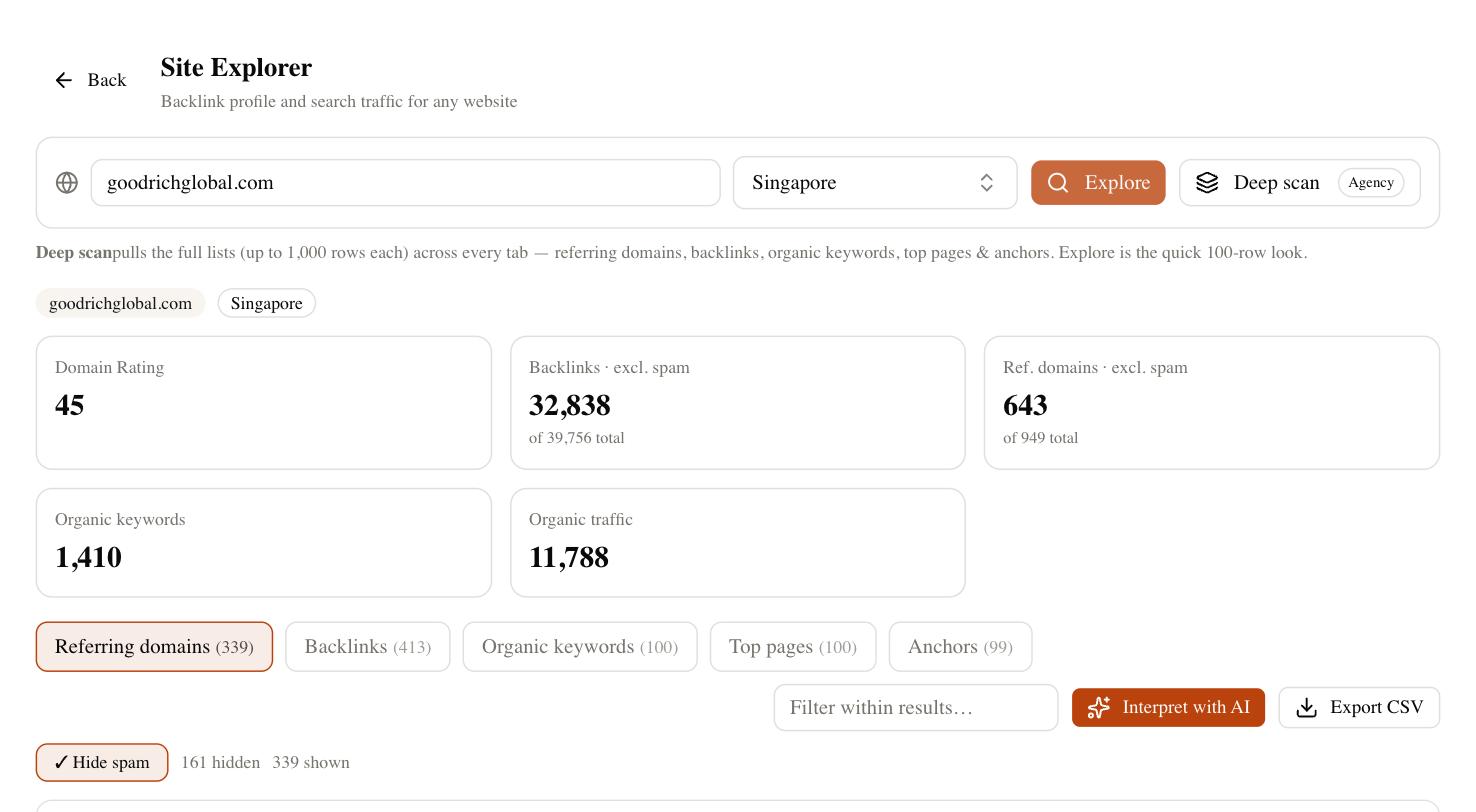
The part Serpstat can’t match is what happens after the lookup. SEO Rocket drafts the article with Claude and tracks whether your brand is being cited across ChatGPT, Perplexity, and Google’s AI Overviews through its Brand Radar feature — the AI-search visibility that no traditional suite answers yet. For consultants, the client-dashboard side means you hand over a read-only report without exporting anything. If your bottleneck is doing more with fewer subscriptions, that consolidation is the honest edge.
Who Serpstat is really for, and the verdict
Serpstat is a strong pick if you’re a freelancer, a small agency, or an in-house marketer who needs solid keyword research, rank tracking, and site audits at a price that won’t hurt — and who doesn’t lean heavily on backlink depth or need AI writing baked in. For that person, it covers the daily work well and saves real money against the premium suites.
It’s the wrong pick if backlinks are your whole world, in which case Ahrefs earns its higher price, or if you want AI content and AI-search visibility in the same tool, in which case an AI-native option fits better. Before you commit, run your own site and two competitors through the free or trial tier for a week. If it answers the three questions you actually ask most — what do I rank for, what are competitors doing, and where are my technical issues — then Serpstat is a genuinely good deal. If your week is deeper than that, spend the extra on the tool that matches it.