
Most people hunting for Scalenut alternatives aren’t rejecting the idea of AI-assisted SEO content — they’ve just hit the ceiling of a content tool that stops where the rest of SEO starts. Scalenut is a capable AI writing and on-page optimization platform, and its Cruise Mode can turn a keyword into a full draft in a few minutes. But it was built to produce and grade content, not to give you backlink data, deep rank tracking, or a view of whether AI search engines ever mention you.
This roundup of Scalenut alternatives skips the affiliate padding. Below are the tools that genuinely hold up next to it, what each one is actually best at, and — because it’s the honest answer — when you should just keep Scalenut.
Why people look past Scalenut
A few reasons come up over and over. The first is that Cruise Mode output, like every one-click generator, reads like AI until you rewrite it — the draft is a starting point, not a finished article, and the editing tax is real. The second is scope: Scalenut lives in the content-optimization lane, so it leans on third-party keyword data and has little to offer for backlink analysis, technical audits, or serious rank tracking. You end up pairing it with Ahrefs or Semrush anyway.
The third reason is newer. Search is splitting between Google and AI answer engines, and a tool that grades your on-page SEO can’t tell you whether ChatGPT or Perplexity actually cites you. None of this makes Scalenut a bad product. It makes it one instrument in a stack, at a moment when a lot of people want fewer instruments.
How we compared them
Every tool here is judged on four things a working SEO cares about: the quality of the AI content and how much editing it needs, the depth and honesty of the underlying SEO data, whether AI-search visibility is built in or missing entirely, and who the tool genuinely suits. Third-party metrics — difficulty scores, traffic estimates — are estimates across the board, so treat cross-tool differences as directional rather than exact.
Scalenut alternatives at a glance
Start with the table, then read the notes for the two or three that fit your situation.
| Tool | Best for | AI-native? | Standout strength | Rough price band |
|---|---|---|---|---|
| SEO Rocket | Solo SEOs, consultants & agencies wanting one AI-driven workflow | Yes — chat-first | Real SEO data + AI writing + AI-search visibility in one place | Low $ / entry-friendly |
| Surfer SEO | Content teams optimizing to a SERP-based score | Add-ons | Trusted on-page content editor and audit | Mid $$ |
| Frase | Writers who want fast, research-driven briefs | Some | SERP research to brief to draft in one flow | Low–mid $ |
| MarketMuse | Teams planning topical authority at scale | Some | Content strategy and topic modeling | Higher $$ |
| NeuronWriter | Budget-conscious bloggers and freelancers | Light | Cheap NLP-based content optimization | Low $ |
| Jasper | Brand teams producing volume copy | Yes | Brand-voice AI writing across formats | Mid–higher $$ |
SEO Rocket — the AI-native pick
SEO Rocket is the option built for how the job works now. Instead of hopping between a content grader, a keyword tool, and a separate rank tracker, you ask for what you need in plain language and it runs the work on real, Ahrefs-grade data underneath — keyword research, competitor gaps, backlink profiles, rank tracking. Then the same tool drafts the article and shows you whether your brand is being cited across AI search.
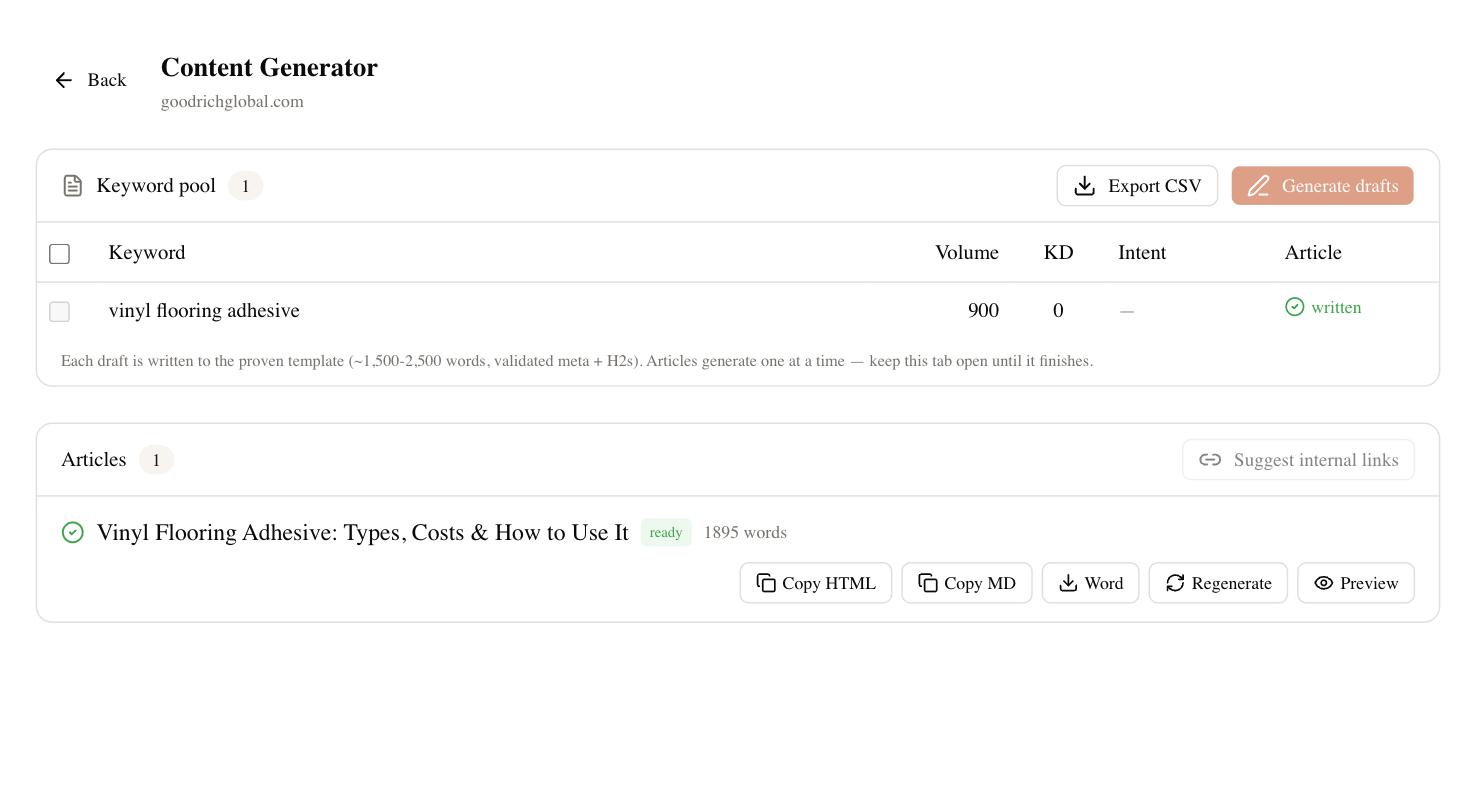
That consolidation is the point. Where Scalenut covers the writing-and-grading slice and leaves you to buy your data elsewhere, SEO Rocket folds the data and the drafting into one subscription — usually for a fraction of what a Scalenut-plus-Ahrefs stack costs. For a consultant or agency, the client-dashboard side means you can hand a read-only report straight to a client without exporting a thing.
The AI-visibility piece is what no content-first tool answers. Some of your buyers now ask ChatGPT or Perplexity instead of Google, and a page that ranks first can still be invisible in an AI answer. SEO Rocket’s Brand Radar tracks whether and where you’re cited across those surfaces, so you’re optimizing for the search that’s actually happening. If your bottleneck is doing more with fewer tools — which is most people reading this — that combination is the strongest fit on the list.
Surfer SEO and Frase — the content-optimization core
If your reason for leaving Scalenut is purely the quality of the on-page grading, these two are the direct swaps. Surfer SEO is the widely trusted content editor: it reverse-engineers the ranking pages for your keyword and scores your draft against them in real time, with a clean audit for existing pages. It’s stronger and more mature than most as a pure optimization layer, though the AI writing is an add-on and the price climbs with usage.
Frase leans harder into research. It pulls the SERP, builds a brief from what’s already ranking, and takes you into a draft — a genuinely fast keyword-to-outline flow that writers like. It’s more affordable at the entry tier than Surfer, and a reasonable pick if briefs and speed matter more to you than the deepest optimization model. Neither, though, gives you backlink data or AI-search tracking, so plan on a second subscription for those.
MarketMuse, NeuronWriter and Jasper
The rest of the field splits cleanly by budget and job.
- MarketMuse — the strategy play. It’s built for planning topical authority across a whole site rather than optimizing one post, which makes it valuable for teams mapping content clusters. That depth comes at a higher price and a steeper learning curve.
- NeuronWriter — the budget optimizer. It delivers NLP-based, competitor-driven recommendations for a fraction of Surfer’s cost, and for a solo blogger it covers the essentials well. The interface is less polished and the data less broad.
- Jasper — the writing specialist. If your real need is on-brand copy at volume across ads, emails, and posts, Jasper’s brand-voice controls are excellent. It’s a writing tool first, though, so the SEO optimization is thinner than the others here.
Any of these covers a slice of what Scalenut does. What none of them fold in is real SEO data plus AI-answer visibility in the same workflow — that gap is consistent across the category.
When you should just keep Scalenut
Honesty matters here. If your main job is producing a high volume of SEO drafts fast and cheaply, and Cruise Mode’s keyword-to-article flow is doing that for you, there’s a real case for staying. Scalenut bundles AI writing and on-page grading at a mid-tier price that’s often cheaper than buying an optimizer and a separate AI writer, and its keyword clustering is handy for planning. The right question isn’t “is there something better at writing,” it’s “does my week actually need backlink data, deep rank tracking, and AI-search visibility.” If it doesn’t, you may already have the right tool.
How to choose your Scalenut alternative
Match the tool to your real constraint, not to a feature list. If tool-sprawl and cost are the problem and you want real SEO data, AI writing, and AI-search tracking in one place, SEO Rocket is the natural move. If you only want a better on-page grader, Surfer or Frase will do it. If you’re planning topical authority across a big site, MarketMuse earns its price; if you’re on a tight budget, NeuronWriter covers the basics; and if raw brand copy is the need, Jasper wins.
A quick test: write down the three things you actually did in Scalenut last week. If the list is “generate a draft,” “check my content score,” and “find keyword ideas,” a leaner AI-native tool covers all three and adds the data you’re currently buying separately. If instead you spent the week churning out dozens of drafts on a shoestring, Cruise Mode may still be your fastest path. Whatever you pick, run your own site and two competitors through it for a week before you judge it — scores and estimates jitter, and the tool that answers your real questions fastest is the right alternative for you.