
If you’re weighing scalenut vs surfer seo, you’ve probably noticed they solve overlapping problems from opposite ends. Scalenut leans into AI writing first and optimization second; Surfer SEO built its name on data-driven on-page optimization and added AI writing later. Both are good. Which one wins for you depends entirely on how you actually spend your week.
This is a straight head-to-head — no fake winner, no padded feature list. Below you’ll get what each tool is genuinely built for, a real comparison across the dimensions that matter, a segment-by-segment verdict, and an honest note on where an AI-native option fits if neither feels quite right.
What each tool is really built for
Scalenut is an AI content platform. Its center of gravity is fast article production: you feed it a keyword, it pulls SERP data, builds an outline, and its “Cruise Mode” drafts a full long-form piece you then refine. Optimization — an NLP-driven content score, term coverage, heading and word-count targets — is baked in, but the pitch is speed from keyword to publishable draft.
Surfer SEO came at it from the other direction. It started as an on-page optimization engine: analyze the pages already ranking, reverse-engineer what they have in common, and score your draft against that in real time inside the Content Editor. Surfer later added a full-article AI writer and a keyword-research module, but its reputation still rests on being the sharpest instrument for making a page match what’s actually ranking.
Scalenut vs Surfer SEO at a glance
Read the table for the shape of it, then the verdicts below for the nuance. Price bands are approximate — both vendors change plans often, so treat these as tiers, not quotes.
| Dimension | Scalenut | Surfer SEO |
|---|---|---|
| Primary strength | AI-first content creation at speed | Data-driven on-page optimization |
| Full-article AI writer | Cruise Mode — included in the core workflow | Surfer AI — capable, typically billed as extra credits |
| Real-time content score | Yes, NLP term coverage | Yes — widely seen as the benchmark |
| SERP / competitor analysis | Solid, built into the writing flow | Deep SERP Analyzer with granular signals |
| Keyword research & clustering | Strong topic-cluster planner | Present, less of a focus |
| Existing-page audits | Available | Content Audit is a standout |
| Ease of use | Friendly for writers | Slight learning curve, rewards SEOs |
| Rough price band | Low–mid $$ | Mid–higher $$ |
| Best for | Content teams producing volume | SEOs optimizing to rank |
Content writing and AI: verdict
For sheer drafting throughput, Scalenut edges it. Cruise Mode is designed to walk you from keyword to a complete draft in one motion, and for teams publishing several pieces a week that momentum is the whole point. The output still needs a human editor — all AI drafts do — but Scalenut gets you to a working first draft faster and treats generation as the main event rather than an add-on.
Surfer AI is genuinely good and produces optimization-aware drafts, but it’s usually metered separately, so heavy generation adds up. Surfer’s writing feels like a feature that serves the optimizer; Scalenut’s optimizer feels like a feature that serves the writer. If your bottleneck is producing content, Scalenut is the more natural home. Verdict: Scalenut for volume drafting.
On-page optimization and SERP data: verdict
This is Surfer’s home turf, and it shows. The SERP Analyzer surfaces more granular signals, and the Content Editor’s real-time score is the one many SEOs trust most when the goal is to match a specific set of ranking pages. Surfer’s Content Audit is also the better tool for dragging an existing, underperforming page back up — it tells you precisely what to add, trim, or restructure.
Scalenut’s optimization is capable and perfectly usable, especially since it lives right next to the draft. But if your work is ranking-led — take this page, make it beat the current top ten — Surfer gives you sharper instrumentation. Verdict: Surfer SEO for optimization depth.
Keyword research and clustering: verdict
Scalenut’s topic-cluster planner is a quiet strength. It helps you map a pillar page plus its supporting articles and see the content architecture before you write a word, which is exactly how you build topical authority rather than a pile of disconnected posts. For anyone planning a content calendar around clusters, it’s the more strategic starting point.
Surfer has keyword research and it works, but it’s clearly the newer, secondary muscle rather than the reason people buy in. If planning and clustering drive your process, Scalenut has the edge; if you already know your targets and just need to optimize against them, the difference barely matters. Verdict: Scalenut for planning, a wash if you already have your keywords.
Pricing and who each suits: verdict
On headline price, Scalenut generally opens lower, and because generation is included rather than metered, a content team producing volume tends to find its total cost more predictable. Surfer sits a tier higher, and once you lean on Surfer AI for full articles the per-article credits push the real bill up further. Neither is expensive by enterprise standards, but they price for different buyers.
Choose Scalenut if you’re a content marketer, small team, or agency whose main job is producing optimized articles quickly and affordably. Choose Surfer SEO if you’re an SEO or agency whose job is making pages rank — auditing, matching the SERP, and squeezing out on-page gains — and you’ll pay the premium for that precision. Verdict: match the tool to your actual job, not the cheaper sticker.
Where SEO Rocket fits
Here’s the honest gap in this whole comparison: both tools are built for the search world of a few years ago. Neither gives you Ahrefs-grade backlink and keyword data, and neither tells you whether your brand shows up when a buyer asks ChatGPT, Perplexity, or Google’s AI Overviews instead of running a classic search. That second question is the one quietly reshaping traffic right now.
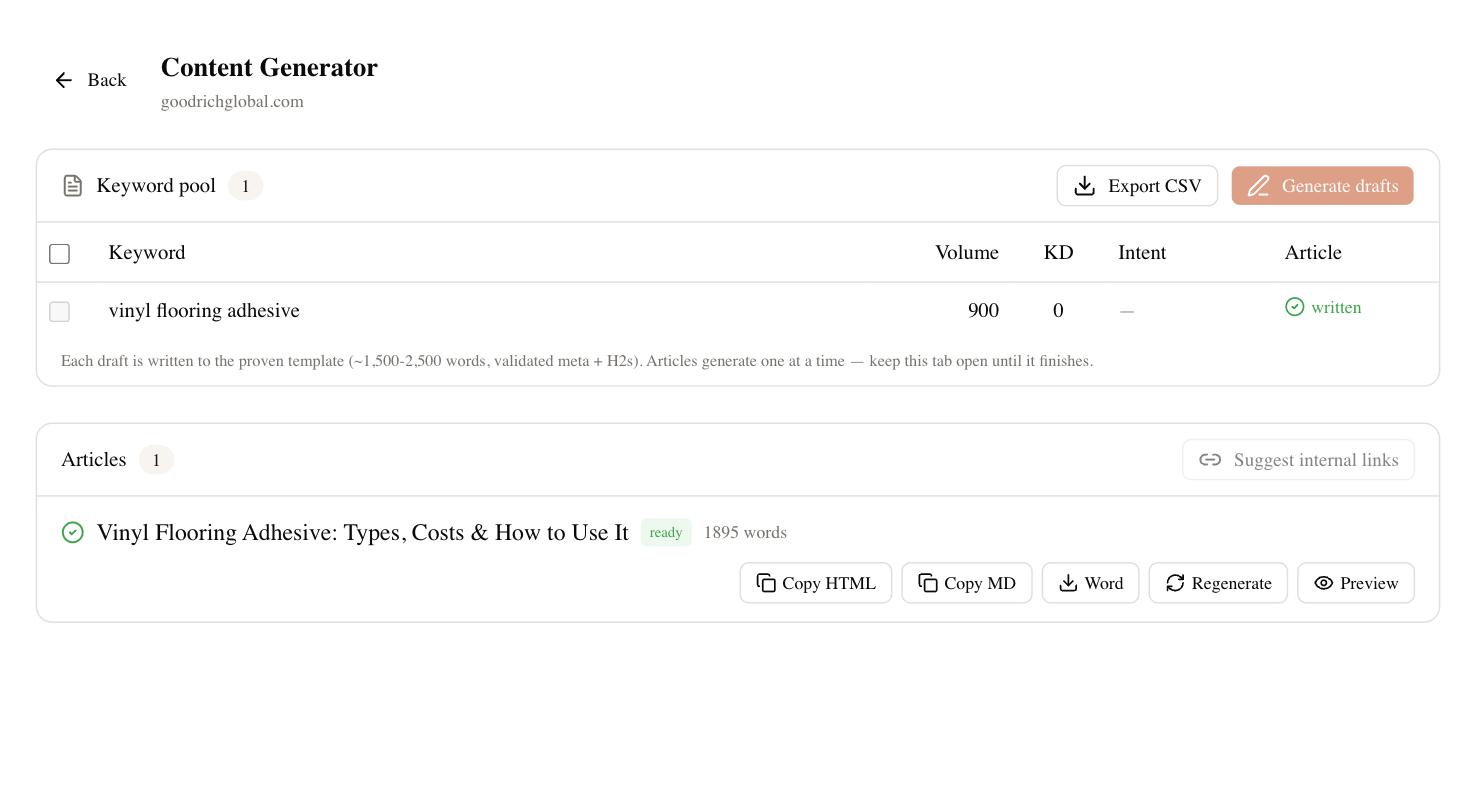
SEO Rocket is the AI-native option that folds those pieces into one chat-first workflow. You ask in plain language and it runs real keyword research, competitor gaps, backlink analysis, and rank tracking on Ahrefs-grade data — then drafts the article and shows you your visibility across AI search through Brand Radar. Instead of Scalenut for writing plus Surfer for optimizing plus a separate rank tracker plus an AI-visibility tool, it’s one subscription doing the whole loop. If your reason for comparing these two is really “I want fewer tools that do more,” SEO Rocket is worth a look before you commit.
How to choose
Strip it down to your Tuesday. If you spend it drafting — churning out articles that need to be decent and on-topic fast — Scalenut is the leaner fit and usually the cheaper one. If you spend it optimizing — auditing pages, chasing the top ten, matching the SERP signal by signal — Surfer SEO earns its higher tier. Write down the last five things you did in your SEO tool; whichever list you match is your answer.
And if that list is starting to include “check whether we rank in AI answers” or “pull real backlink data” or “stop paying for four overlapping tools,” neither of these will fully cover you, and an AI-native platform like SEO Rocket will. Whatever you pick, run your own site and two competitors through it for a week before you judge — content scores and traffic estimates are directional, not gospel, and the tool that answers your real questions fastest is the right one.