The short version of Writesonic vs SEO Rocket is that they start from opposite ends of the same problem. Writesonic began as an AI writing platform and grew outward toward SEO; SEO Rocket began as an SEO workflow built on real ranking data and grew AI writing into it. Both now claim to help you plan, write, and track content — but the thing each one does best still shows through, and it should decide which one you pay for.
This is not a takedown of Writesonic. It is a genuinely capable content engine, and for some teams it is the better buy. Below is where each tool is stronger, where it is weaker, and how to pick based on the work you actually do rather than the feature list you skim.
What each tool actually is
Writesonic is, at its core, a content generation platform. It grew up producing marketing copy — ads, product descriptions, blog drafts, social posts — across a large library of templates and a long list of languages, and it has since layered on SEO and AI-search features to keep pace with how content gets found now. If your bottleneck is producing a lot of copy in many formats, that heritage is a real advantage.
SEO Rocket is a chat-first SEO tool. You ask for what you need in plain language and it runs the lookup against real, Ahrefs-grade data underneath: keyword research, competitor gap analysis, backlink profiles, rank tracking, and site audits. The same chat then drafts the article and reports whether your brand is being cited across AI search surfaces. It is less a template library and more a single operator you brief.
Writesonic vs SEO Rocket at a glance
Read this as a map, not a verdict — the notes underneath explain where each row actually matters.
| Dimension | SEO Rocket | Writesonic |
|---|---|---|
| Core strength | AI-native SEO workflow on real data | High-volume AI content generation |
| Interface | Chat-first — you brief it in plain language | Templates, editor and dashboards |
| SEO data (keywords) | Ahrefs-grade index built in | Via integrations / lighter native depth |
| Backlink index depth | Solid, general-purpose | Not its focus |
| AI writing | Built in, data-informed | Deep — many formats and languages |
| AI-search visibility | Brand Radar across AI answers | Available in some plans |
| Rank tracking & site audit | Built in | Limited / add-on |
| Agency client dashboards | Yes — read-only client views | Team-oriented, less agency-native |
| Rough entry price band | Low $ / entry-friendly | Low $ (roughly $20–50/mo) |
Where Writesonic is genuinely stronger
Be honest about this before making the SEO Rocket case. If your job is producing large volumes of copy in many shapes — landing pages, ad variations, product blurbs, social captions, email sequences — Writesonic’s template breadth and format range are hard to beat. It has spent years tuning that exact task, and it shows in how quickly you can spin up ten variations of something.
Language coverage is another real edge. Writesonic supports a long list of languages out of the box, which matters if you publish across multiple markets. It also folds in adjacent tools like image generation and a chat assistant, so a team that wants one place for general content creation — not just SEO articles — gets more surface area for the money.
Where SEO Rocket pulls ahead
SEO Rocket’s advantage is that writing is downstream of real data, not separate from it. When you ask it to plan a piece, it is looking at what you actually rank for, where the ranking gap sits versus two named competitors, and which keywords carry real traffic — then it drafts against that. Writing without that grounding produces fluent copy that may target the wrong thing; the data-first order is the difference between output and results.
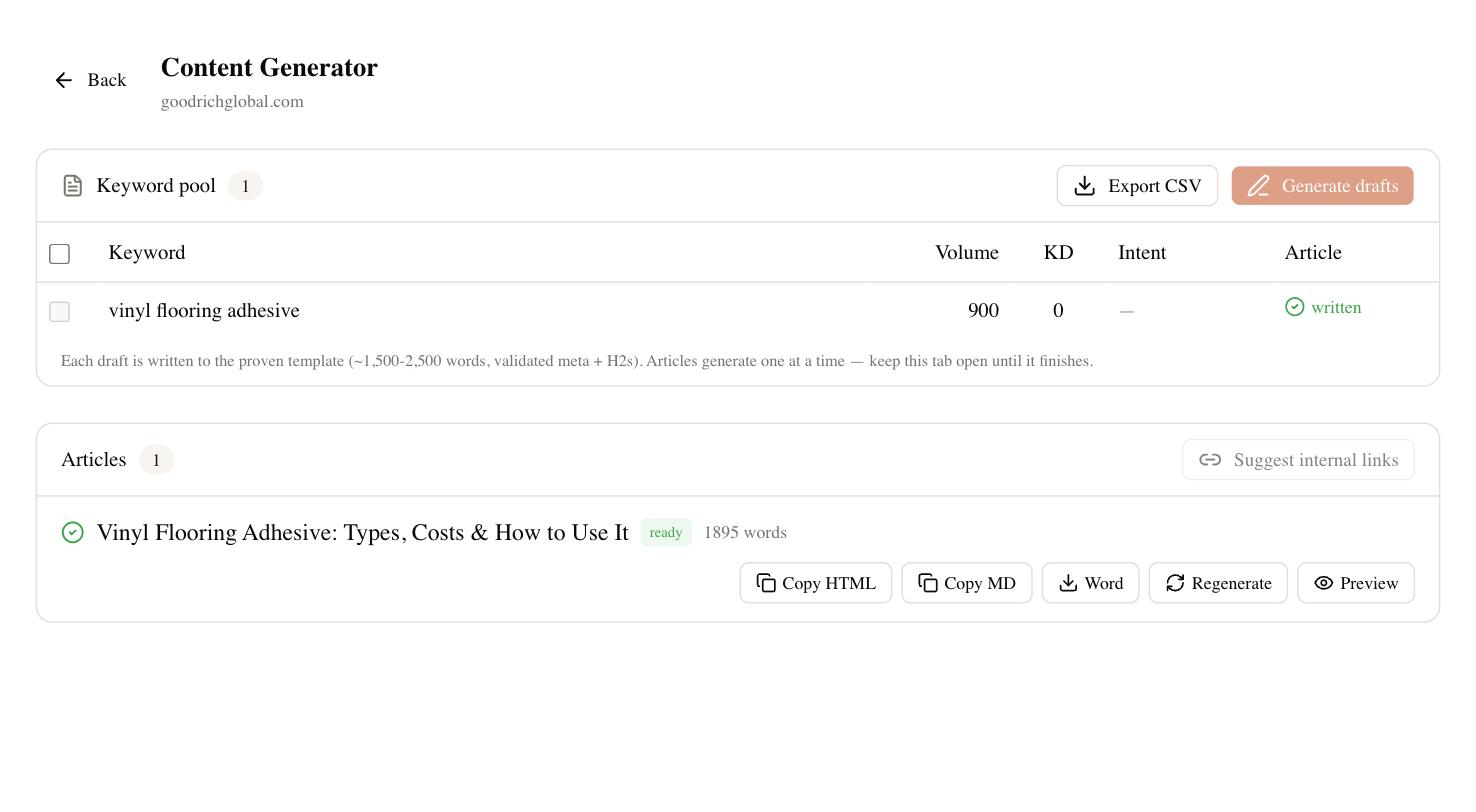
The chat-first interface is the other structural difference. Instead of moving between a keyword tool, a separate writer, a rank tracker, and a dashboard, you brief one system and it runs the whole chain. That consolidation replaces a stack — a data tool plus an AI writer plus a visibility tracker — with a single subscription, and for consultants the read-only client dashboards mean you can hand a report straight to a client without exporting anything.
Then there is AI-search visibility, the part most writing tools still treat as an afterthought. Some of your buyers now ask ChatGPT, Perplexity, or Google’s AI Overviews instead of typing a query and scrolling. A page that ranks first can be invisible in an AI answer. SEO Rocket’s Brand Radar tracks whether — and where — you are being cited across those surfaces, so you optimize for the search that is actually happening.
Data quality: the real dividing line
This is where the comparison stops being about features and starts being about foundations. SEO Rocket runs on an Ahrefs-grade keyword and traffic index, so the numbers behind a recommendation are the same class you would trust from a dedicated SEO platform. Writesonic pulls SEO data too, but data has never been its center of gravity — it is a writing tool that reaches for numbers, not a data tool that also writes.
For content that has to compete in search, that ordering matters. A keyword suggestion is only as useful as the volume and difficulty estimate behind it, and a competitor gap is only actionable if the underlying index is deep and fresh. Treat every third-party metric as an estimate regardless of tool — domain and traffic figures are directional, not gospel — but the depth and recency of the index still separate a guess from a plan.
Pricing and total cost
Headline prices are close enough that they should not decide this. Both sit in entry-friendly territory — Writesonic’s starter tiers run roughly $20–50 a month depending on usage, and SEO Rocket’s entry pricing is comparable. The honest cost comparison is not the sticker; it is the stack.
If you buy Writesonic mainly for writing, you will likely still pay for a separate SEO data tool and possibly a separate AI-visibility tracker to cover what it does not. If you buy SEO Rocket, the data, the writing, the rank tracking, and the visibility live in one place, so the second and third subscriptions fall away. Add those up before comparing line items — a cheaper writer that forces two more tools is not cheaper.
Which one should you choose?
Match the tool to your actual constraint. If your week is dominated by producing high volumes of varied copy across many formats and languages — and SEO is one input among several — Writesonic earns its place and will feel faster for that job. It is a better content factory.
If your week is closer to “check what I rank for, see what a competitor is doing, and publish a piece that has a real shot at ranking,” then SEO Rocket fits the way you work. The data-first, chat-driven flow plus built-in rank tracking, competitor gap, site audit, and AI-search visibility covers the whole cycle without a second login. A quick test: write down the three things you did in your content tool last week. If they were mostly writing tasks, lean Writesonic; if they were mostly SEO tasks that ended in writing, lean SEO Rocket. Run your own site and two competitors through whichever you pick for a full ranking cycle before you judge it — positions jitter a few spots day to day, and the tool that answers your real questions fastest is the right one for you.