The Ahrefs vs Semrush debate rarely has a clean answer, because the two tools were built to win different arguments. Ahrefs started as a backlink index and grew outward; Semrush started as a competitive-research and paid-search platform and grew into SEO. Both are excellent, both are expensive, and the right pick depends far more on how you actually spend your week than on which one tops a feature-count chart.
This is a working comparison, not a spec sheet. Below you’ll see how the two stack up on the four dimensions that decide the bill and the day-to-day experience — data quality, ease, AI features, and price — followed by a segment-by-segment verdict and an honest look at where a newer, AI-native option fits.
Ahrefs vs Semrush at a glance
Strip away the marketing and these are two different philosophies. Ahrefs is a specialist’s instrument: deep, fast, and unusually good at anything touching backlinks and keyword data. It assumes you know what you’re doing and gets out of your way. Semrush is a marketing platform that happens to include a strong SEO toolkit — it also covers PPC research, social scheduling, PR monitoring, and content workflows under one login. That framing matters because most “which is better” arguments are really “which shape of work do you have.” A link builder and a full-funnel marketing manager should not buy the same tool.
Start with the summary, then read the sections below for the two or three rows that apply to you. Price bands are deliberately rough — both vendors change plans often, and the headline number is never the real number once you add seats and usage.
| Dimension | Ahrefs | Semrush |
|---|---|---|
| Core strength | Backlink index & keyword data | All-in-one marketing suite |
| Data quality | Deepest, freshest link data | Largest keyword database, strong PPC data |
| Ease of use | Dense but fast once learned | Broad; steeper because there’s more of it |
| AI features | Limited, mostly assistive | More AI content and SEO add-ons |
| Best for | Link builders, technical SEOs, consultants | Marketing teams wanting one login for everything |
| Rough price band | Entry plans roughly $100–150/mo | Entry plans roughly $130–150/mo, more with add-ons |
Data quality: a near tie, split by specialty
This is the closest fight, and it ends in a split decision. Ahrefs still runs one of the largest and freshest backlink indexes in the industry — if your work involves link audits, disavow files, or watching competitors build links, Ahrefs surfaces new and lost referring domains faster and in more detail. Its crawler is aggressive, so the link graph feels current.
Semrush answers with breadth. Its keyword database is enormous, its paid-search and advertising data is genuinely better than Ahrefs’, and its competitive traffic estimates draw on a wider clickstream. For keyword discovery and PPC intelligence, Semrush often gives you more to work with. Remember that every third-party metric here — domain rating, authority score, traffic estimates — is a model, not a measurement. When the two tools disagree on a number, treat the gap as directional, and benchmark your target against the weakest site already ranking on page one rather than an intimidating average.
Ease of use: dense versus sprawling
Neither tool is simple, but they’re hard in different ways. Ahrefs is dense — a lot of power packed into a few screens. The learning curve is steep for a week, then it disappears, and experienced users move through it quickly. Most people never touch more than a fifth of it, which is fine.
Semrush is sprawling rather than dense. There’s simply more of it, so the challenge is knowing which of the dozens of tools you actually need. For a solo SEO that breadth is noise; for a marketing team splitting SEO, ads, and social across people, it’s the whole point. If a clean, focused interface is what you want, Ahrefs feels tidier day to day.
AI features: both playing catch-up
Honesty first: neither of these tools was born for the AI era, and it shows. Semrush has moved faster on paper, bolting on AI writing assistants, a content toolkit, and features aimed at AI-search visibility. Ahrefs has stayed more conservative, adding assistive AI in spots but keeping its core focused on data.
The deeper issue is architectural. Both tools treat AI content and AI-search visibility as add-ons stacked onto a platform designed for a Google-only world. That works, but it rarely feels like one workflow — you’re still exporting data, pasting it into a writer, and checking a separate report to see whether ChatGPT or Perplexity ever mentions your brand. If AI is central to how you plan to work, this is the dimension where a purpose-built tool pulls ahead of both incumbents.
Price: expensive in different shapes
Both are premium products, and the honest comparison is total cost, not the entry price. Ahrefs entry plans run roughly $100–150 a month, with credits that burn quickly on a busy account and per-seat costs that add up for agencies. Semrush entry plans land in a similar range, but the features that justify buying it — extra users, historical data, the content and PPC add-ons — push the real bill higher.
The practical rule: Ahrefs tends to be cheaper if you only want deep SEO data, while Semrush costs more but replaces several separate marketing subscriptions. If you’d otherwise pay for a rank tracker, a PPC tool, and a social scheduler, Semrush’s price starts to look reasonable. If you just want backlinks and keywords, you’re overpaying for a suite you won’t open.
The verdict, segment by segment
There’s no single winner in Ahrefs vs Semrush — there’s a winner for each kind of user. Match yourself to the closest row:
- Link builders and technical SEOs — Ahrefs. The link index depth and crawl freshness are hard to beat, and the focused interface suits specialists.
- Full-funnel marketing teams — Semrush. One login for SEO, PPC, social, and PR earns its higher price when several people share it.
- Keyword and PPC research — Semrush, narrowly, for database size and ad data.
- Consultants who want speed and clean data — Ahrefs, unless you also need the marketing breadth.
- Anyone whose work now revolves around AI content and AI search — neither is a natural fit, which is the honest answer.
The AI-native third option worth a look
If that last bullet is you, it’s worth seeing the category from a different starting point. SEO Rocket was built AI-first rather than retrofitted: you ask for what you need in plain language and it runs the lookup — keyword research, competitor gaps, backlink profiles, rank tracking — on real, Ahrefs-grade data underneath.
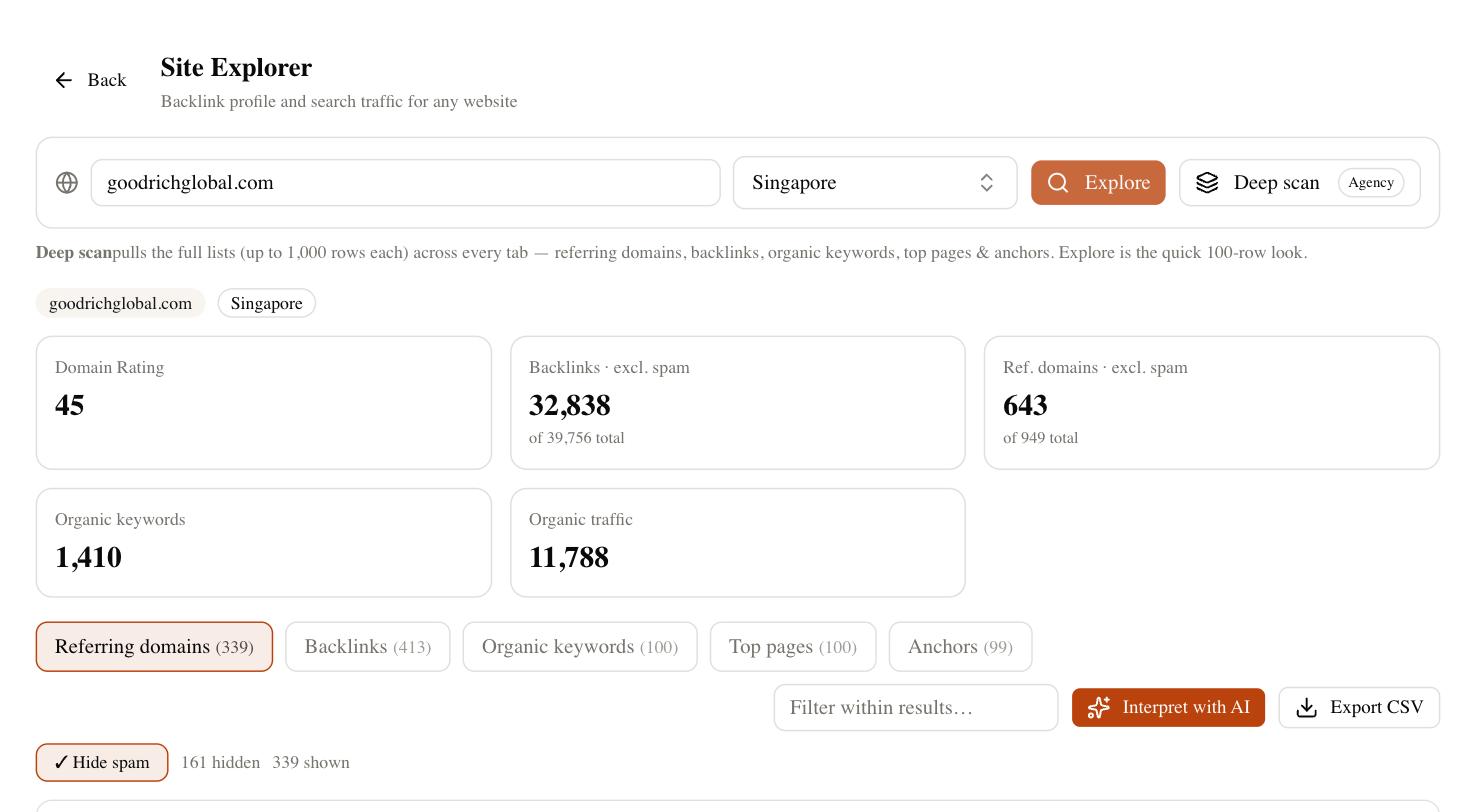
The difference is what happens next. The same tool drafts the article with Claude and shows you whether your brand is being cited in ChatGPT, Perplexity, and Google’s AI Overviews through its Brand Radar view — the question neither incumbent answers cleanly. For consultants and agencies, the client dashboards mean you hand a read-only report straight to a client without exporting anything. It won’t out-index Ahrefs on raw backlink depth, and a large marketing team may still want Semrush’s full channel spread. But if your real bottleneck is doing more with fewer tools, it consolidates a three-subscription stack into one.
How to choose today
Skip the feature checklist and write down the three tasks you actually did in your SEO tool last week. If they were link audits and competitor backlink checks, buy Ahrefs. If they spanned SEO, ads, and content across a team, buy Semrush. If they were “find keywords, draft a page, and see if AI mentions me,” look at an AI-native tool before you renew either. Whatever you pick, run your own site and two competitors through it for a full week — rankings jitter a few spots day to day, and the tool that answers your real questions fastest is the one that wins your particular version of Ahrefs vs Semrush.