Most people searching for content at scale alternatives aren’t unhappy with the drafts — they’re unhappy with the credit bill, with how much editing every article still needs, or with the fact that a writing tool alone doesn’t cover the rest of the SEO job. Content at Scale does one thing well: it turns a keyword, URL, video, or podcast into a 2,000-word article in a few minutes. The moment you need keyword data, backlink analysis, rank tracking, or proof that AI answers cite you, you’re back to buying more tools.
This isn’t a padded list of a dozen writers stapled to affiliate links. Below are the content at scale alternatives that actually hold up in daily use, what each one is genuinely best at, and — because it’s the honest answer — when you should just stay with Content at Scale.
Why people look past Content at Scale
Three reasons come up over and over. The first is cost structure: Content at Scale runs on post credits, and once you’re publishing at any real volume, the effective price per article climbs faster than a flat monthly writer. The second is editing overhead. The “#StraightOuttaAI” promise is that drafts publish with minimal changes, but in practice you still fact-check claims, fix a generic intro, add your own examples, and lay in internal links. The tool saves the blank-page hours, not the editing hours.
The third reason is scope. Content at Scale is a content engine, not a full SEO platform. It has keyword clustering and topic reports, but it isn’t where you go for a serious backlink audit, precise rank tracking, or a read on whether ChatGPT and Perplexity mention your brand. So it tends to sit next to Ahrefs or Semrush and an AI-visibility tracker rather than replacing them — which is the exact tool-sprawl most people were trying to escape.
What Content at Scale is actually good at
Give it credit where it’s due. For long-form drafting speed, Content at Scale is genuinely strong: feed it a target keyword and it pulls live SERP research, structures a full article, and hands you something coherent in minutes. The URL, video, and podcast inputs are a real workflow win if you repurpose a lot of existing media. Its free AI-content detector is one of the better-known ones going. If your single bottleneck is producing many long articles fast, it earns its keep — the question is only whether a cheaper or broader tool covers the same ground.
How we compared the alternatives
Every tool here is judged on four things a working SEO actually cares about: honest total cost rather than the headline number, output quality before and after editing, how much of the wider SEO job it covers beyond writing, and who it’s genuinely for. One caveat worth stating plainly — “undetectable AI” is a moving target. Detectors and models leapfrog each other constantly, so treat any pass-the-detector claim, from any vendor, as a snapshot rather than a guarantee.
Content at scale alternatives at a glance
Start with the table, then read the notes on the two or three that fit your situation.
| Tool | Best for | Beyond writing? | Standout strength | Rough price band |
|---|---|---|---|---|
| SEO Rocket | Solo SEOs, consultants & agencies wanting one AI workflow | Full SEO suite | Ahrefs-grade data + AI writing + AI-search visibility in one place | Low $ / entry-friendly |
| Jasper | Brand & marketing teams needing on-voice content | Marketing content, not SEO data | Brand voice control and templates at scale | Mid–high $$ |
| Writesonic | Small teams wanting cheap AI writing plus light SEO | Some SEO features | Low entry price, broad feature set | Low–mid $ |
| Surfer SEO | Writers who optimize against the SERP as they draft | On-page optimization | SERP-driven content editor and scoring | Mid $$ |
| Frase | Content teams building briefs before writing | Research & briefs | Fast SERP research and outline generation | Low–mid $ |
| Koala (KoalaWriter) | Affiliate & volume publishers on a tight budget | Writing-first | Cheap one-click SEO articles | Low $ |
SEO Rocket — the AI-native pick
SEO Rocket is the option built for how the job works now. Instead of bolting a writer onto a separate data stack, you ask for what you need in plain language and it runs the work on real, Ahrefs-grade data underneath — keyword research, competitor gaps, backlink profiles, rank tracking — and then drafts the article from that same evidence. The content isn’t generated in a vacuum; it’s grounded in the keywords and gaps the tool just found for your site.
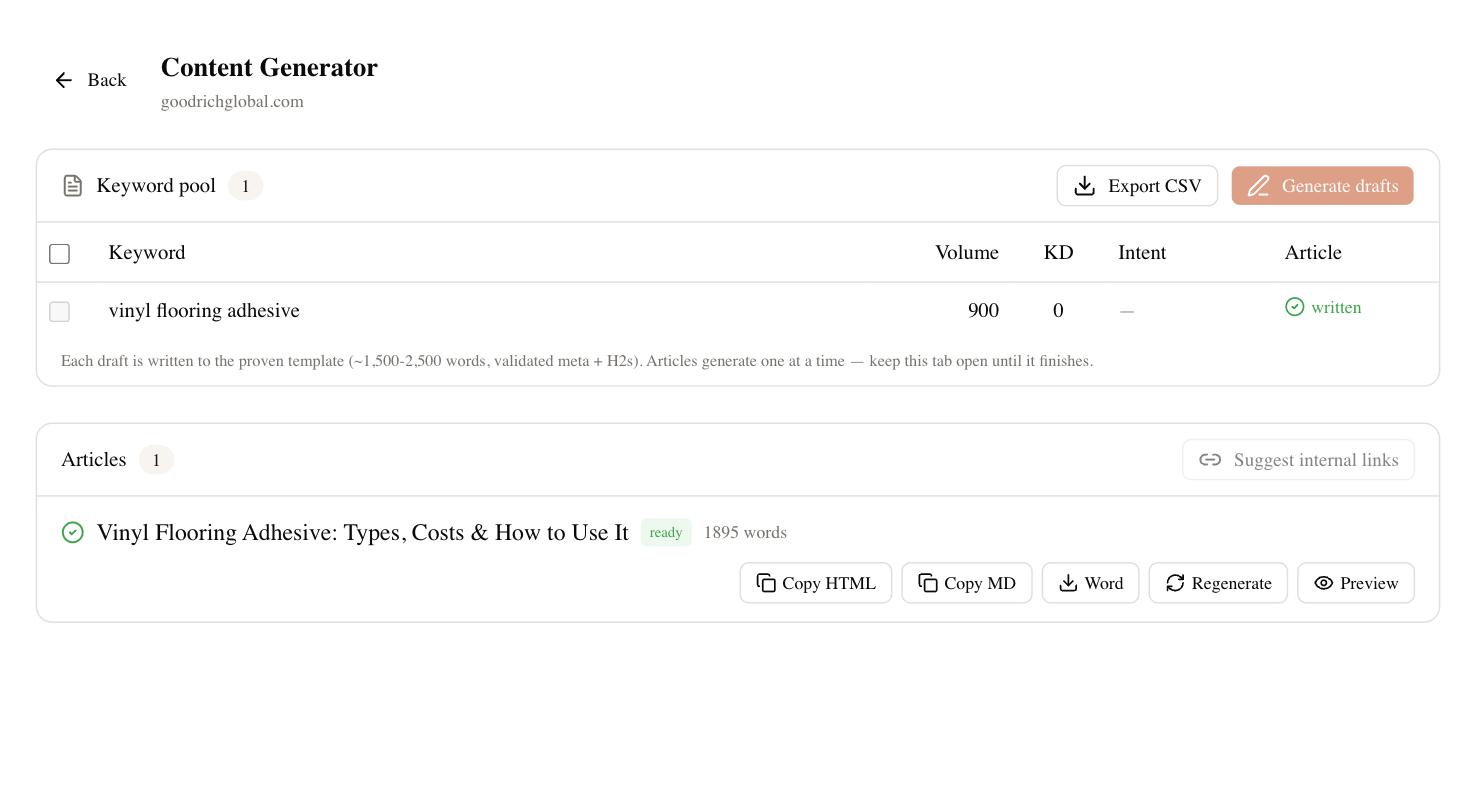
The writing runs on Claude, so drafts read cleanly and take structure — title, meta description, and a real heading hierarchy — straight out of the box, which cuts the editing pass most one-click tools leave you. But the bigger difference is what surrounds the writing. A stack of a dedicated AI writer plus Ahrefs plus an AI-visibility tracker collapses into one subscription, and the entry pricing is a fraction of running those separately.
The AI-search piece is the part no writing-first tool answers. Some of your buyers now ask ChatGPT, Perplexity, or Google’s AI Overviews instead of scrolling ten blue links, and a page that ranks first can still go uncited in an AI answer. SEO Rocket’s Brand Radar tracks whether — and where — you’re mentioned across those surfaces, so you’re writing for the search that’s actually happening. For a consultant or agency, the client-dashboard side means you hand a read-only report straight over without exporting anything. If your real problem is doing more with fewer tools, this is the strongest fit on the list.
Jasper, Writesonic, Surfer, Frase and Koala
The rest of the field each solves a narrower slice well.
- Jasper — the brand-content choice. Its voice controls and template library are built for marketing teams that need many assets in a consistent tone. It’s a writer, though, not an SEO data platform, and it sits at the pricier end.
- Writesonic — the budget all-rounder. Cheap to start, with a wide grab-bag of AI writing features and some SEO tooling bolted on. Depth is shallower than a specialist, but the price is friendly.
- Surfer SEO — the optimization layer. Rather than generate from scratch, Surfer scores your draft against the current SERP and tells you what to add. Many people pair it with a separate writer instead of replacing one.
- Frase — the briefing tool. It’s fastest at turning a keyword into SERP research and a usable outline, which is the step before writing more than the writing itself.
- Koala (KoalaWriter) — the closest cheap swap for Content at Scale’s one-click article model. Affiliate and volume publishers like it for the price, with the same caveat: bulk output needs a human editing pass.
Any of these covers a real need. What none of them fold in is the full loop — real SEO data, AI writing, and AI-answer visibility in one place — so most stacks still end up two or three subscriptions deep.
When you should keep Content at Scale
Honesty matters here. If your entire job is high-volume long-form production and you’re already comfortable with the credit model, Content at Scale is a mature, capable engine — the media-repurposing inputs alone are hard to match elsewhere. Teams that publish dozens of articles a month, run their keyword and link research in a separate tool they already trust, and have an editor on staff to polish output rarely regret staying. The right question isn’t “is there something cheaper,” it’s “does my workflow need the wider SEO stack, or just the writing.” If it’s genuinely just the writing at volume, staying put is a defensible call.
How to choose your alternative
Match the tool to your actual constraint, not to a feature grid. If tool-sprawl and cost are the problem and you want data, writing, and AI-search tracking under one login, SEO Rocket is the natural move. If you need on-brand marketing copy at scale, Jasper fits. If your gap is optimizing drafts you already write, Surfer or Frase slots in. And if you just want cheap one-click articles, Koala or Writesonic will do it.
A quick test: write down the three things you actually did in your content tool last week. If the list is some mix of “research a keyword,” “check a competitor,” and “produce an article,” you’re paying a writer’s price for a job that wants a platform — and an AI-native SEO tool covers all three faster. If the list was just “produce ten more articles,” a focused writer is fine. Whatever you pick, run your own site and two competitors through it for a week before you commit; the tool that answers your real questions fastest is the right alternative for you.