
The ChatGPT vs Jasper question usually comes up when a marketing team already pays for one and starts wondering if the other would do more. Both write content with AI, both are good at it, and both cost real money once you add seats. But they are not the same kind of product, and the honest answer to ChatGPT vs Jasper depends almost entirely on who is doing the writing and how much structure they need around it.
This is a practical head-to-head, not a feature dump. You will get what each tool genuinely does well, a side-by-side table on the dimensions that matter, a verdict by use case, and — because neither one is actually an SEO tool — where a purpose-built SEO platform fits into the picture.
What ChatGPT is really good at
ChatGPT is a general-purpose AI assistant from OpenAI. It is a blank canvas: you talk to it, and it drafts, edits, brainstorms, summarizes, codes, and reasons through problems. Nothing about it is marketing-specific, which is both its strength and its limitation. The paid individual tier sits in the low tens of dollars per month, with higher per-seat bands for team and enterprise plans, and there is a usable free tier.
For flexibility and raw quality, it is hard to beat. Custom instructions let you set a persistent tone, uploaded files give it context, and the newer models reason well enough to handle long, messy prompts. If you are a strong writer who wants a fast, cheap thinking partner, ChatGPT is often all you need. The catch is that everything depends on your prompting. There is no built-in brand library, no team workflow, and no guardrails to stop five writers producing five different voices.
What Jasper is built for
Jasper is a marketing-first AI platform. Where ChatGPT hands you an empty box, Jasper wraps the same kind of underlying models in structure aimed at marketing teams: reusable brand voices, a knowledge base for your products and style rules, campaign and template workflows, and collaboration features so a whole team stays on-message. It routes across multiple foundation models under the hood rather than betting on one.
That structure is the product. For a content team producing dozens of assets a week across email, ads, and landing pages, Jasper’s brand-voice consistency and templates save real time and reduce the review burden. Pricing reflects the extra layer — entry plans typically run in a higher band than a ChatGPT subscription, and business tiers are custom-quoted. You are paying for the workflow scaffolding, not for a smarter model.
ChatGPT vs Jasper: side by side
Here is how the two line up on the things a working team actually weighs. Treat the price bands as directional — both vendors change tiers often.
| Dimension | ChatGPT | Jasper |
|---|---|---|
| Core purpose | General-purpose AI assistant | Marketing-specific content platform |
| Brand voice | Manual, via custom instructions | Built-in, reusable across the team |
| Templates & workflows | None native — you prompt from scratch | Campaign templates and structured flows |
| Team collaboration | Basic on team plans | Core strength — shared assets and voices |
| Flexibility | Very high — does far more than marketing | Focused on marketing use cases |
| SEO data | None | Limited; leans on integrations |
| Rough price band | Low $ per user | Mid–high $$ per user |
| Best for | Individuals and strong writers | Marketing teams needing consistency |
Segment-by-segment: who wins what
Do not look for a single winner here, because there isn’t one. For a solo marketer, consultant, or founder writing most of the content yourself, ChatGPT wins on value almost every time. It is cheaper, more flexible, and a capable writer can steer it anywhere. You will spend a little more effort on prompting, but you keep that budget.
For a team, the verdict flips. When five people are producing content that all has to sound like one brand, Jasper’s reusable voices, shared knowledge base, and templates earn their higher price by cutting revision cycles and keeping output consistent. That governance is exactly what ChatGPT leaves to you. If your bottleneck is coordination rather than raw writing, recommend Jasper without hesitation.
On pure output quality for a single well-crafted piece, the two are closer than the price gap suggests — both draw on strong foundation models, so a skilled prompter gets excellent results from either. The difference is not the sentence Jasper produces; it is the system around producing a thousand sentences a month on-brand.
The gap neither one fills: SEO
Here is the trap in the whole comparison. Both tools help you write, but writing is the middle of the SEO job, not the start or the end. Neither ChatGPT nor Jasper tells you which keywords are worth targeting, what your competitors already rank for, where your backlink gaps are, or whether a published page actually moved in the results. You can ask ChatGPT for keyword ideas, but it is guessing from training data, not reading a live index.
And there is a newer blind spot both share: AI-search visibility. Buyers increasingly ask ChatGPT, Perplexity, and Google’s AI Overviews instead of scrolling a results page, and a piece that reads beautifully can still never get cited in those answers. A writing tool cannot see that, because it has no data layer underneath. So the real stack for most teams ends up being a writer plus a separate SEO tool plus a third thing to track AI mentions — three subscriptions doing one job.
SEO Rocket — the AI-native SEO option
SEO Rocket collapses that stack. It is a chat-first SEO tool: you ask for what you need in plain language, and it runs the lookup on real, Ahrefs-grade data underneath — keyword research, competitor gaps, backlink profiles, and rank tracking. The same tool then drafts the content with Claude and, crucially, shows you whether your brand is being cited across ChatGPT, Perplexity, and Google AI Overviews through its Brand Radar visibility view.
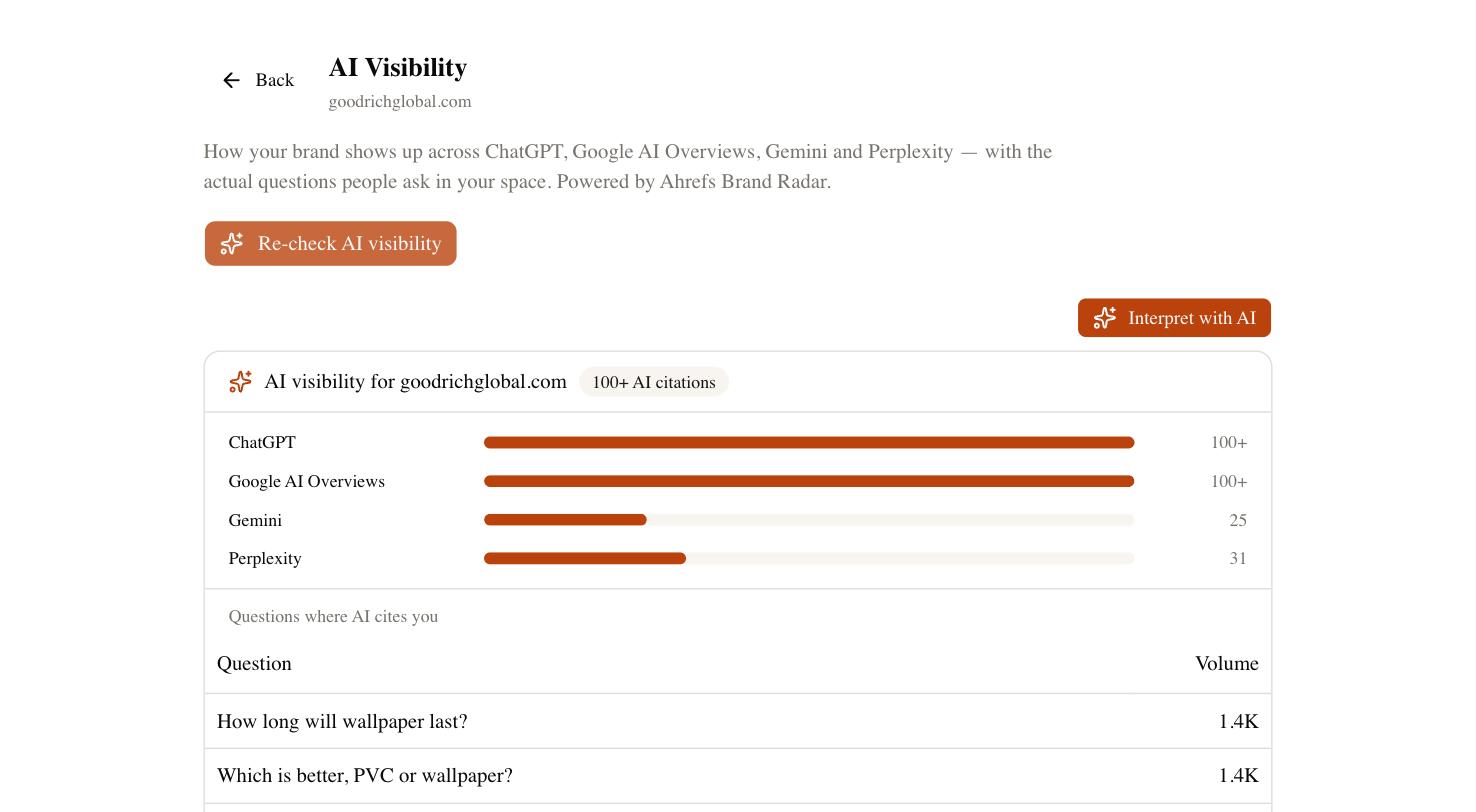
The point is not that SEO Rocket writes better prose than ChatGPT or Jasper — it uses a top-tier model just like they do. The point is that it writes with data in the loop: it knows what to write about because it can see the keyword and competitor picture, and it knows whether the piece worked because it tracks both classic rankings and AI-answer citations. If your reason for comparing writers in the first place was to move search results, that missing data layer is the thing actually holding you back.
How to choose
Start from your real constraint, not the feature lists. If you are a strong individual writer who wants a cheap, flexible AI partner, ChatGPT is the honest pick and you can stop there. If you run a content team that lives or dies on brand consistency and repeatable campaigns, Jasper’s structure is worth its higher band — pay for the workflow, not the model.
But if the reason you are producing content at all is to win search — and you keep hitting the wall where a great draft still doesn’t rank or get cited by an AI answer — then the writer was never your missing piece. You need keyword and competitor data feeding the draft and visibility tracking behind it, which is where an AI-native SEO platform like SEO Rocket does the job neither ChatGPT nor Jasper was built for. Pick the tool that matches the outcome you are actually chasing, and be honest about which part of the job is really slowing you down.