Most roundups of the best AI writing tools are really lists of whoever pays the biggest affiliate commission. This one isn’t. Below are the tools that actually earn their keep in daily content work, what each is genuinely best at, and where it falls short — because the best AI writing tools for a solo SEO are rarely the same ones a 40-person marketing team should buy.
One thing to settle up front: raw text generation is now a solved, cheap commodity. Any of these will produce a clean draft. What separates them is everything around the draft — brand voice control, SEO data, research, fact-checking, and whether the tool fits the actual job you do all week. That is what the comparison below is built on.
How we compared them
Each tool was judged on four things a working writer or marketer cares about: the quality and steerability of the output, whether SEO and research are built in or left to you, honest cost including the tier you’d realistically need, and who the tool genuinely suits. Price is shown as a band, not a headline number, because plans change and per-seat costs add up fast once a team gets involved.
One more caveat worth stating plainly: no tool here removes the need to edit. AI drafts are a strong first pass, not a finished page. Every one of these can produce a confident sentence that is simply wrong, so the human check matters as much as the model. The right tool shortens the distance from idea to publishable draft — it doesn’t erase your judgment.
The best AI writing tools at a glance
Skim the table, then read the notes on the two or three that match your situation. There is no single winner here — there’s a right pick for your workflow.
| Tool | Best for | Standout strength | Rough price band |
|---|---|---|---|
| SEO Rocket | SEOs, consultants & agencies who write to rank | Ahrefs-grade SEO data, Claude-powered drafting and AI-search visibility in one chat | Low $ / entry-friendly |
| Jasper | Brand and marketing teams at scale | Brand voice controls, campaign workflows, team governance | Higher $$ |
| Copy.ai | Sales & marketing go-to-market copy | Prompt-chained workflows for repeatable output | Low–mid $ |
| Writesonic | High-volume blog and SEO articles on a budget | SEO-aware long-form article generator | Low–mid $ |
| Surfer SEO | Optimizing existing drafts to rank | SERP-based on-page scoring inside the editor | Mid $$ |
| Frase | Research and content briefs | Fast SERP research and outline building | Low $ |
| ChatGPT & Claude | Flexible, general-purpose drafting | Best raw model quality, near-zero learning curve | Low $ |
SEO Rocket — writing that’s wired to the data
SEO Rocket is built for people who write content to rank, not just to publish. Most AI writers hand you polished prose with no idea whether the topic has demand, what competitors already cover, or which keywords are winnable. SEO Rocket closes that loop: you ask in plain language, it pulls Ahrefs-grade keyword and competitor data, then drafts the piece with Claude against what the SERP actually rewards — all in one chat instead of three browser tabs.
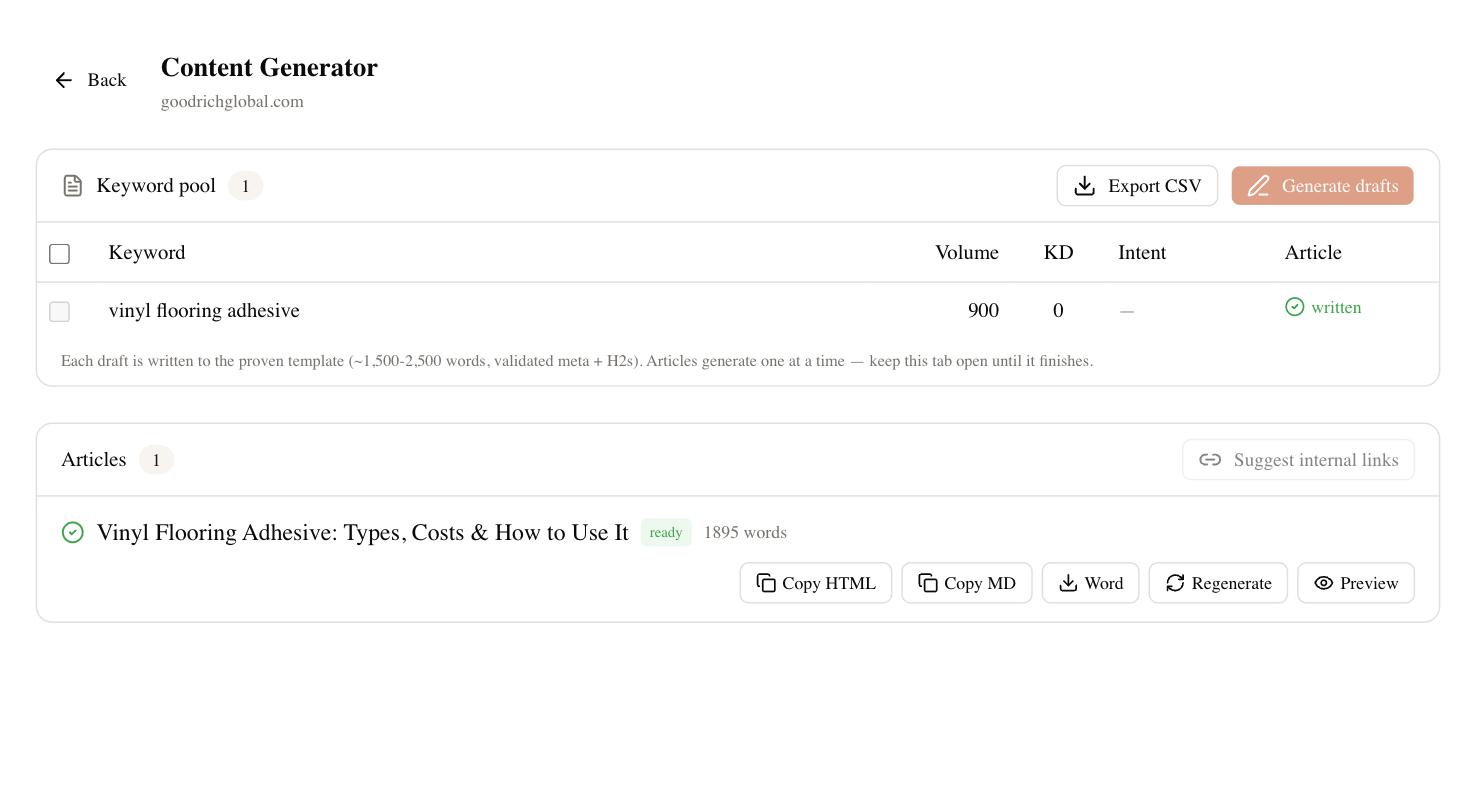
The part no traditional writer touches is AI-search visibility. Some of your buyers now ask ChatGPT or Perplexity instead of Google, and a page that ranks first can still go unmentioned in an AI answer. SEO Rocket’s Brand Radar tracks whether you’re cited across those surfaces, so you’re writing for the search that’s actually happening. If your bottleneck is doing research, drafting, and rank tracking with fewer tools, this is the strongest fit on the list. If you only need marketing copy and never touch SEO, a lighter tool below will serve you better and cheaper.
Jasper — the team and brand pick
Jasper is the most mature option for larger marketing teams. Its real value isn’t the drafting — it’s the guardrails around it: reusable brand voices, tone controls, campaign templates, and the governance that keeps twenty people producing on-message copy. For an in-house team that ships across email, ads, landing pages, and social every week, that consistency is worth paying for.
The trade-off is price and scope. Jasper sits at the higher end, and per-seat costs climb quickly. If you’re a solo writer or a two-person shop, you’ll pay for a lot of enterprise scaffolding you never use. SEO is also thinner than a dedicated tool — you can integrate it, but it isn’t the core.
Copy.ai and Writesonic — volume and workflows
These two win on throughput. Copy.ai leans into prompt-chained workflows, so a repeatable job — turning a product list into a hundred descriptions, or a call transcript into follow-up emails — becomes a one-click process. It’s a favorite of sales and go-to-market teams that need the same output shape again and again.
Writesonic tilts more toward SEO blog content, with a long-form article flow that folds in keyword targeting and a competitive read on the topic. For a small team that publishes a lot of articles and watches its budget, it’s a sensible middle ground. Neither matches a specialist SEO platform on data depth, but both cover core writing needs at a friendly price. If you already know your keywords and just need clean volume, either one gets you there without a steep bill.
Surfer SEO and Frase — optimize and research
Not every tool needs to write the whole draft. Surfer SEO and Frase both earn a place by doing one thing well.
- Surfer SEO — the on-page optimizer. Paste a draft and it scores it against the pages already ranking, suggesting terms, structure, and length to close the gap. It’s an editor’s tool, not a blank-page tool, and pairs naturally with whatever writes your first draft.
- Frase — the research and brief builder. It pulls the top-ranking pages for a query, summarizes what they cover, and turns that into an outline fast. Great for handing a writer a solid, evidence-backed brief before a word is written.
Both are affordable and both are honest about their lane. What neither does is track AI-search visibility or write with your keyword and backlink data already in context — so they tend to sit alongside another tool rather than replace it.
ChatGPT and Claude — the raw engines
Sometimes the best answer is the underlying model itself. ChatGPT and Claude produce the strongest general-purpose prose on this list, cost little for an individual plan, and have essentially no learning curve. For flexible, one-off writing — a pitch, an essay, a rewrite — they’re hard to beat.
What you give up is structure. There’s no SEO scoring, no brand-voice library your team shares, no research pulled from live SERP data, and no memory of your keyword targets between sessions. You supply all of that in the prompt, every time. For a disciplined writer that’s freedom; for a team that needs repeatable, on-brand, search-optimized output, the bare model quietly becomes a lot of manual work.
How to choose the right tool
Match the tool to your real constraint, not to a feature list. If you write to rank and you’re tired of juggling a data tool, a writer, and an AI-visibility tracker, SEO Rocket folds all three into one workflow. If you’re a brand team that needs voice consistency across many channels, Jasper earns its price. If you churn out high-volume copy or repeatable assets, Copy.ai or Writesonic will keep pace for less. Need only optimization or research? Surfer and Frase do those jobs cleanly. And if you just want a smart, flexible drafting partner, ChatGPT or Claude are cheap and excellent.
A quick test: write down the three writing tasks you actually did last week. If they were “research a topic, draft an article, and check what I rank for,” you want a tool that connects all three rather than three subscriptions stitched together. If they were “write ten ad variations” or “polish a draft I already have,” a narrower, cheaper tool is the smarter buy. Most of these offer a trial — run one real piece of your own work through your shortlist before you commit. The best writing tool is the one that fits how you actually spend your Tuesday, not the one with the longest feature page.