
Most roundups of the best AI tools for bloggers are affiliate lists dressed up as advice — twelve tools, every one a “game-changer,” no mention of what any of them get wrong. This isn’t that. Below are the tools that actually earn a spot in a blogger’s week, what each one is genuinely best at, and where a cheaper or simpler option beats the flashy one.
The catch with the best AI tools for bloggers is that “AI writing” and “ranking” are two different jobs. A tool can draft beautiful prose that never ranks, or nail on-page SEO while producing copy you’d be embarrassed to publish. The picks here are sorted by which job they do well, so you can build a stack that covers both without paying for four subscriptions.
What makes an AI tool actually worth it for a blogger
Three things separate a tool you keep from one you cancel in a month. First, does it start from real search data — what people actually query and what already ranks — or does it just generate text from a prompt? Generic drafts read fine and rank for nothing. Second, how much editing does the output need before it’s publishable? A tool that saves an hour of drafting but costs an hour of cleanup is a wash. Third, honest total cost: the headline price, plus every add-on you’ll quietly need to make it useful.
Keep one thing in mind throughout. AI speeds up the parts of blogging that are mechanical — outlines, first drafts, meta descriptions, on-page checks. It does not replace a point of view. The blogs that win with these tools use them to publish more of their own thinking, not to flood a site with copy no human would choose to read. Google’s helpful-content signals reward exactly the thing generic AI output lacks, so the tools that pull ahead are the ones that hand you a strong starting point and then get out of your way.
One practical note on budget. Almost every tool here has a free tier or a trial, and you should use them in that order: prove a tool earns its place on your real posts before you commit to an annual plan. Blogging tool costs creep — a writer here, an optimizer there, a rank tracker on top — and the moment your stack costs more than the traffic it earns, something has to consolidate.
The best AI tools for bloggers at a glance
Start with the table, then read the notes on the two or three that fit how you actually work.
| Tool | Best for | Standout strength | Rough price band |
|---|---|---|---|
| SEO Rocket | Bloggers who want research, writing, and rank tracking in one place | Ahrefs-grade data + AI drafting + AI-search visibility, chat-first | Low $ / entry-friendly |
| Jasper | Brand-led blogs that need a consistent voice at volume | Polished long-form and reusable brand-voice profiles | Mid–higher $$ |
| Surfer SEO | Writers optimizing a draft against the live SERP | Real-time on-page scoring versus ranking pages | Mid $$ |
| Frase | Researching and outlining before you write | Fast SERP research and AI content briefs | Low–mid $ |
| Grammarly | Anyone publishing without an editor | Clean, reliable proofreading and tone checks | Free / low $ |
| Writesonic | High-volume drafting on a tight budget | Cheap, fast first drafts and short-form copy | Low $ |
| Rank Math | WordPress bloggers handling their own on-page SEO | Free on-page guidance built into the editor | Free / low $ |
SEO Rocket — the all-in-one, AI-native pick
SEO Rocket is the option built for how blogging works now, when research, writing, and tracking used to mean three logins. Instead of a wall of tabs, you ask for what you need in plain language — “what should I write about coffee subscriptions,” “draft this post,” “am I ranking yet” — and it runs the lookup on real, Ahrefs-grade data underneath. The keyword volumes and competitor gaps aren’t guesses from a language model; they come from an actual index.
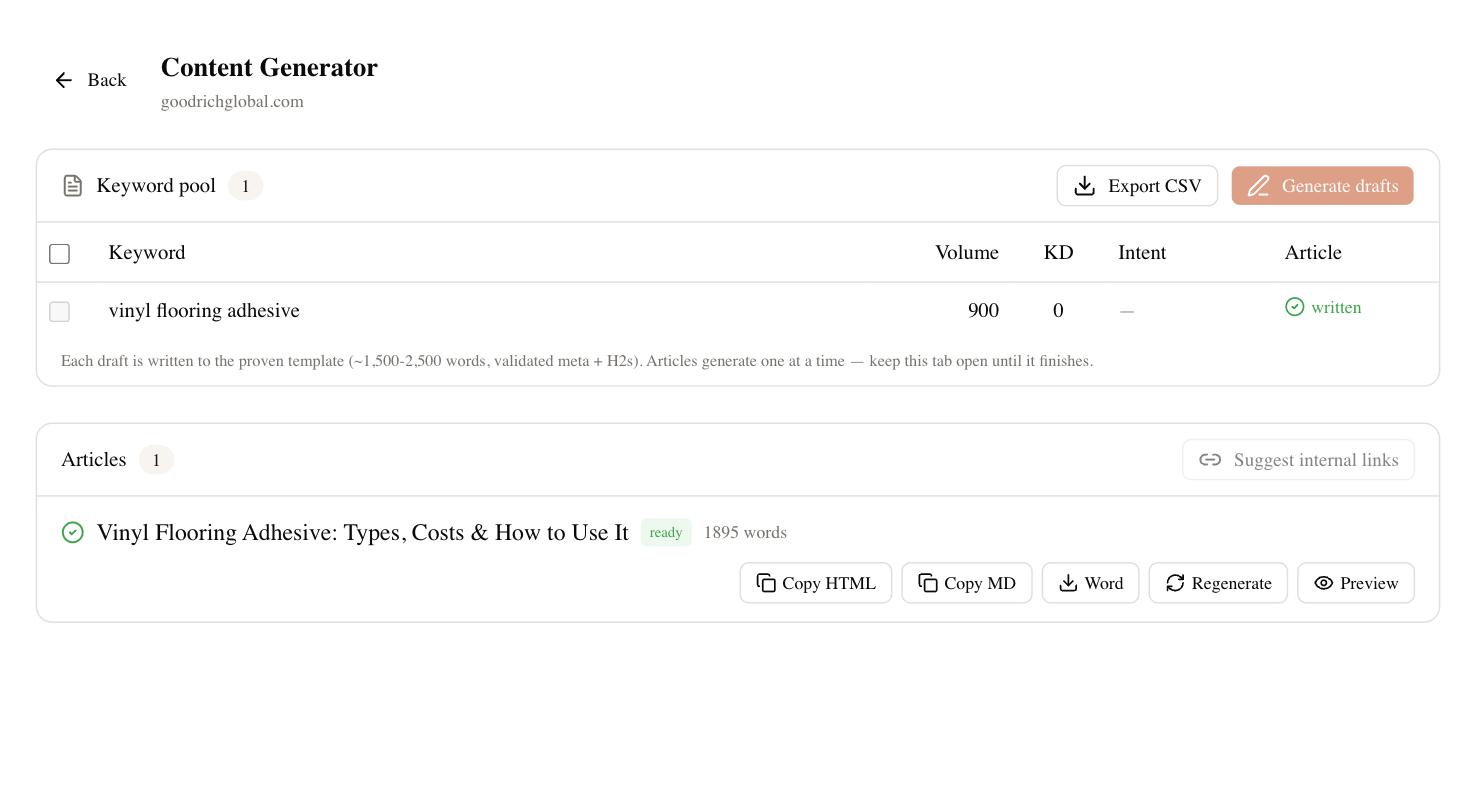
The part that sets it apart is what happens after the draft. Most writing tools stop at the text. SEO Rocket also tracks whether your posts are climbing in Google and — through its Brand Radar feature — whether your blog gets cited when someone asks ChatGPT, Perplexity, or Google’s AI Overviews. That last piece matters more every month, because a growing share of readers now get answers from an AI instead of clicking a blue link, and a post that ranks first can still be invisible in an AI summary. For a blogger whose real constraint is doing more with fewer tools, folding research, drafting, rank tracking, and AI-visibility into one chat-first subscription is the strongest fit on this list, and the entry pricing sits well below a typical data-tool-plus-AI-writer stack.
Jasper, Surfer, and Frase — the writing and optimization core
If your bottleneck is the writing itself, these three cover it from different angles.
- Jasper is the polished long-form pick. Its brand-voice profiles keep tone consistent across dozens of posts, which is genuinely useful for a blog with a distinct personality or a small team publishing under one name. It’s priced for businesses, though — if you’re a solo blogger writing a few posts a month, you’ll pay for capacity you don’t use.
- Surfer SEO isn’t a writer so much as an on-page coach. You paste a draft and it scores it against the pages currently ranking, flagging terms and structure you’re missing. It’s excellent at the last mile before publishing. It won’t do your keyword research or track rankings, so treat it as one layer, not a full stack.
- Frase shines earlier in the process. It pulls the top-ranking results for a query, summarizes what they cover, and builds a brief you can write from. For research and outlining on a modest budget, it’s one of the better values going, and its own AI writer is fine for filling in sections once the brief is solid.
None of these three tracks whether you actually rank afterward, and none touches AI-search visibility. That’s the gap a combined tool fills — but if you already have a data source you trust, any of them slots cleanly into your workflow.
Grammarly, Writesonic, and Rank Math — editing, drafting, and WordPress SEO
The rest of a practical blogging stack is cheaper and more specialized.
Grammarly is the one almost everyone should run. If you publish without an editor, its proofreading catches the typos and clumsy sentences that quietly cost credibility, and the free tier covers most bloggers. It’s a safety net, not a content engine — don’t expect it to help you rank. Writesonic is the budget drafting workhorse: fast first drafts and short-form copy for very little, at the cost of more editing to make the output sound like you rather than like a template. And Rank Math, for WordPress users, bakes on-page SEO guidance straight into the editor — title, meta, keyword placement, readability — mostly for free. It’s the least glamorous tool here and one of the most quietly useful.
A note on where these smaller tools stop. Grammarly won’t tell you whether a topic is worth writing, Writesonic won’t tell you if the draft ranks, and Rank Math scores your on-page work without knowing what your competitors are doing. Each is excellent inside its lane and blind outside it. That’s fine — a good stack is a few sharp specialists, not one bloated do-everything app you only half-use. The trap is buying three overlapping writers and no way to measure results.
How to choose the best AI tool for your blog
Match the tool to your real constraint, not to a feature list. Write down the three things you actually spent time on last week. If it was some mix of “figure out what to write,” “get a draft down,” and “check if last month’s posts are working,” you’re describing an all-in-one job, and SEO Rocket covers it in one place. If the writing is your only pain and you have data elsewhere, pair Frase for briefs with Surfer for optimization, or lean on Jasper if voice consistency at volume is the priority. If you just need cleaner copy and free WordPress on-page help, Grammarly and Rank Math will carry you a long way for almost nothing.
Whatever you pick, give it a fair trial before you judge it. Run three real posts through the tool end to end, publish them, and watch a full ranking cycle — positions jitter a few spots day to day, so a week of movement tells you nothing. The best AI tool for your blog is the one that makes your Tuesday faster and your posts better, not the one with the longest feature page. Most bloggers over-buy on writing horsepower and under-invest in knowing whether any of it ranks. Fix that balance first, and the shortlist above gets a lot shorter.