If you’re hunting for the best AI detectors, you’re usually trying to answer one nervous question: was this text written by a person or a machine? The best AI detectors give you a probability score, highlight the suspicious sentences, and — the good ones — check for plagiarism in the same pass. What none of them give you is certainty, and that caveat matters before you spend a dollar.
Detection is probabilistic, not forensic. Every tool below can flag human writing as AI and wave AI writing through as human, especially on short passages or lightly edited drafts. So treat these as risk gauges, not lie detectors. Here are the ones that hold up best in daily use, what each is genuinely for, and where a free option is the honest call.
What an AI detector actually does (and where it fails)
An AI detector is a trained classifier. It reads statistical fingerprints in your text — how predictable each word is, how much the sentence length varies — and estimates the odds a language model produced it. That’s a useful signal, but it’s a signal, not a verdict. The failure modes are consistent across every vendor.
Two problems come up again and again. The first is false positives: plainly written, non-native, or heavily templated human text can score as “likely AI,” which has real consequences when a grade or a paycheck rides on it. The second is that “humanizer” tools and a few minutes of genuine editing defeat most detectors, so a determined user gets a clean score anyway. Short samples under a couple hundred words are close to a coin flip. Keep that in mind whenever a tool hands you a confident-looking percentage.
There’s also a moving-target problem worth naming. New models write with more variation than the ones these classifiers were originally trained on, so detection accuracy drifts every time a major model ships. Vendors retrain to keep up, which means the tool that scored best last quarter may not lead this one. That churn is another reason to lean on your own judgment rather than any single automated reading.
How we compared them
Each tool here was judged on four things that actually matter in a working day: accuracy on mixed, real-world text rather than obvious ChatGPT dumps; whether plagiarism checking is bundled or a separate purchase; honest cost, including free tiers and pay-as-you-go credits; and who the tool is truly built for. One warning on accuracy — no vendor publishes independent, reproducible benchmarks, and every marketing page quotes a number that flatters its own model. Treat all accuracy claims, including the ones you’ll read elsewhere, as directional.
The best detectors at a glance
Start with the table, then read the notes on the two or three that fit your situation. Prices are bands, not quotes — check each site for the current number.
| Tool | Best for | Standout strength | Rough price band |
|---|---|---|---|
| SEO Rocket | Writing content you won’t need to hide from a detector | AI drafting on real SEO data — editor-ready, not spun filler | Low $ / entry-friendly |
| Originality.ai | Content marketers, publishers & agencies | AI detection plus plagiarism, fact-check and readability in one | Low $ / pay-as-you-go credits |
| GPTZero | Teachers and individual writers | Sentence-level highlighting, generous free tier | Freemium / low $ |
| Copyleaks | Enterprises and institutions | Multilingual detection, LMS integrations, solid API | Mid $$ / credit-based |
| Winston AI | Educators and web publishers | OCR for scanned work, plagiarism bundled | Freemium / low–mid $ |
| Turnitin | Schools and universities | Built into existing academic-integrity workflows | Institutional licensing only |
| ZeroGPT | Quick, no-login spot checks | Free and instant for a fast gut check | Free / low $ |
SEO Rocket — for content you won’t need to hide
SEO Rocket is the odd one on this list, and it’s fair to say so up front: it is not a detector, and it will not hand you a pass-or-fail percentage. It’s the tool on the other side of the problem — the AI writer people are usually running detectors against in the first place. It earns the top spot because the durable answer to “will this get flagged” isn’t a cat-and-mouse humanizer, it’s producing content genuinely worth publishing.
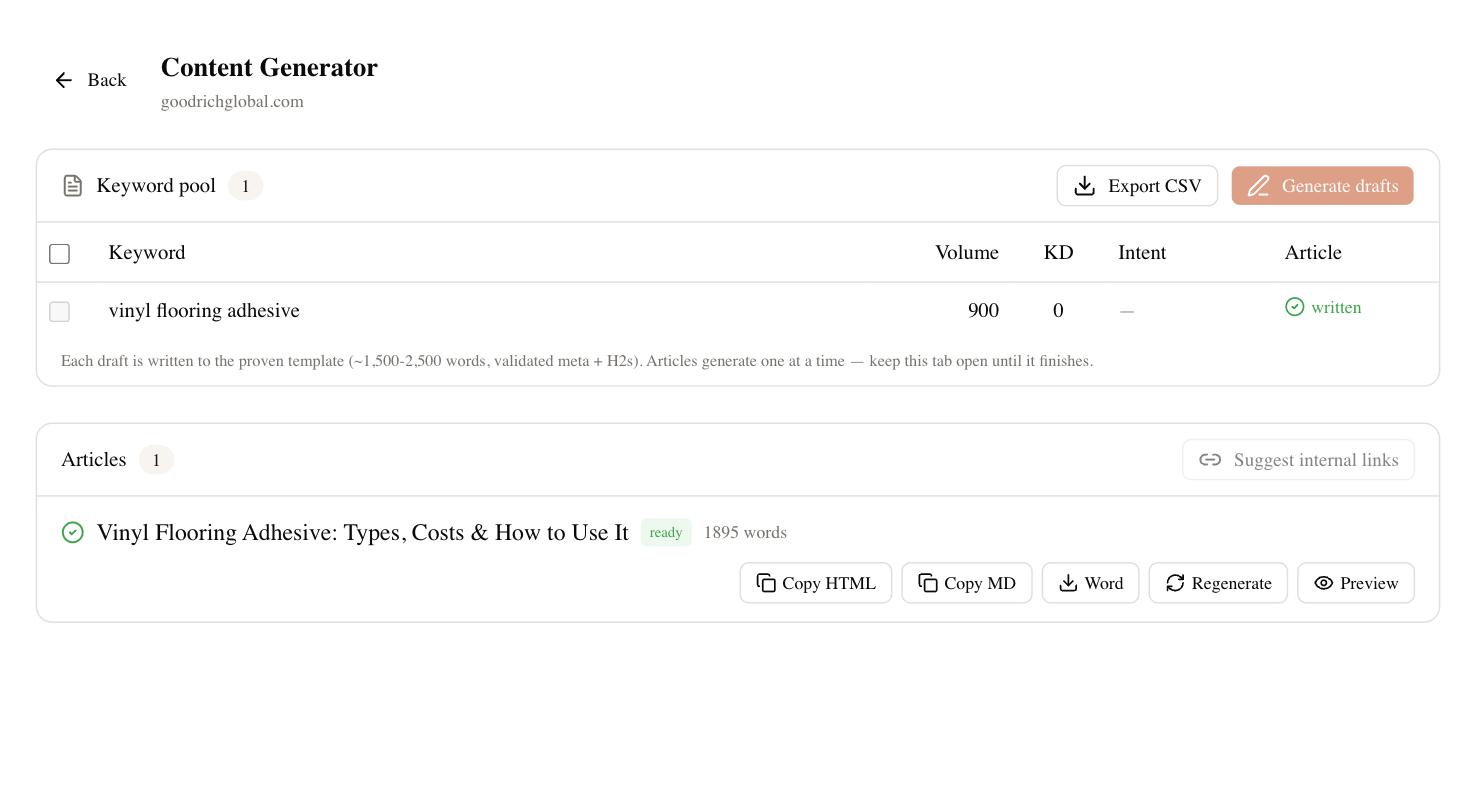
Here’s the practical difference. SEO Rocket drafts in a chat-first workflow on top of real, Ahrefs-grade search data, so an article comes out grounded in actual keywords, competitor gaps, and search intent rather than the generic, low-variance prose that trips detectors hardest. You then edit it in your own voice — the step most people skip when they paste straight from a raw model. Content built and refined that way tends to read as human because a human genuinely shaped it. Pair it with any detector below if you need a number for a client, but the point is to not need one.
It won’t help a student trying to sneak a machine-written essay past Turnitin, and it shouldn’t. For marketers, consultants, and agencies who want AI to speed up real work without leaving a spun-content smell, it’s the strongest fit here — and the entry pricing sits well below a stack of separate writing and detection tools.
Originality.ai — the publisher’s pick
If you want a detector built for content marketing rather than the classroom, Originality.ai is the one most agencies settle on. It rolls AI detection, plagiarism checking, a fact-check pass, and readability scoring into a single scan, which is exactly the batch a publisher wants before a freelancer’s draft goes live. The team dashboard and pay-as-you-go credits make it easy to vet a pile of articles without committing to a heavy subscription.
The honest trade-off is the same one that haunts the whole category: it’s tuned aggressively, so it catches more AI but also produces more false positives on plain human writing. Use it to open a conversation with a writer, not to fire one on a single red score.
GPTZero, Copyleaks, Winston AI and Turnitin
The rest of the field splits cleanly by who you are.
- GPTZero — the individual’s default. It made its name in education, highlights suspect text sentence by sentence, and has a free tier that covers casual checks. If you just need to eyeball the occasional document, start here before you pay for anything.
- Copyleaks — the enterprise workhorse. Strong multilingual detection, LMS and workflow integrations, and a proper API make it the pick when detection has to run at scale or plug into existing systems. You pay mid-market rates for that reach.
- Winston AI — the educator-and-publisher hybrid. It bundles plagiarism, handles scanned documents through OCR, and keeps a usable free entry point, which suits teachers dealing with handwritten or printed submissions.
- Turnitin — the academic incumbent. Its AI-writing signal lives inside the plagiarism workflow schools already run, so it’s only sold through institutions, not to individuals. If your work touches academia, this is the one that actually matters — and the one to write for.
Any of these will give you a defensible score. None of them escapes the core limitation, so don’t treat a single reading as proof of anything.
How to choose the right AI detector
Match the tool to your role, not to a leaderboard. If you’re vetting freelance or agency content, Originality.ai’s all-in-one scan saves the most time. If you’re a teacher or a solo writer, GPTZero’s free tier probably covers you. If detection has to run across a big organization or many languages, Copyleaks earns its price, and inside a school Turnitin is simply where the decision already lives. For a fast, free gut check with nothing on the line, ZeroGPT does the job.
One rule protects you no matter which you pick: never act on a single score. Run the same passage twice, run it through a second tool, and remember that a “98% AI” flag on a real person’s honest writing is a well-documented outcome, not a bug you’ve uniquely avoided. The best AI detectors narrow uncertainty; they don’t remove it, and anyone selling you certainty is overselling.
And if the reason you’re here is that your own AI-assisted content keeps tripping alarms, the fix usually isn’t a better disguise — it’s better source material and a real editing pass. Write from actual data, shape it in your own words, and the detector question mostly answers itself. That’s the workflow SEO Rocket is built around, and it’s a more durable strategy than staying one step ahead of a classifier that gets retrained every few months.