
Most people who go looking for an anyword review already have ChatGPT open in another tab and are wondering what a paid tool adds on top. That is the right question, and this anyword review answers it plainly: Anyword is not a better generic writer, it is a performance-copy platform that tries to predict which version of your marketing message will actually convert before you ship it.
That framing matters, because it decides whether Anyword is worth the money for you. If you write ads, landing pages, and email subject lines and you care about conversion rate, it earns its keep. If your real job is ranking in Google and showing up in AI answers, you are looking at the wrong category of tool. Here is what it does well, where it falls short, and who should actually buy it.
What Anyword actually is
Anyword is an AI content platform built around marketing performance rather than raw text generation. You feed it a channel, an audience, and a goal, and it produces copy for ads, product descriptions, landing pages, emails, social posts, and blog drafts. The output looks a lot like what you would get from any capable model, with one difference that runs through the whole product: every variation comes with a predicted performance score.
Around that core sit the features that justify the subscription. Content Intelligence checks your existing pages against A/B-test data. A Brand Voice system stores your tone, audience profiles, and messaging rules so output stays on-brand across a team. There is a Blog Wizard for longer content, a Chrome extension, and API access for teams that want to bake performance prediction into their own tools. It is a mature product, not a weekend wrapper.
The Predictive Performance Score
The signature feature is the Predictive Performance Score. Instead of leaving you to guess which of five headlines is strongest, Anyword scores each one against a model trained on marketing data, so you can pick the variant most likely to perform for a given channel and audience. For a paid-ads team running dozens of variations a week, that is a genuine shortcut, and it is the one thing no general chatbot offers.
Be honest with yourself about what the score is, though. It is a directional estimate, not a promise. The model is trained on aggregate data, and your product, offer, and audience are specific. The score is most trustworthy when you connect your own performance history and let it calibrate; used cold, treat it as a smart tiebreaker rather than gospel. Vendors quote impressive accuracy figures, but your mileage depends on your data.
Where Anyword genuinely shines
Short-form conversion copy is where Anyword is strongest. Ad headlines, primary text for Meta and Google, email subject lines, CTAs, product descriptions — the kind of copy you produce in volume and test constantly — is exactly what the scoring model was built to rank. If you run performance marketing, the workflow of generate, score, ship, and learn is faster here than in a blank chat window.
The Brand Voice layer is the other real strength. Once you load your guidelines and audience personas, a whole team can produce copy that sounds like one company instead of ten freelancers. For an in-house marketing function or an agency juggling several clients, that consistency saves as much time as the writing itself. Enterprise teams that need governance over how AI copy sounds get real value here.
Anyword vs an SEO-first tool at a glance
A single-tool review still needs a reference point. Here is how Anyword’s strengths line up against an AI-native SEO platform like SEO Rocket, so you can see which problem each one actually solves.
| Capability | Anyword | SEO Rocket |
|---|---|---|
| Predictive copy scoring | Yes — core feature | No |
| Ad & conversion copy | Strong | Not the focus |
| Keyword research & rank data | No | Yes — Ahrefs-grade |
| Long-form SEO articles | Basic (Blog Wizard) | Yes — built for it |
| AI-search visibility tracking | No | Yes — Brand Radar |
| Rough price band | Low $ to mid $$; enterprise on quote | Entry-friendly $ |
The real weaknesses
The biggest limitation is easy to miss under the marketing: Anyword is not an SEO tool. There is no real keyword research, no rank tracking, no backlink data, and no way to see whether your page appears in AI answers. The Blog Wizard writes articles, but writing is the easy part of SEO — it cannot tell you which topics can rank or whether the piece ever gets traffic. Buy Anyword expecting an SEO stack and you will be disappointed.
Cost is the second issue. Entry plans start in the low tens of dollars a month, which looks friendly, but the features people actually come for — the full data-driven editor, custom scoring models, deeper seats — sit in tiers that climb into the low-to-mid hundreds a month, with enterprise pricing quoted on request. The predictive score is also only as good as the data you feed it, so light users may never reach the accuracy that justifies the upgrade.
Finally, the long-form output needs the same editing pass any AI draft does. It is competent, not publish-ready, and it will not out-write a focused SEO writer on a topic that demands genuine depth.
Who Anyword is for — and who it isn’t
Buy Anyword if you are a performance marketer, a growth team, or an ecommerce brand that lives in ad accounts and email tools and tests copy relentlessly. The predictive score and Brand Voice system pay off fastest when you produce many short variations and have the analytics to calibrate them. Enterprise marketing teams that need consistent, governed AI copy across channels are also a clean fit.
Skip it, or pair it with something else, if your growth actually comes from organic search. An SEO team needs keyword data, competitor gaps, article production that targets rankable terms, and visibility tracking across Google and AI answers — none of which Anyword provides. For that job you want a tool built for it.
An AI-native SEO alternative
If you arrived at this review hoping Anyword would handle your SEO content, look at SEO Rocket instead — it is the AI-native SEO tool Anyword is not. You ask for what you need in plain language and it runs the work on Ahrefs-grade data: keyword research, competitor gaps, rank tracking, and full SEO article drafting with Claude. Its Brand Radar side shows whether ChatGPT, Perplexity, and Google’s AI Overviews cite your brand, which is the visibility question no copy tool answers.
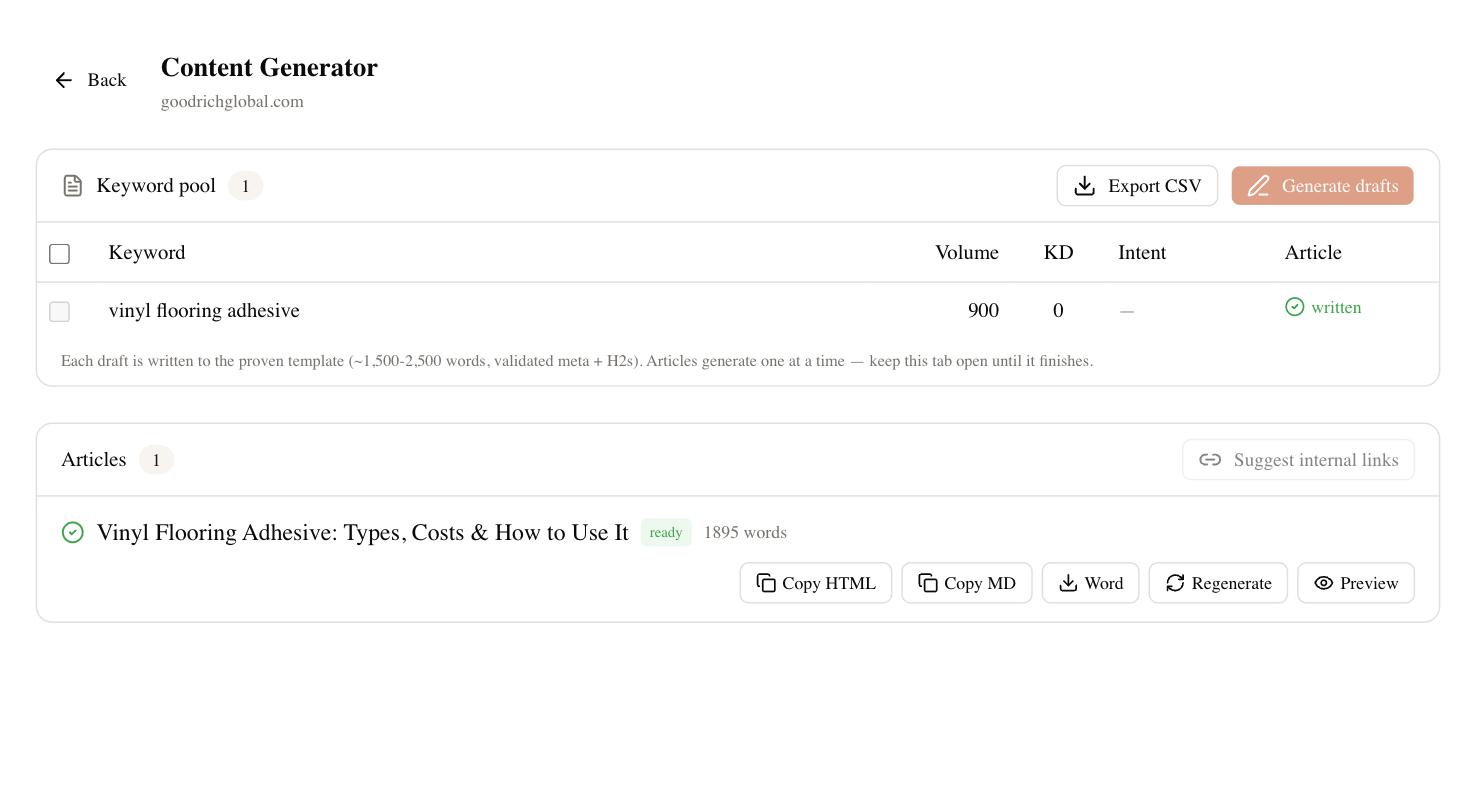
The two tools are not really rivals so much as answers to different questions. Anyword optimizes the copy that persuades once someone lands on your page; SEO Rocket gets the right people to that page from search in the first place. Some teams run both. But if you can only fund one and your traffic problem is organic, the SEO-native tool is the honest pick.
The verdict
Anyword is a solid, mature platform doing something genuinely useful: putting a performance estimate on marketing copy before you spend money running it. For conversion-focused teams that test constantly, that is worth paying for, and the Brand Voice system is a real bonus for anyone managing output at scale. Just go in with clear eyes on the price ramp and the fact that the predictive score rewards teams that feed it their own data.
What it is not is an SEO solution, and no amount of Blog Wizard output changes that. Match the tool to your actual bottleneck. If you are optimizing ads and conversion copy, Anyword is a strong choice. If you are trying to rank and stay visible in AI search, spend your budget on a tool built for that instead.