
If you’re weighing mangools vs ubersuggest, you’re almost certainly a freelancer, blogger, or small-business owner who wants solid keyword data without paying enterprise-suite prices. Both tools were built for exactly that reader, both sit in the low price band, and both do a genuinely good job of the core work — which is why the mangools vs ubersuggest question rarely has an obvious loser. It comes down to what you value most: a clean, focused research experience or a cheaper all-in-one with a lifetime option.
This comparison walks through the dimensions that actually change your day: data quality, ease of use, AI features, price band, and who each one really suits. No fake winner, no affiliate padding — just where each tool is stronger and where you might want a third option entirely.
Where each tool comes from
Mangools is a bundle of five small tools — KWFinder, SERPWatcher, SERPChecker, LinkMiner, and SiteProfiler — built around the idea that keyword research should feel pleasant. KWFinder in particular has a reputation as one of the friendliest research interfaces going, and the whole suite is designed to look uncluttered and load fast.
Ubersuggest started life as a free keyword tool and grew into a broader SEO platform. Its pitch has always been accessibility: a low monthly price, plus a lifetime-license option that appeals to anyone tired of recurring subscriptions. It covers keyword research, site audits, rank tracking, and backlink data under one login, aimed squarely at beginners and cost-conscious owners.
Mangools vs Ubersuggest at a glance
Here’s the short version before the segment-by-segment detail. Treat the price column as a rough band, not a quote — both vendors change plans often, and third-party metrics from either tool are estimates, not gospel.
| Dimension | Mangools | Ubersuggest |
|---|---|---|
| Data quality | Strong keyword difficulty & SERP data; smaller backlink index | Broad but shallower; usable ideas, less depth |
| Ease of use | Excellent — clean, focused, fast | Good — simple, but more cramped as features pile up |
| AI features | Minimal | Light AI writing assists |
| Best for | Freelancers who research daily | Beginners & lifetime-license seekers |
| Rough price band | Low $ (subscription) | Low $ (subscription or lifetime) |
Data quality and keyword depth
On keyword research, Mangools has the edge for most users. KWFinder’s difficulty scores and search-volume ranges tend to feel more trustworthy in daily use, and its SERP analysis in SERPChecker gives you a clear read on who you’re actually competing against for a term. Where Mangools is weaker is backlinks — LinkMiner and SiteProfiler are fine for a quick look, but the link index is smaller than what a dedicated backlink tool offers.
Ubersuggest casts a wider net across features but goes less deep in each. Its keyword ideas are perfectly usable for finding topics and long-tail variations, and the volume estimates are in the right ballpark. You’ll just notice the gaps when you push hard — fewer suggestions on niche terms, and difficulty scores that can feel coarse. For a first client or a hobby site that difference rarely matters; for someone doing research all day, it adds up.
Ease of use and day-to-day workflow
This is where Mangools earns its following. The interface is calm, the learning curve is nearly flat, and moving from a keyword idea to a SERP breakdown to a rank-tracking setup feels natural. If you’ve ever bounced off a heavier suite, Mangools is the antidote — you can be productive in your first ten minutes.
Ubersuggest is also beginner-friendly, and its guided flow does a nice job of holding a new user’s hand through an audit or a first keyword list. The catch is that stuffing keyword research, audits, tracking, and backlinks into one dashboard makes some screens busier than Mangools’ focused panels. Neither is hard to learn; Mangools simply feels lighter, while Ubersuggest trades a little polish for breadth.
AI features and where both fall short
Neither tool is AI-native, and that’s the honest headline. Ubersuggest has added light AI writing assists to help draft content ideas and outlines, which is a small plus if you want everything in one place. Mangools stays closer to pure research and leans minimal on AI.
What neither does is fold real AI content production and AI-search visibility into the workflow. In 2026 a growing slice of buyers ask ChatGPT, Perplexity, or Google’s AI Overviews instead of typing a classic query, and a page that ranks first can still go uncited in an AI answer. Both Mangools and Ubersuggest will tell you where you rank in traditional results; neither shows you whether an AI assistant ever mentions your brand. If that surface matters to you, you’ll be running a second subscription to see it.
Who each tool is best for
Here’s the segment-by-segment verdict, because a single winner would be dishonest. Choose Mangools if keyword research is a daily habit and you value a fast, pleasant interface — freelancers and content-focused SEOs get the most from it, and the weaker backlink data is easy to forgive when research is your main job.
Choose Ubersuggest if you’re a beginner or a very small budget and you want one simple tool that covers a bit of everything — especially if the lifetime-license option appeals more than another monthly bill. It won’t match Mangools on research finesse, but it stretches further across tasks for the money. Both are legitimately good picks in their lane; the right answer is the one that matches how you actually spend your week.
The AI-native third option: SEO Rocket
If your real frustration is that neither tool touches AI content or AI-search visibility, there’s a third option worth a look. SEO Rocket is built chat-first: instead of clicking through panels, you ask for what you need in plain language — keyword ideas, competitor gaps, rank tracking, a site audit — and it runs the lookup on Ahrefs-grade data underneath.
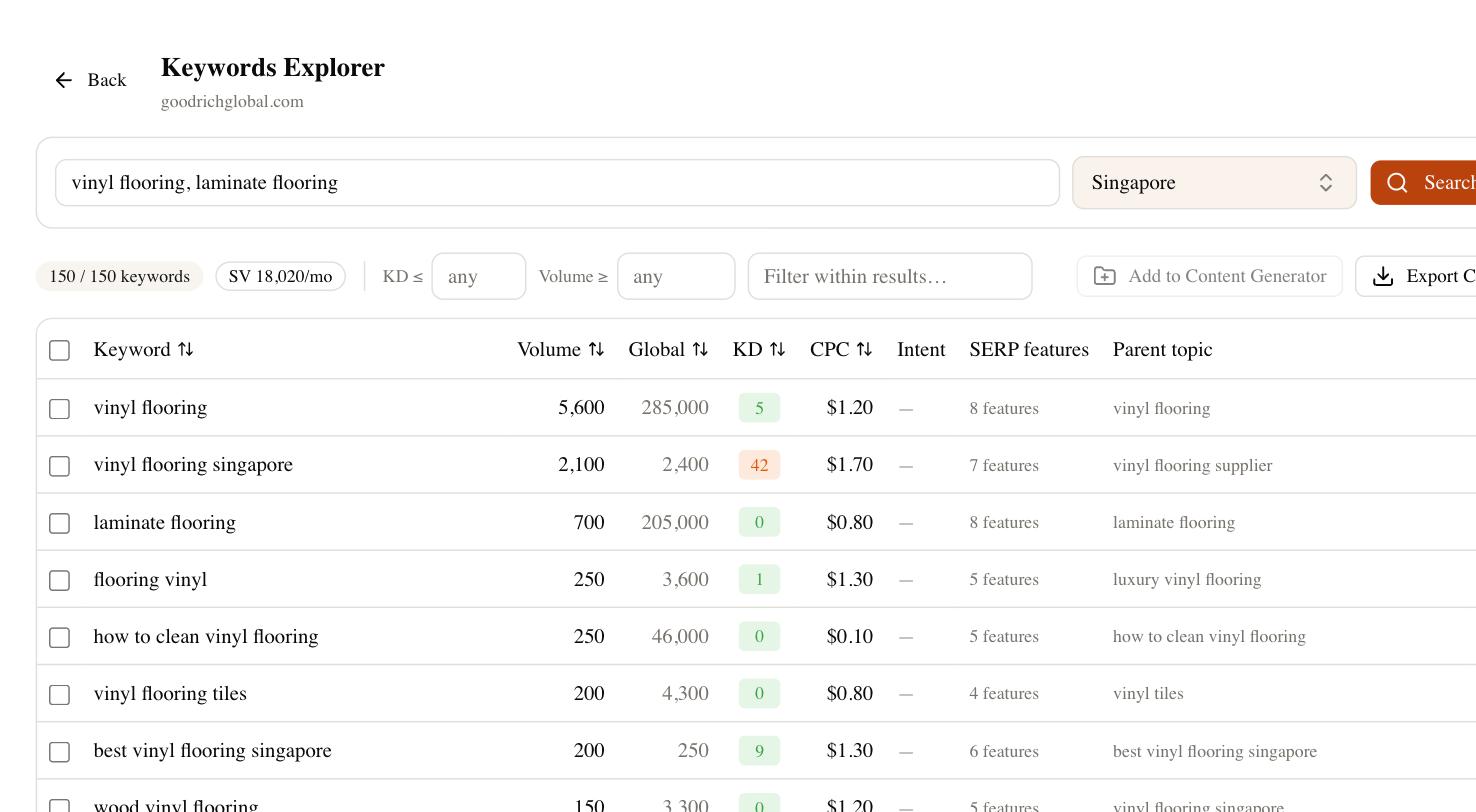
The difference isn’t just the data. The same tool then drafts the article with Claude and shows you, through its Brand Radar feature, whether you’re being cited across ChatGPT, Perplexity, and AI Overviews — the exact gap Mangools and Ubersuggest leave open. For a consultant, the built-in client dashboards mean you can hand over a read-only report without exporting anything. It sits in an entry-friendly price band too, so consolidating a research tool plus a separate AI writer into one subscription can actually cost less than the stack it replaces.
How to choose
Match the tool to your real constraint, not to a feature list. If you research keywords daily and want the nicest experience for the money, Mangools is the natural pick. If you’re just starting out, want broad coverage cheaply, or prefer a lifetime license, Ubersuggest earns its place. And if the thing holding you back is that traditional tools ignore AI writing and AI-search entirely, an AI-native option like SEO Rocket covers that ground in one workflow.
Whichever way you lean, run your own site and two competitors through the tool for a full week before you judge it — rankings jitter a few spots day to day, and no tool’s estimates are exact. The winner of your personal mangools vs ubersuggest test is simply the one that answers your real questions fastest.