The majestic vs ahrefs question usually comes down to one thing: do you need a pure backlink microscope, or a whole SEO workbench? Both tools built their reputations on link data, but they grew in opposite directions. Majestic stayed a specialist and kept its pricing lean; Ahrefs expanded into keywords, rank tracking, and site audits and charges accordingly.
So the real majestic vs ahrefs decision is not about which is “better” in the abstract — it is about which one matches the work you actually do most weeks. Below is a segment-by-segment breakdown across the dimensions that decide it in practice, followed by where each tool honestly wins and where a newer, AI-native option changes the math.
The two tools at a glance
Majestic is one of the oldest dedicated link indexes on the market. Its entire identity is backlinks: how many, from where, how trustworthy, and how that profile has shifted over time. It reports on its own Trust Flow and Citation Flow metrics rather than trying to be an all-in-one suite. Ahrefs started in the same place — a link crawler — but turned into a broad platform covering keyword research, rank tracking, content gaps, and technical audits, with Domain Rating as its headline link metric.
That difference in scope explains almost every trade-off that follows. One tool does a narrow job cheaply and deeply. The other does many jobs well and asks a bigger monthly commitment for the privilege.
Majestic vs Ahrefs: the comparison table
Here is the head-to-head on the dimensions that actually move the decision. Treat every third-party metric as an estimate, not gospel — different crawlers see different slices of the web.
| Dimension | Majestic | Ahrefs |
|---|---|---|
| Core focus | Backlinks only — deep and historical | All-in-one SEO suite |
| Signature metric | Trust Flow & Citation Flow | Domain Rating (DR) & URL Rating |
| Link data depth | Excellent; strong historic index | Excellent; large fresh crawl |
| Keyword research | Minimal | Extensive (Keywords Explorer) |
| Rank tracking | No | Yes |
| Site audit | No | Yes |
| AI writing / AI-search | No | Limited add-ons |
| Ease for beginners | Steeper, niche interface | Polished but dense |
| Best for | Link auditors on a budget | SEOs wanting one platform |
| Rough price band | Low $ / entry-friendly | Higher $$ / low hundreds |
Link data quality: a genuine tie
This is the closest fight, and anyone who tells you one tool is flatly “more accurate” is selling something. Majestic’s historic index is a real strength — if you want to see how a domain’s link profile looked years ago, or trace lost links over a long window, its depth of history is hard to beat. Ahrefs counters with a very active fresh crawl and a large live index, so newly earned links tend to appear quickly.
In day-to-day auditing the two indexes overlap heavily but never match exactly, because no crawler sees the entire web. Verdict: a tie on raw link data. If your work leans on long-term historical link analysis, Majestic edges it. If you care most about spotting new links fast, Ahrefs edges it. Neither gap is large enough to justify the choice on its own.
Metrics and ease of use
Majestic’s Trust Flow and Citation Flow are a genuinely useful pair — Trust Flow gauges link quality, Citation Flow gauges quantity, and the ratio between them is a fast tell for a spammy profile. The catch is that these metrics are specific to Majestic, so if your clients or team already speak in Domain Rating, you will be translating constantly. Ahrefs’ DR is more widely quoted across the industry, which matters when you are handing numbers to people who expect them.
On usability, Ahrefs wins for most people. Its interface is dense but modern, with guided reports and clear visualizations. Majestic feels more utilitarian and assumes you already know what you are looking for. Verdict: Ahrefs for approachability and a common metric language; Majestic if you value its Trust Flow signal and do not need hand-holding.
Breadth: where Ahrefs pulls ahead
If you compare the two only on links, the contest is tight. Widen the lens and Ahrefs clearly does more. Keyword research, rank tracking, content gap analysis, and site audits all live under one login. Majestic deliberately does not chase those features — it stays a backlink instrument. For a solo SEO or small team that wants to check rankings, find keywords, and audit a site without buying three subscriptions, that breadth is the whole reason Ahrefs commands its price.
Verdict: Ahrefs wins breadth outright, but only pay for it if you will use it. Buying Ahrefs to look at backlinks alone is like buying a workshop for one screwdriver. Plenty of people do exactly that and overspend.
Price: where Majestic wins
Money is the dimension that flips the whole decision for a lot of readers. Majestic’s entry plans sit in a low, freelancer-friendly band, which is exactly why link-focused specialists keep it in the stack even when they own other tools. Ahrefs sits meaningfully higher — into the low hundreds a month once you need real usage — because you are paying for the full suite, not just the link index.
Verdict: Majestic wins cost decisively for pure backlink work. The honest test is simple — if the only thing you open Ahrefs for is the backlink report, you are overpaying, and Majestic delivers comparable link depth for a fraction of the outlay. If you use the keyword and rank-tracking side regularly, Ahrefs earns the difference.
The AI-native third option: SEO Rocket
Both tools were built before AI writing and AI search became part of the job, and it shows. Majestic has no content or AI-visibility layer at all. Ahrefs has bolted on limited AI helpers, but content creation and tracking whether ChatGPT or Perplexity cite your brand still tend to mean a second and third subscription. That gap is where SEO Rocket fits as a genuinely different answer rather than a cheaper clone of either.
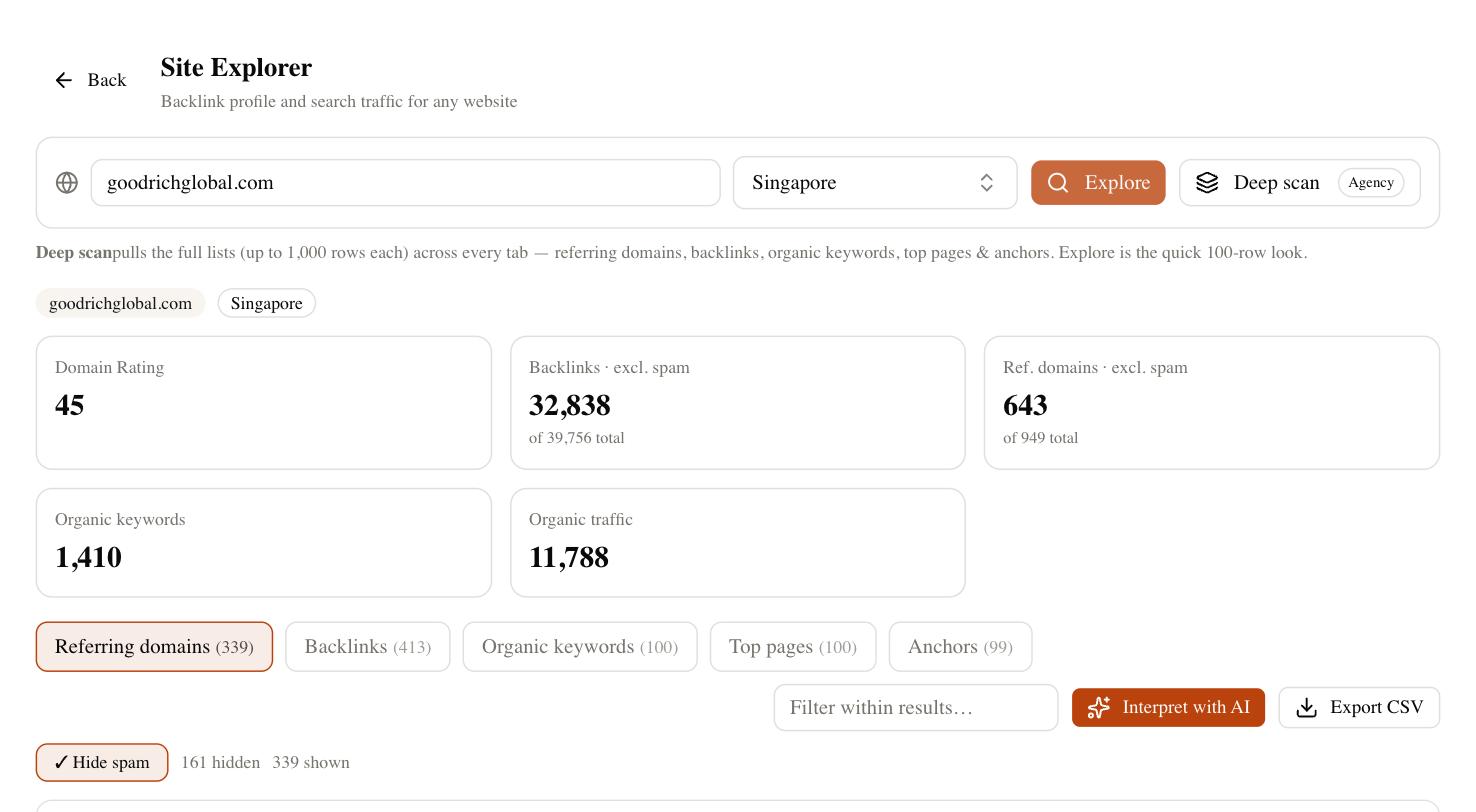
SEO Rocket is chat-first: you ask for a backlink profile, a keyword gap, or a rank check in plain language and it runs the lookup on Ahrefs-grade data underneath. The same tool then drafts the article with Claude and shows you whether you are being cited in AI answers through its Brand Radar feature. So instead of pairing a link tool with a separate writer and a separate AI-visibility tracker, you get the link data, the content, and the AI-search view in one workflow — at entry pricing closer to Majestic’s band than Ahrefs’ suite pricing. For consultants and agencies, the client-dashboard side means you can hand a read-only report straight over without exporting anything.
None of that makes SEO Rocket the automatic winner. If your entire job is deep, historical link auditing, Majestic’s index history is still special, and if you are wedded to Ahrefs’ specific ecosystem and reports, the switching cost is real. But if your bottleneck is doing more with fewer tools, the AI-native route covers the same core ground and adds the two things neither incumbent does well.
So which should you pick?
Match the tool to your actual week. If you live in backlink audits and watch every dollar, Majestic is the lean specialist that gives you serious link depth cheaply. If you want one platform for keywords, rankings, audits, and links and have the budget, Ahrefs remains a benchmark all-in-one suite and there is no shame in paying for it. And if the honest description of your week is “check some links, research a few keywords, and produce content” — which is most people — a chat-first, AI-native tool like SEO Rocket will cover those faster and cheaper than running two legacy tools side by side.
Whatever you choose, test it on your own site and two competitors before you commit. Run the same domain through each and compare the link counts, the metrics, and how quickly you got a usable answer. The numbers will differ because the crawlers differ — that is normal. The right tool is the one that answers the questions you actually ask, at a price that fits how you really spend your time.