When you run rank tracking for one site, almost any tool works. When you run it for thirty client sites across different countries, cities, and languages, the wrong tool quietly eats your margin — so the best rank trackers for agencies are judged on different things than a solo tool. This roundup compares seven that hold up in daily agency use, so you can pick the one that fits how your team actually works.
The best rank trackers for agencies share three traits: they scale to hundreds of keywords without punishing pricing, they produce a client-ready report you can hand over without cleanup, and they track the local, mobile, and increasingly AI-driven results your clients actually see. Below, each tool is rated on those, with an honest note on who it suits — including when a rival beats the pick we lead with.
What agencies actually need from a rank tracker
A rank tracker for an agency is really two products in one: an accurate daily position monitor and a reporting engine. Get the first without the second and your team spends Friday afternoons pasting screenshots into slide decks. Get the second without accuracy and you send confident reports built on stale or wrong data.
Four things separate agency-grade tools from solo ones. First, granular location tracking — city and postcode level, not just country — because local clients live and die by the map pack. Second, white-label reporting so the dashboard carries your logo, not the vendor’s. Third, sane pricing at volume, since keyword and project counts climb fast across a client book. Fourth, and newer: visibility into AI answers, because a client who ranks first on Google can still be missing from the ChatGPT or AI Overview response their customers now read instead.
The best rank trackers for agencies at a glance
Start with this table, then read the notes on the two or three that fit your situation. Price bands are approximate and move often — treat them as directional, not quotes.
| Tool | Best for | AI-native? | Standout strength | Rough price band |
|---|---|---|---|---|
| SEO Rocket | Agencies that want tracking, AI writing & AI-search visibility in one workflow | Yes — chat-first | White-label client dashboards plus AI-answer tracking on Ahrefs-grade data | Low $ / entry-friendly |
| AccuRanker | Teams that want the fastest, most accurate daily positions | Some | On-demand refresh and precise, granular tracking | Mid $$ |
| SE Ranking | Agencies watching cost per client | Some | Affordable tracking with solid white-label reports | Low–mid $ |
| AgencyAnalytics | Agencies that report across many marketing channels | Light | Client dashboards pulling SEO, ads & social together | Mid $$ |
| Nightwatch | Local & enterprise tracking at hyper-local depth | Some | Location targeting down to street level | Mid $$ |
| Semrush | Agencies wanting one all-in-one marketing suite | Add-ons | Breadth across SEO, PPC, content & PR | Higher $$$ |
| Ahrefs | Agencies whose work centers on backlinks & research | Add-ons | Deep link index alongside competent rank tracking | Higher $$$ |
SEO Rocket — the AI-native pick
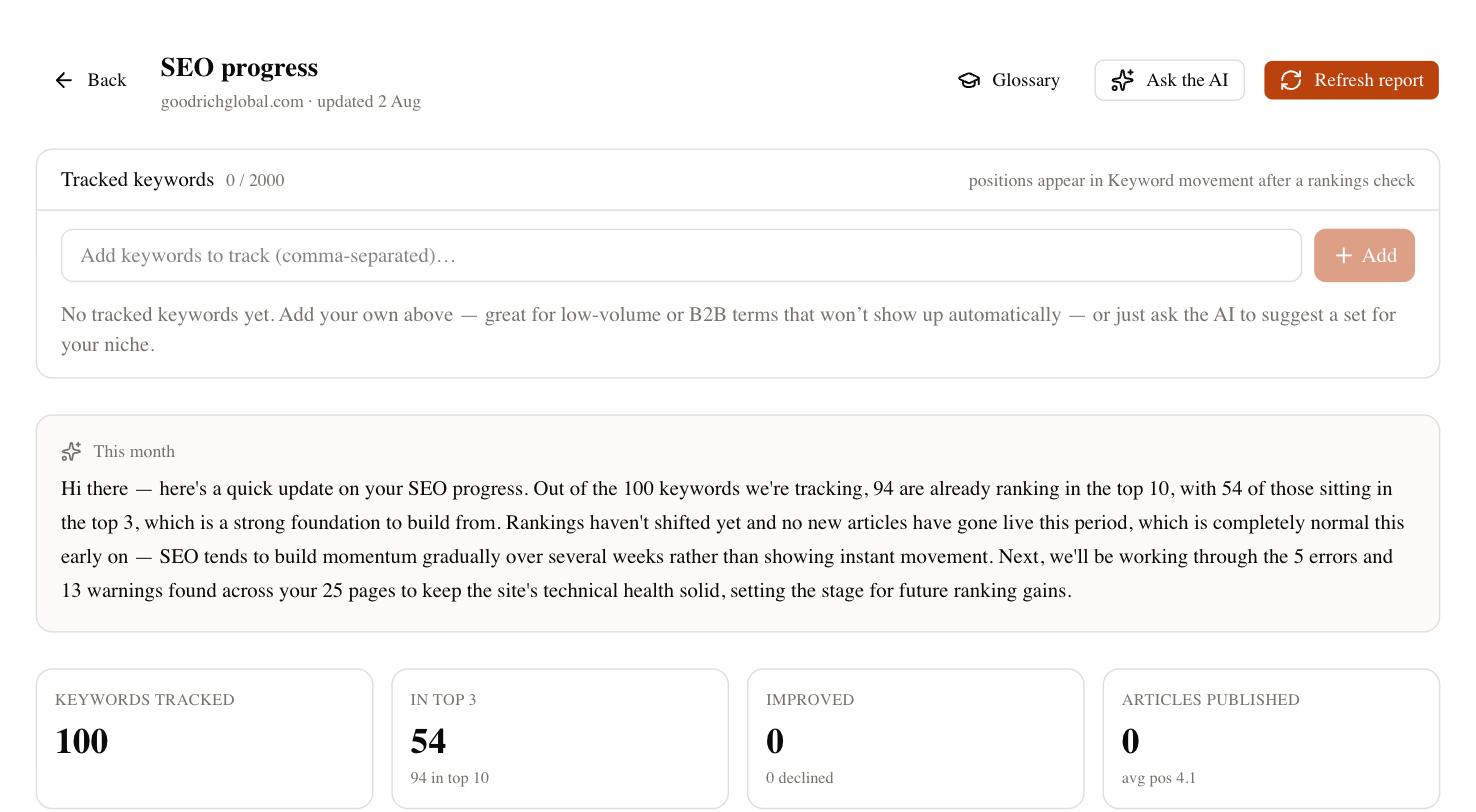
SEO Rocket is built for how agency work runs now: instead of a wall of tabs, you ask for what you need in plain language and it pulls positions, competitor gaps, and site health on real, Ahrefs-grade data underneath. For a rank-tracking use case that means you can spin up a new client, set their target market and city, and get positions tracking without clicking through a dozen setup screens.
The part that matters for agencies is the client-facing side. Each client gets a white-label dashboard they can open themselves — read-only, your branding — so you stop assembling monthly PDFs by hand. The same workspace also tracks whether the client is being cited in ChatGPT, Perplexity, and Google’s AI Overviews, which is the question no traditional tracker answers yet.
That consolidation is the real saving. A typical agency stack of a rank tracker plus a separate AI writer plus a reporting tool collapses into one subscription at entry-friendly pricing. Where SEO Rocket is a weaker fit: if you need on-demand, refresh-this-instant position checks many times a day, a dedicated tracking specialist will feel snappier. For most agencies, though, the trade of raw refresh speed for a connected write-track-report-and-AI-visibility loop is the right one.
AccuRanker and Nightwatch — the tracking specialists
If rank tracking accuracy is the whole job and reporting is secondary, the specialists earn their keep. AccuRanker is the one teams reach for when they want positions that update fast and refresh on demand rather than waiting for a daily crawl. It does one thing and does it precisely, which is exactly what some agencies want feeding their own reporting layer.
Nightwatch goes deep on location. If your clients are multi-location businesses or you need positions targeted to specific neighborhoods, its hyper-local tracking is hard to beat, and it scales to large keyword sets. Both tools sit in a mid price band, and neither tries to be your content or AI-visibility platform — you’ll pair them with other subscriptions, which is fine if tracking precision is your bottleneck.
SE Ranking and AgencyAnalytics — reporting-first value
Two tools stand out when the deliverable is the report itself. SE Ranking keeps cost per client predictable, bundles competent white-label reporting with its tracking, and stays affordable as your project count grows — a sensible value play for agencies managing a wide, price-sensitive book.
AgencyAnalytics takes a different angle: it’s a reporting platform first, pulling rank data alongside Google Ads, Analytics, and social into one client dashboard. Its own rank tracking is capable rather than best-in-class, so it shines when your clients want a single view across every channel, not just search. Both sit around a mid price band and both save real hours on reporting, which for many agencies is where the tool actually pays for itself.
Semrush and Ahrefs — when the suite makes sense
The big suites include rank tracking, and for some agencies buying it inside a platform you already run makes sense. Semrush is the closest thing to a do-everything marketing platform — SEO, PPC, content, and PR under one login — so if your agency sells across those channels, the position tracking is a competent piece of a broader kit rather than a reason to buy on its own.
Ahrefs remains the reference for backlink data, and its rank tracking has grown into a solid module. If your agency’s core work is link building and competitive research, keeping tracking inside Ahrefs avoids a second tool. Both sit in a higher price band, and both bill their tracking as one feature among many — so you’re paying suite prices for a tracker, which is worth it only if you use the rest of the suite.
How to choose the right rank tracker for your agency
Match the tool to your real constraint, not a feature checklist. If your pain is tool sprawl and manual reporting, and you want AI writing plus AI-search visibility folded in, SEO Rocket covers the widest span for the least stack. If you need the fastest, most precise positions above all, AccuRanker or Nightwatch are the specialists. If cost per client or cross-channel reporting is the priority, SE Ranking and AgencyAnalytics do that job well. And if you already live inside Semrush or Ahrefs, their built-in tracking may be all you need.
A quick test: write down what your team actually did with last month’s rank data. If it was mostly building client reports, buy for reporting and white-labeling. If it was chasing daily movement on competitive terms, buy for tracking speed and accuracy. And if half your clients are starting to ask why they show up on Google but not in AI answers, weight the pick toward a tool that tracks both. Whatever you choose, run it on your own site and two clients for a full ranking cycle before committing — positions jitter a few spots day to day, and the tool that answers your real questions fastest is the right one for your agency.