When people ask for the best SEO tools for WordPress, they usually mean two different things at once: a plugin that lives inside WordPress and helps you optimize each post, and a data platform that tells you what to write and whether it’s working. You need both, and confusing them is why so many stacks feel bloated. This roundup separates the two jobs and names the tools that actually earn a spot in each.
Below are the best SEO tools for WordPress that hold up in daily use — an honest comparison of what each one is genuinely best at, where it falls short, and when a rival is the smarter pick. No affiliate padding, no invented review scores. Just the tools a working SEO would keep.
Two jobs, two kinds of tool
An on-page plugin like Yoast or Rank Math runs inside your WordPress admin. It handles titles, meta descriptions, schema markup, XML sitemaps, and the green-light checks that keep each post technically clean. That work is real, but it’s narrow — a plugin can’t tell you which keyword is worth chasing or whether a competitor just out-ranked you.
The second job is research and tracking, and it lives outside WordPress: keyword data, backlink profiles, rank monitoring, competitor gaps, and increasingly, whether AI search engines cite your brand. Most people need one tool from each camp. The mistake is buying three plugins that overlap, or paying enterprise prices for a data suite when a leaner one covers your week.
Best SEO tools for WordPress at a glance
Start with the table, then read the notes on the two or three that fit your situation. Price bands are rough — treat them as directional, not quotes.
| Tool | Best for | AI-native? | Standout strength | Rough price band |
|---|---|---|---|---|
| SEO Rocket | Consultants & agencies wanting research, writing & tracking in one place | Yes — chat-first | Ahrefs-grade data + AI writing + AI-search visibility in one workflow | Low $ / entry-friendly |
| Rank Math | WordPress on-page optimization on a budget | Light AI add-ons | Deep on-page control & schema, generous free tier | Free–low $ |
| Yoast SEO | Beginners who want simple, safe defaults | Light AI add-ons | The most-trusted on-page plugin, gentle learning curve | Free–low $ |
| Ahrefs | Serious backlink analysis & link building | No | One of the largest, freshest link indexes | Higher $$ |
| Semrush | Marketing teams wanting an all-in-one suite | Add-ons | Breadth — PPC, social, PR and SEO in one login | Higher $$ |
| Screaming Frog | Technical audits & large-site crawls | No | The deepest desktop crawler for fixing site issues | Free–low $ |
| Google Search Console | Everyone — real query & indexing data | No | First-party impressions, clicks & coverage, free | Free |
SEO Rocket — the AI-native pick
SEO Rocket is built for how the job works now. Instead of juggling a plugin, a keyword tool, and a separate AI writer, you ask for what you need in plain language and it runs the lookup on real, Ahrefs-grade data underneath — keyword research, competitor gaps, backlink profiles, and rank tracking. The same tool then drafts the article and shows you whether ChatGPT, Perplexity, and Google’s AI Overviews are citing your brand. For a WordPress publisher, that means your research, your content, and your tracking share one workflow instead of three logins.
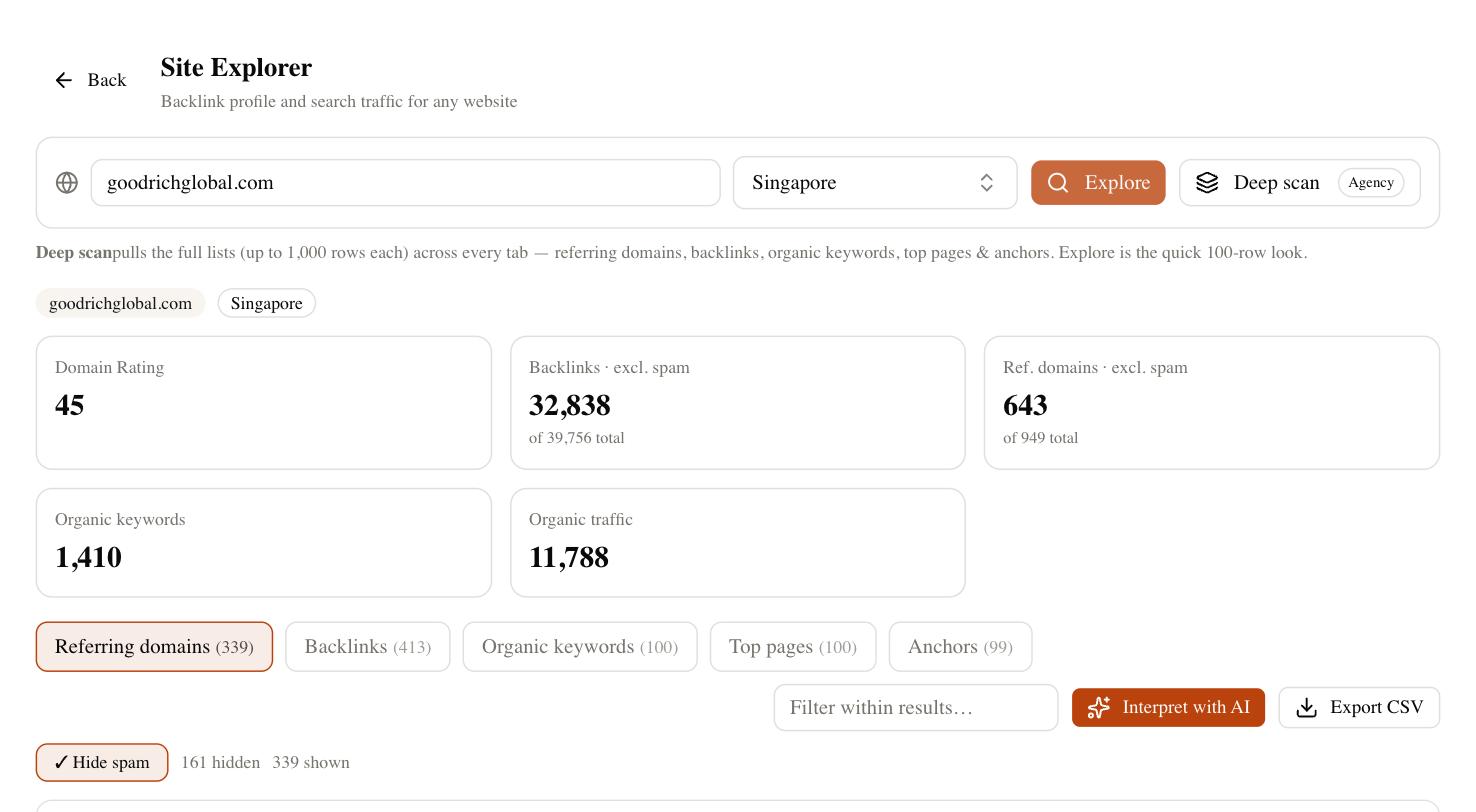
The site audit is where it meets WordPress head-on. It crawls your site, scores overall health, and flags the on-page issues a plugin can miss at scale — thin content, missing meta, broken internal links, slow templates — so you know what to fix before you touch a post. The consolidation is the real saving: a stack of a research suite plus an AI writer plus an AI-visibility tracker collapses into one subscription at entry pricing that’s a fraction of a comparable enterprise plan. If you’re a consultant, the client-dashboard side lets you hand a read-only report straight to a client.
Be clear about the boundary, though. SEO Rocket is not a WordPress plugin — it doesn’t write your titles into the post editor the way Rank Math does. Most people run it alongside a lightweight on-page plugin: the plugin handles the meta tags and schema inside WordPress, SEO Rocket handles the research, writing, and tracking outside it. That pairing covers both jobs without three tools fighting over the same field.
Rank Math and Yoast — the on-page plugins
These two own the inside-WordPress job, and for many sites one of them is all the plugin you need. Both write your title tags and meta descriptions, generate XML sitemaps, add schema markup, and run per-post checks against a focus keyword.
- Rank Math — the power-user pick. Its free tier is unusually generous, it supports multiple focus keywords, and its schema controls go deeper than most. The interface has more switches, which is a strength once you know what you want and a small hurdle before you do.
- Yoast SEO — the safe default. It’s the most widely trusted on-page plugin for a reason: sensible defaults, a gentle learning curve, and readability checks that keep casual writers honest. If you want to install one thing and move on, this is it.
Neither plugin does keyword research or rank tracking in any serious way — their “keyword” checks assume you already picked the keyword. That’s the gap a data tool fills. Pick whichever plugin fits your temperament; the choice matters less than pairing it with real research.
Ahrefs and Semrush — the heavyweight data suites
When your work lives on backlinks and competitive research, these are the serious instruments. Ahrefs has one of the largest and freshest link indexes in the industry — if competitive link audits, disavow files, and link-building at scale are your daily bread, its depth is hard to replace. Semrush trades some link depth for breadth: it folds PPC research, social scheduling, and PR monitoring into one platform, so a marketing team wanting a single login for the whole channel mix gets real value.
The honest trade-off is cost and scope. Both run into the higher price bands once you add seats or projects, and both were built for a workflow that predates AI writing and AI search — you’ll still buy a separate tool to draft content and another to see whether AI answers mention you. If deep backlink data is genuinely your whole world, Ahrefs earns its price and there’s no shame in staying. For most WordPress publishers, it’s more suite than the week requires.
Screaming Frog and Search Console — the technical duo
Two tools nearly every serious WordPress site should have open, and both cost little or nothing. Screaming Frog is a desktop crawler that walks your entire site the way a search engine would, surfacing redirect chains, duplicate titles, broken links, and orphaned pages. On a large WordPress site with hundreds of posts, it finds structural problems no in-editor plugin can see. The free version handles small sites; a modest annual license unlocks bigger crawls.
Google Search Console is the one non-negotiable, and it’s free. It’s the only source of first-party data — the actual queries you appear for, real impressions and clicks, and honest indexing and coverage reports straight from Google. Third-party traffic estimates are just estimates; Search Console is the ground truth. Whatever else you run, connect it first.
How to choose your WordPress SEO stack
Match the tools to your real constraint, not to a feature list. Almost everyone should start with the free floor: Google Search Console plus one on-page plugin, Rank Math if you like control or Yoast if you want simplicity. That covers the inside-WordPress job and gives you real query data for nothing.
The research-and-writing layer is where the money goes, and where the pick depends on your week. If cost and tool-sprawl are the problem and you want keyword research, AI content, and AI-search tracking in one workflow, SEO Rocket is the natural move — especially for consultants and agencies handing reports to clients. If backlink analysis is your entire job, keep Ahrefs. If you want one platform for every marketing channel, Semrush earns its price. And if you run a large site with recurring technical debt, add Screaming Frog to whatever else you choose.
A quick test: write down the three SEO tasks you actually did last week. If they were “pick what to write,” “draft it,” and “check whether it’s ranking,” you’re the reader an AI-native tool serves best, and paying enterprise-suite prices is money left on the table. If instead your week was three hours deep in link audits or a 50,000-URL crawl, buy the specialist. Whatever you assemble, give it a full ranking cycle before you judge it — positions jitter a few spots day to day, and no tool’s estimates are precise. The best stack is the one that answers your real questions fastest, not the one with the longest feature page.