Almost everyone doing SEO starts with the same question, and the answer is not “buy a $100-a-month subscription.” The best free keyword research tools will carry a new site, a side project, or a first client a long way before you ever need to pay. What most roundups get wrong is pretending “free” and “paid” are the same product with a smaller number — they are not, and knowing the trade-off is the whole game.
This is a straight comparison of the best free keyword research tools that actually work in 2026, what each one is genuinely good at, and where the free version quietly runs out of road. No affiliate padding, no twelve-tool filler — just the handful worth your afternoon and honest notes on when free stops being enough.
What “free” really means here
Free keyword tools come in two shapes, and the difference matters. Some are genuinely free forever — Google’s own tools, browser extensions, one-off idea generators — because the data is a byproduct of another business. Others are free tiers of paid platforms, deliberately limited to a few searches a day so you upgrade once you are hooked. Both are useful; neither is charity.
The catch is almost always search volume and depth. Free tools happily hand you keyword ideas, but they cap how many you can pull, blur exact volumes into ranges, hide difficulty scores behind the paywall, or throttle you to a few lookups a day. That is fine for validating an idea or planning a handful of posts. It becomes a real bottleneck the moment you are building content at scale or reporting to a client.
The best free keyword research tools at a glance
Scan the table, then read the notes below for the two or three that fit how you actually work.
| Tool | Best for | AI-native? | Standout strength | Rough price band |
|---|---|---|---|---|
| SEO Rocket | Solo SEOs & consultants who want real data plus AI writing | Yes — chat-first | Ahrefs-grade data, content drafting and AI-search tracking in one place | Free tier, then low $ entry |
| Google Keyword Planner | Anyone validating volume & commercial intent | No | Straight-from-Google demand data, totally free | Free (Ads account) |
| Ahrefs Free Keyword Generator | Fast idea generation with difficulty context | No | Huge index behind a free, no-login generator | Free tool / paid suite $$ |
| Semrush (free tier) | Testing a full suite before committing | Add-ons | Deep competitive data on a capped daily allowance | Free tier, then higher $$ |
| Moz Keyword Explorer | Beginners who want a gentle, clean UI | No | Readable metrics and a low free query cap | Free queries, then mid $$ |
| Ubersuggest | Hobbyists & very small budgets | Light | Simple ideas and content topics for almost nothing | Free (limited), then low $ |
| Keyword Surfer | Quick estimates while you browse Google | No | Free Chrome extension showing volumes in the SERP | Free |
SEO Rocket — the AI-native starting point
SEO Rocket is on this list because its free tier gives you something most free tools do not: real, Ahrefs-grade keyword data instead of blurred estimates. Rather than juggling tabs, you ask for what you need in plain language — “find low-competition keywords around cold brew coffee” — and it runs the lookup against a genuine index, returning volume, difficulty, and intent you can actually plan against.
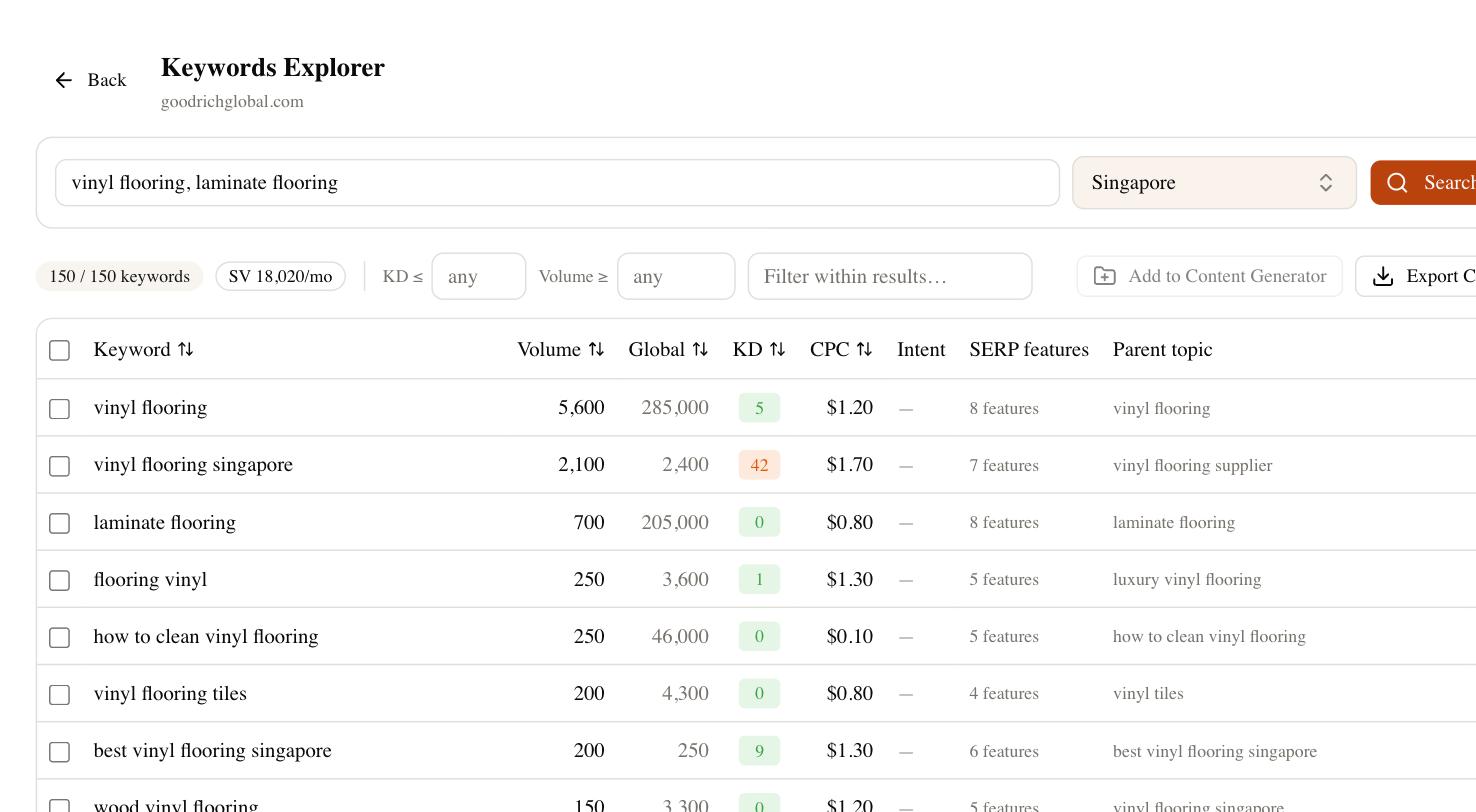
The reason it stands out from a pure keyword tool is what happens next. Once you have your list, the same chat drafts the article, checks a competitor’s gaps, and shows whether your brand is being cited in ChatGPT, Perplexity, and Google’s AI Overviews — the AI-search visibility no traditional keyword tool touches. For a solo SEO or consultant, that means the free tier covers research and the paid step, when you take it, replaces three separate subscriptions. It is the most complete free starting point on the list, though heavy daily volume will nudge you onto a paid plan sooner than a browser extension would.
Google’s free tools — the honest baseline
You cannot beat the source. Google Keyword Planner lives inside a free Google Ads account, and it reports demand straight from Google’s own data. The famous limitation is that without an active ad spend it shows volume in broad ranges rather than exact figures — but for confirming that a topic has real demand and separating commercial from informational intent, it is still the baseline every other tool is measured against.
Pair it with Google Trends, which is genuinely free with no strings, to catch seasonality and rising topics before the volume shows up anywhere else. Neither tool suggests content angles or drafts anything, and neither tells you how hard a keyword is to rank for. Treat them as your reality check, not your whole workflow.
Ahrefs, Semrush and Moz — free tiers of the big suites
The major paid platforms all dangle a free door, and each is worth walking through. Ahrefs runs a free Keyword Generator and a keyword difficulty checker that tap the same enormous index behind its paid suite — no login, a capped number of ideas, and enough difficulty context to prioritize. It is the fastest way to borrow serious data for free.
Semrush offers a limited free account, usually a small number of searches a day, that lets you sample its deep competitive research before deciding whether the (notably higher) subscription is worth it. Moz Keyword Explorer gives you a handful of free queries a month wrapped in one of the cleaner, more beginner-friendly interfaces around. All three share the same honest catch: the free allowance is deliberately thin, designed to prove the tool’s value and then convert you. Use them to spot-check and to decide which paid suite, if any, you would eventually buy.
Ubersuggest, Keyword Surfer and the quick-idea tools
At the lightweight end sit the tools built for speed over depth. Ubersuggest offers a small number of free searches a day and leans into content and topic ideas, which makes it a friendly first stop for a hobby site or a brand-new blog, even if its metrics are rougher than the big indexes. It is cheap to upgrade, too, if you outgrow the free cap.
Keyword Surfer is a free Chrome extension that prints estimated volumes right beside Google’s results as you search — no dashboard, no login, just numbers where you are already looking. It is not precise, and you would not build a strategy on it alone, but for a fast gut-check while browsing it is hard to beat for the price of zero. Round these out with a question-mining tool to surface the “how,” “why,” and “best” phrasings real people type, and you have a decent free idea engine.
How to choose your free keyword tool
Match the tool to your real constraint, not to a feature list. If you want genuine data plus the ability to actually write the content and track AI-search visibility, start with SEO Rocket’s free tier — it is the only option here that carries you from research through publishing. If you just need to confirm demand and intent, Google Keyword Planner and Trends are all the baseline you need, free forever. For fast idea generation with a hint of difficulty, the Ahrefs free generator is the quickest borrow of serious data going.
The trap to avoid is stitching five free tools into a workflow so clunky that you waste more time than a cheap paid plan would cost. A practical routine: use Google to validate demand, one suite’s free tier or SEO Rocket for difficulty and ideas, and a question tool for angles — then stop. When you find yourself hitting daily caps three days running, that is the market telling you it is time to pay for the one tool that fits how you spend Tuesday. Until then, the best free keyword research tools above will take you further than most people expect.