The best SEO tools for local business are not the same ones a national e-commerce brand reaches for. A plumber in Denver or a dental clinic with three locations lives and dies on the Google map pack, a clean set of citations, a steady stream of reviews, and a handful of “near me” queries — not on a million-keyword national index. So the tools that matter are the ones that measure where you show up on a map, keep your business details consistent across the web, and help you produce the local pages that actually convert.
This is an honest roundup, not an affiliate list. Below are six of the best SEO tools for local business owners and agencies use every day, what each one is genuinely best at, and where a single tool is not enough on its own. Most local operators end up running two of these together, and I will tell you which pairings make sense.
What local SEO actually needs from a tool
Before the comparison, get clear on the job. Local search has four moving parts, and no single tool nails all four. First, the map pack — the three business listings that sit above the normal results — which is driven mostly by your Google Business Profile, proximity to the searcher, and reviews. Second, citations: your name, address, and phone number repeated consistently across directories so Google trusts the data. Third, the organic pages under the map, where service and location pages compete on normal ranking signals. Fourth, the newer surface almost nobody tracks yet — whether ChatGPT, Perplexity, and Google’s AI Overviews recommend you when someone asks for the best option in your town.
Judge every tool below on those four jobs plus honest total cost. A geo-grid rank tracker is brilliant at job one and useless at job three. A content-and-data platform is strong on jobs three and four but will not build a citation for you. Matching the tool to the job you are weakest at is the whole game.
Best SEO tools for local business at a glance
Start with the table, then read the notes on the two or three that fit your situation.
| Tool | Best for | AI-native? | Standout strength | Rough price band |
|---|---|---|---|---|
| SEO Rocket | Local businesses that also want to win organic search and AI answers, not just the map | Yes — chat-first | Ahrefs-grade data, AI content writing, and AI-search visibility in one workflow | Low $ / entry-friendly |
| Google Business Profile | Every local business — the non-negotiable baseline | No | It is the map pack; nothing else moves it more | Free |
| BrightLocal | Multi-location brands and agencies managing citations and reviews | Some | Local rank grids, citation building, and review reporting together | Mid $$ |
| Whitespark | Owners who need to fix and build local citations | No | Citation Finder heritage and manual listing cleanup | Low–mid $ |
| Local Falcon | Anyone who wants to see map rank across a radius | No | Visual geo-grid of where you rank block by block | Low–mid $ |
| Semrush | Marketing teams wanting a broad suite with a local add-on | Add-ons | Listing management plus full national-scale research | Higher $$ |
SEO Rocket — the AI-native pick
SEO Rocket is the option built for how local marketing works now, when part of your audience has stopped Googling and started asking an AI which contractor or clinic to call. Instead of a wall of dashboards, you ask for what you need in plain language and it runs the lookup — keyword research, competitor gaps, backlink profiles, and rank tracking — on real, Ahrefs-grade data underneath. For a local business the payoff is the pages: the same tool drafts the service and city pages you need to rank organically, and then shows whether your brand is being cited across ChatGPT, Perplexity, and AI Overviews.
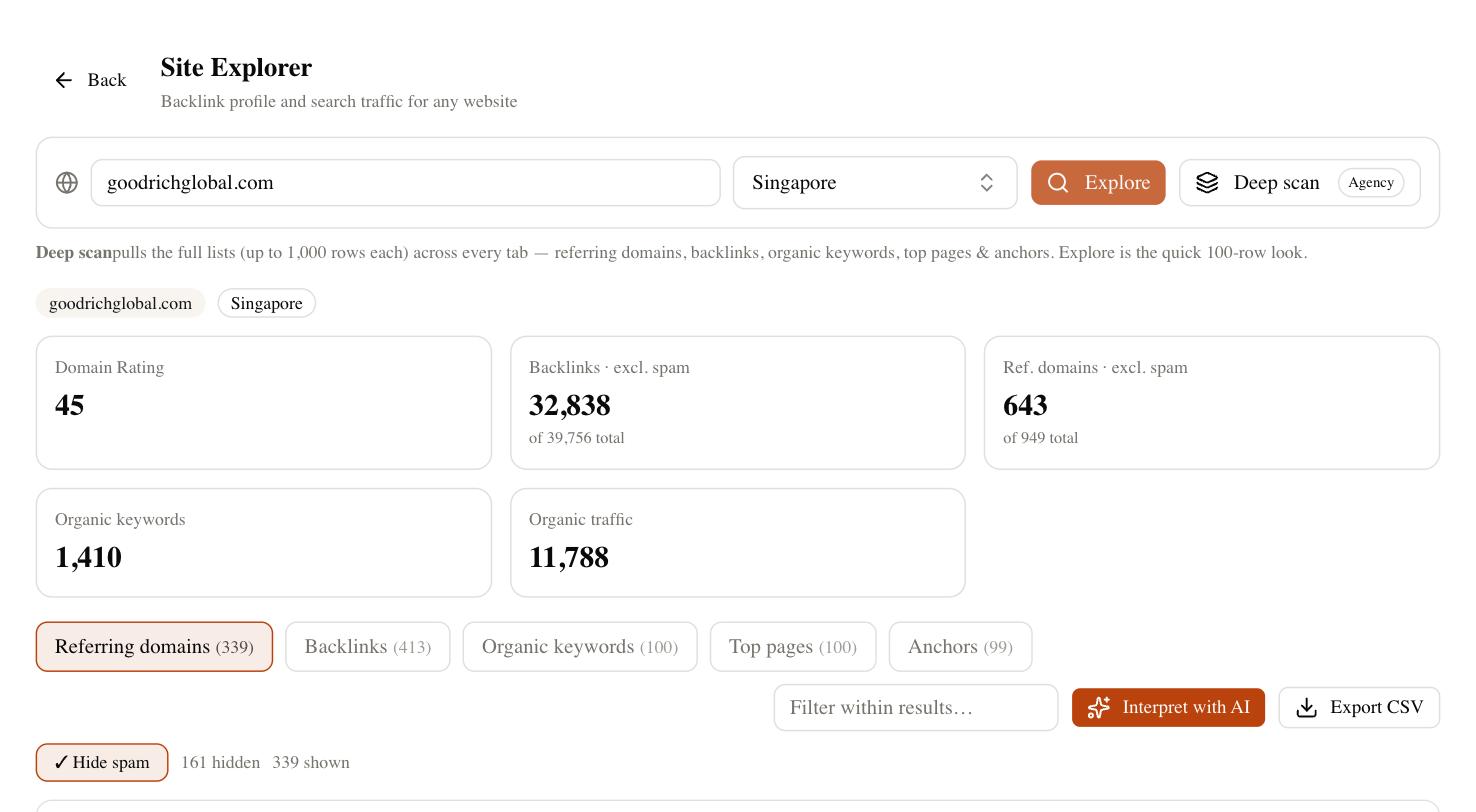
Be clear about what it is and is not. SEO Rocket will not build a directory citation or push listing updates to fifty aggregators — that is a dedicated local tool’s job. What it does better than any citation platform is the content and visibility half of local SEO: finding the “emergency [service] [city]” queries worth a page, writing that page, tracking where it lands, and telling you when an AI answer starts naming a competitor instead of you. For a solo owner or a lean agency, folding that into one subscription replaces a data tool, an AI writer, and an AI-visibility tracker at a fraction of a comparable Ahrefs stack. The agency client dashboard means you can hand a location owner a read-only report without exporting anything.
Google Business Profile — the free foundation you skip at your peril
No paid tool outranks a well-run Google Business Profile, and it costs nothing. This is the single biggest lever on your map-pack position: accurate categories, real hours, photos, posts, and a steady flow of genuine reviews you actually reply to. Before you spend a dollar on software, claim the profile, fill every field, and get your first twenty reviews. Plenty of local businesses buy a rank tracker to watch a number they could move faster by simply answering more reviews.
The limits are obvious: Google Business Profile shows you your own listing, not the competitive landscape, and its insights are thin. It tells you people found you, not why the shop two miles away outranks you for the query that matters. That is where the paid tools earn their place — measuring the gap the free profile cannot see.
BrightLocal, Whitespark and Local Falcon — the local specialists
These three own the parts of local SEO that national suites treat as an afterthought. Pick by the specific job you are weak on.
- BrightLocal — the all-round local platform. It combines geo-grid rank tracking, citation building, and review monitoring in one place, with reporting built for agencies handing dashboards to clients. If you manage several locations, its per-location structure keeps things sane.
- Whitespark — the citation specialist. Its Local Citation Finder pedigree makes it the tool for finding where you are listed inconsistently and fixing name, address, and phone data by hand. Less flashy, very effective at the unglamorous cleanup that quietly moves rankings.
- Local Falcon — the map-rank microscope. It plots your position across a grid of points around your address, so you can literally see that you rank first at the shop and eighth a mile east. Nothing shows proximity’s effect on the map pack as clearly.
The catch shared by all three: none of them writes your content or tells you whether an AI assistant recommends you. They measure and manage the map-and-citation layer beautifully, then stop. You will still run something alongside them for the organic pages and the AI-answer surface.
Semrush — the broad suite with a local add-on
Semrush is the closest thing to a do-everything marketing platform, and it bolts a Local add-on onto that breadth. You get listing management across aggregators, review handling, and map-rank tracking, sitting next to a full national keyword and competitor research suite. For a marketing team that also runs paid, content, and social from one login, that consolidation is real.
The trade-off is familiar. It gets expensive once you add the local module and the seats to make the suite worth buying, and a single-location owner pays for a lot of platform they will never open. If your world is one town and one storefront, a focused local tool plus a free Google Business Profile covers the same ground for far less.
How to choose the right stack for your local business
Match the tools to your weakest job, and expect to run two, not one. Almost everyone starts with a fully optimized Google Business Profile — that is free and non-optional. From there, ask what is actually holding you back. If your listings are a mess and citations are inconsistent, add Whitespark or BrightLocal. If you cannot see where you rank across the neighborhood, Local Falcon answers that in an afternoon. If your problem is that competitors outrank you on the organic pages and are starting to show up in AI answers you are absent from, SEO Rocket is the natural pick because it handles the content and AI-visibility half that the local specialists ignore.
A quick way to decide: write down the three local searches you most want to win, then check where you already stand. If you are missing from the map pack, your money goes to profile and citation work first. If you sit in the map but have no organic pages ranking beneath it, and you have no idea whether ChatGPT ever names you, you need the content-and-visibility tool more than another rank grid. Most local businesses land on a simple, honest stack: a great Google Business Profile, one local specialist for citations and map tracking, and SEO Rocket for the pages and the AI-search layer that decide who gets called next year. Give any tool a full ranking cycle before you judge it — local positions jitter with proximity and reviews, and no estimate is precise. The best tool is the one that fixes the job you are losing, not the one with the longest feature list.