Choosing the best SEO tools for consultants is a different problem from choosing tools for an in-house team. You are not optimizing one site with a fixed budget — you are juggling five, ten, maybe twenty clients, each with their own data, their own reports, and their own patience for jargon. The tool that wins is the one that saves you billable hours and makes you look sharp in front of a client, not the one with the longest feature list.
So this roundup judges the best SEO tools for consultants on the things that actually move your P&L: honest data you can defend, client-ready reporting, whether AI writing and AI-search visibility are built in, and total cost across a client roster. Below are seven real tools, what each is genuinely best at, and how to pick.
What a consultant actually needs from a tool
Strip away the marketing and a consultant’s toolkit comes down to four jobs. First, trustworthy research — keyword data, competitor gaps, and backlink profiles solid enough that you can build a strategy on them and defend it in a client meeting. Second, rank tracking across many domains without the per-project bill spiraling. Third, reporting a non-technical client can actually read, ideally white-labeled so it carries your brand instead of the vendor’s. Fourth, and increasingly, content production and AI-search visibility — because clients now ask whether they show up in ChatGPT, not just Google.
Most legacy tools nail one or two of those and make you bolt on the rest. That is the real cost for a consultant: not the sticker price of any single subscription, but the three or four subscriptions you end up stacking to cover the whole job. Every extra login is also another export to reconcile, another data model to explain, and another place your numbers can quietly disagree with each other in front of a client.
Best SEO tools for consultants at a glance
Start with the table, then read the notes on the two or three that match how you actually work.
| Tool | Best for | AI-native? | Standout strength | Rough price band |
|---|---|---|---|---|
| SEO Rocket | Solo consultants who want research, writing & client reports in one workflow | Yes — chat-first | Ahrefs-grade data + AI writing + AI-search visibility + white-label client dashboards | Low $ / entry-friendly |
| Ahrefs | Consultants whose work is heavy on backlink analysis | Limited | One of the largest, freshest link indexes | Higher $$ |
| Semrush | Consultants running SEO plus PPC and content for clients | Add-ons | Breadth across the whole marketing channel mix | Higher $$ |
| SE Ranking | Consultants watching cost per client project | Some | Affordable rank tracking that scales across many domains | Low–mid $ |
| Mangools | Freelancers who want fast, friendly keyword research | No | KWFinder’s ease of use | Low $ |
| Moz Pro | Consultants who value a gentle interface | No | Clean UI, long-trusted domain authority metric | Mid $$ |
| AgencyAnalytics | Consultants who live in client reporting | No | White-label dashboards pulling many data sources | Mid $$ |
SEO Rocket — the AI-native pick
SEO Rocket is built for the way consulting works now. Instead of hopping between tabs, you ask for what you need in plain language and it runs the lookup — keyword research, competitor gaps, backlink profiles, rank tracking — on real, Ahrefs-grade data underneath. The same tool then drafts the article and tracks whether your client’s brand is being cited in ChatGPT, Perplexity, and Google’s AI Overviews, which is the question more clients ask every month.
For a consultant, the client-facing side is where it earns its keep. You can hand a client a read-only, white-label dashboard instead of exporting a spreadsheet and rebuilding it in slides every month.
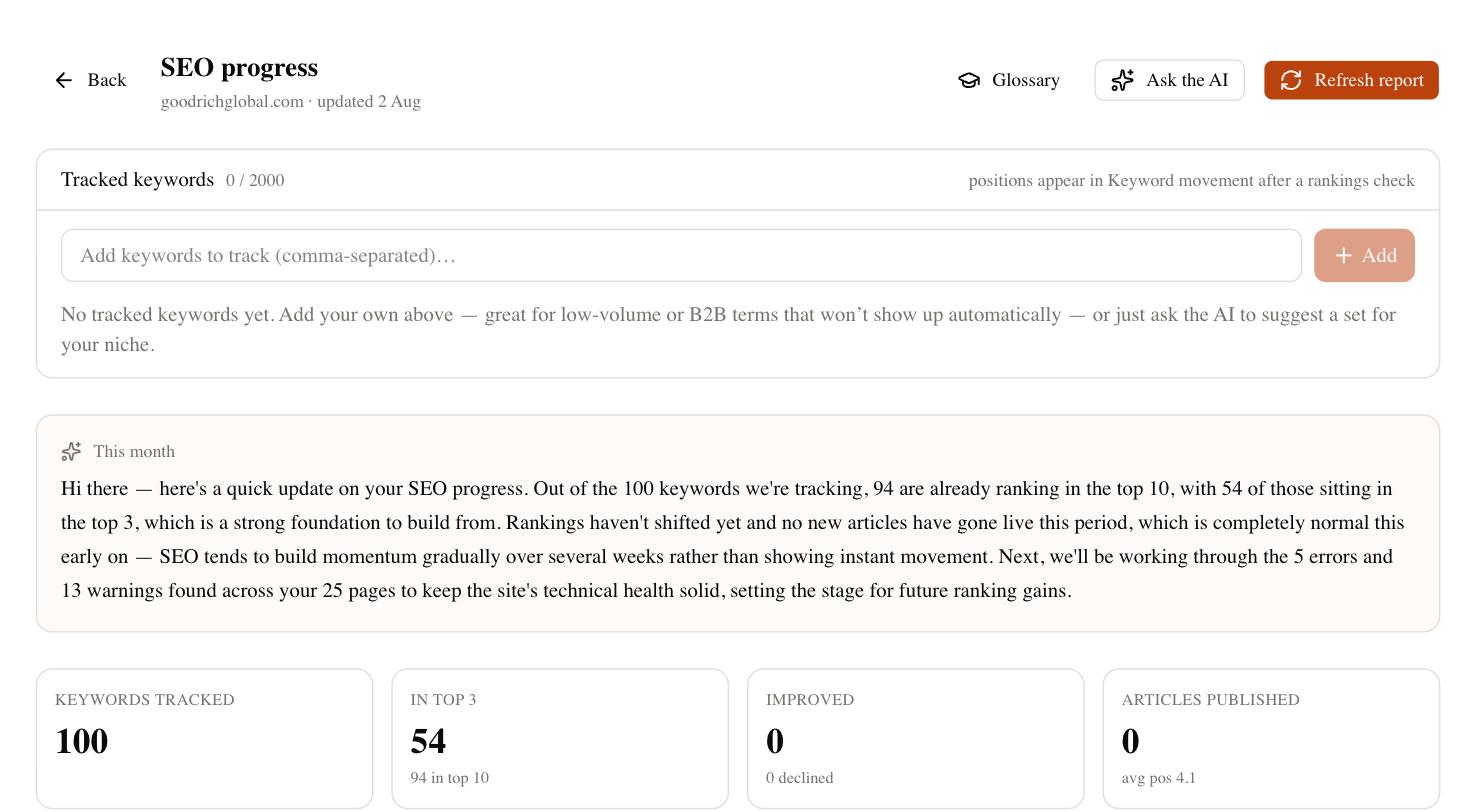
The real saving is consolidation. A typical consultant stack — a data tool like Ahrefs, plus a separate AI writer, plus a reporting platform, plus an AI-visibility tracker — collapses into one subscription at entry pricing that is a fraction of a comparable Ahrefs plan. There is also a cost-to-rank estimate and a competitor gap view that make scoping a new client faster, so you can quote work with numbers instead of guesses. If your bottleneck is doing more client work with fewer tools and fewer logins, this is the strongest fit on the list.
Ahrefs and Semrush — the data heavyweights
Ahrefs and Semrush are the tools most consultants cut their teeth on, and both remain excellent. Ahrefs has one of the largest and freshest backlink indexes anywhere, so if a meaningful slice of your work is link audits, disavow files, or link-building campaigns, its depth is genuinely hard to replace. Semrush casts a wider net — beyond SEO it covers PPC research, content, and social — which suits a consultant who handles a client’s whole marketing mix from one login.
The trade-off for both is the same, and it stings more for a consultant than for an in-house team: they are expensive once you add the seats and projects a client roster demands, the learning curve is steep, and neither folds AI content and AI-answer visibility into the core workflow. You will likely run a second subscription for that, which is exactly the tool sprawl a lean practice is trying to avoid.
SE Ranking, Mangools and Moz Pro — value and simplicity
The mid-market has strong options when budget and ease matter more than raw index size.
- SE Ranking — the cost-per-project play. Rank tracking scales affordably across many client domains, and predictable per-project pricing keeps your margins clean as the roster grows.
- Mangools — the freelancer favorite. KWFinder is one of the nicest keyword-research experiences going, and the bundle stays cheap enough for a first few clients.
- Moz Pro — the gentle on-ramp. If Ahrefs felt overwhelming, Moz’s cleaner interface and long-trusted domain authority metric make client conversations easier, though the index is smaller.
Any of these covers core keyword and rank-tracking work at a price a growing practice can stomach. What none of them do yet is build AI writing and AI-answer visibility into the same place — so plan on a separate tool for content and for tracking your presence in AI answers.
AgencyAnalytics — reporting-first
AgencyAnalytics comes at the problem from the client-reporting end rather than the research end. It pulls data from many sources — search, ads, social, third-party rank trackers — into white-label dashboards a client can log into with your branding on top. For a consultant whose weekly pain is assembling reports, that alone can justify the cost.
The honest caveat is that it is a reporting layer, not a research engine. You still need a tool underneath it to actually do keyword research, link analysis, and content work, which means it lives on top of your stack rather than replacing anything in it. If reporting is your only gap and you are happy with the research tools you already pay for, it fills that gap well; if you are trying to shrink your stack, layering another subscription on top runs the opposite direction.
How to choose the best SEO tools for your consulting practice
Match the tool to your real constraint, not to a feature grid. Write down the three tasks you actually billed for last week. If the list is some mix of “research a client’s opportunity,” “produce content,” and “send a report,” you are the exact case an AI-native, all-in-one tool like SEO Rocket was built for, and you are probably overpaying for a stack that does those three things across four logins. If instead your week was three hours deep in link audits, keep Ahrefs; if it spanned SEO, PPC, and social for one client, Semrush earns its price.
Whatever you shortlist, test it on your own site plus two client domains for a full ranking cycle before you commit. Positions jitter a few spots day to day and every tool’s traffic estimates are just estimates, so give it a week of real work and judge it on one thing: how fast it answers the questions your clients actually ask. The best tool for a consultant is the one that gets you to a defensible, client-ready answer with the fewest tabs open.