The best domain research tools aren’t the ones that check whether a name is available — a registrar does that for free. They’re the ones that answer the expensive question: is this domain worth acquiring, and will its authority survive a 301 redirect into your site? A name can carry a Domain Rating of 40 and still be a graveyard of spam links pointing at a site that hasn’t seen real traffic since 2019.
This roundup compares the tools serious buyers actually use to research a domain before they wire money — whether you’re hunting expired domains to redirect, buying an aged name for a new brand, or valuing a portfolio to sell. SEO Rocket is featured first because it’s what we build, but every tool below gets an honest best-for, and for some buyers the right answer is a $5 expired-domain database, not a subscription.
What “domain research” really means
People use the phrase to mean two very different jobs. The first is availability and naming — is yourname.com free, what does it cost, are there better TLDs. That’s a five-minute registrar task and no premium tool is required. The second job is the one that separates a smart acquisition from a costly mistake: evaluating a domain’s existing SEO equity. That means its backlink profile, how much of that profile is genuine versus PBN spam, its real organic-traffic history, whether it’s been penalized, and whether the homepage already quietly redirects somewhere else.
Everything in this guide is aimed at that second job. If you only need to check availability, close the tab and go to any registrar. If you’re about to pay three or four figures for a name because a tool flashed a high authority score, keep reading — that score is exactly where people get burned.
How we compared them
Each tool is judged on four things a buyer genuinely cares about. First, the quality and freshness of the underlying link and traffic data, because a valuation is only as good as its inputs. Second, whether it distinguishes real link equity from spam and toxic links instead of trusting a single authority number. Third, honest total cost, not the headline. And fourth, who the tool is actually for — a domain flipper, an SEO redirecting expired names, or someone buying one aged domain for a rebrand.
One caveat that applies to every tool here: authority metrics like Domain Rating and traffic estimates are third-party approximations. Treat differences between tools as directional, and never let a single number stand in for reading the actual link profile.
The best domain research tools at a glance
Start with the table, then read the notes on the two or three that fit your use case.
| Tool | Best for | AI-native? | Standout strength | Rough price band |
|---|---|---|---|---|
| SEO Rocket | SEOs & agencies vetting a domain to buy or redirect | Yes — chat-first | Buy/pass verdict from real link + traffic history, spam-filtered | Low $ / entry-friendly |
| Ahrefs | Deep manual backlink audits on a target domain | No | One of the largest, freshest link indexes | Higher $$ |
| Spamzilla | Bulk-vetting expired domains for spam and history | No | Aggregated spam scores + archive history in one view | Low–mid $ |
| ExpiredDomains.net | Free bulk hunting of dropped and expiring names | No | Enormous, filterable database at no cost | Free / low $ |
| Estibot | Automated dollar valuations for buying and selling | Light | Fast appraisal engine for name-level worth | Low–mid $ |
| DomCop | Flippers scanning marketplaces with SEO metrics | No | Millions of listings ranked by authority signals | Low–mid $ |
SEO Rocket — the AI-native verdict machine
SEO Rocket approaches domain research the way an experienced buyer does: it doesn’t hand you a number and wish you luck, it gives you a buy-or-pass read. You paste a domain into the Buy & Sell Domains view and it pulls the backlink overview, the top referring domains, the anchor profile, and the organic-traffic history on real, Ahrefs-grade data — then classifies every referring domain as clean, spam, or toxic and tells you what percentage of that shiny Domain Rating is actually inflated by junk.
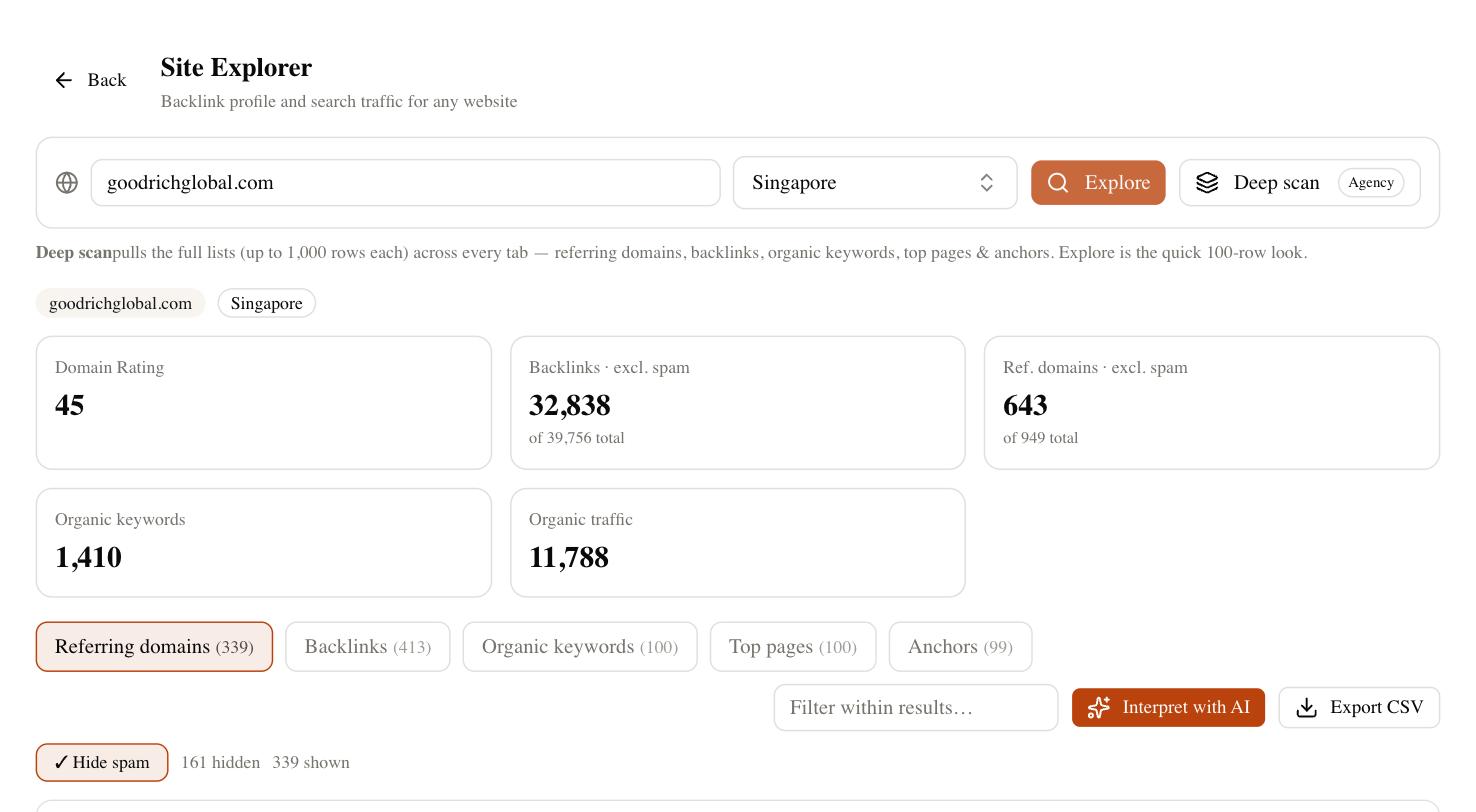
The traffic-history chart is the part that saves you money. A domain that peaked at a few thousand organic visits in 2018 and now sits at two percent of that peak is the classic penalized-or-expired pattern — its authority is a mirage held up by old links, and SEO Rocket flags it as exactly that. It also detects when a homepage already 301-redirects off-site, a sign the equity has been siphoned before you ever got there. Because it’s chat-first, you can ask it to assess five candidates at once and get back a plain-language verdict on each, with the clean linkers you’d actually inherit listed out.
Where it fits: solo SEOs, consultants, and agencies who are buying domains to redirect or rebrand and want the judgment, not just the raw export. It won’t replace a registrar for the actual purchase, and a pure domain flipper trading hundreds of names a month may still want a dedicated marketplace scraper alongside it. But for turning “this looks authoritative” into “this is safe to buy, here’s why,” it’s the most complete pick on the list.
Ahrefs, Spamzilla and the specialists
Ahrefs remains the gold standard for the raw material. If your workflow is to manually audit a target domain’s backlinks — reading referring domains one by one, checking anchor distribution, spotting link velocity — its index is deep and fresh, and few tools match it for a genuinely forensic link audit. The trade-off is that it does the looking, not the concluding: you assemble the verdict yourself, and the pricing is built for full-time SEO work, not the occasional acquisition.
The specialists each own a slice of the job:
- Spamzilla — the expired-domain vetting workhorse. It aggregates spam scores, blacklist checks, and Wayback history so you can filter thousands of dropped names down to the few worth a closer look. Ideal when volume is your problem.
- Estibot — the appraisal engine. When you need a dollar figure to anchor a buy or sell decision at the name level, its automated valuations are fast and widely referenced, though like any appraisal they’re a starting point, not gospel.
- DomCop — the marketplace scanner. It pulls millions of expired and auction listings and ranks them by authority signals, which is a strong fit for flippers who want to surface candidates before rivals do.
What none of these do is close the loop the way an all-in-one does. You’ll often run a name through two or three of them — Spamzilla for history, Estibot for a number, Ahrefs for the deep link read — and reconcile the answers yourself.
The free option worth knowing
ExpiredDomains.net deserves its own mention because it’s free and genuinely useful. It’s a massive, filterable database of dropped, expiring, and auction domains, sortable by the metrics that matter — referring domains, age, backlink counts pulled from third-party sources. For hunting raw candidates it’s hard to beat on price, and many buyers start their day here.
The catch is that it surfaces names, not judgment. The metrics it displays are borrowed and cached, so a domain that looks strong in the list can fall apart the moment you check its live link profile or traffic history elsewhere. Use it as the top of your funnel, then verify every serious candidate in a tool that reads current data. Free is the right price for discovery; it’s the wrong price for the final buy decision.
How to choose for your use case
Match the tool to how you actually buy. If you’re an SEO or agency acquiring a handful of domains to redirect or rebrand and you want a defensible buy/pass verdict — spam ratio, traffic trajectory, redirect status, all read for you — SEO Rocket is the natural pick, and its entry pricing suits occasional buyers. If you live inside backlink audits and want to draw your own conclusions from the deepest index, Ahrefs earns its keep. If you move at volume through expired auctions, pair a discovery source like ExpiredDomains.net or DomCop with Spamzilla for vetting and Estibot for a price anchor.
Whatever you choose, run the same discipline every time before you pay. Pull the live backlink profile and ask what share is genuine versus spam. Look at the organic-traffic history, not just the authority score — a collapsed curve is the single loudest warning a domain gives you. Confirm the homepage still resolves to itself and hasn’t been quietly redirected. Do those three checks on any candidate and you’ll avoid the mistake that catches most first-time buyers: paying for authority that evaporates the day the redirect goes live. The best tool is the one that makes those checks fast enough that you never skip them.