If you’re weighing Jasper vs Frase for SEO, you’ve already spotted the thing most comparison posts gloss over: these tools are not really the same category. Jasper is a marketing writer that happens to touch SEO. Frase is an SEO research tool that happens to write. Line them up on a feature grid and they look like rivals, but the honest answer to “which is better” depends entirely on which half of the job you care about more.
This is a head-to-head from someone who runs both kinds of workflow every week. Below you’ll find where each tool genuinely wins, where each one leaves you reaching for a second subscription, and a third option worth a look if you’d rather not stitch three tools together.
What each tool is actually built for
Jasper started life as a copywriting engine and still thinks like one. Its strengths are brand voice, tone control, and cranking out volume across formats — ad copy, email sequences, landing pages, long-form drafts that sound like your company wrote them. If you manage content across channels and your bottleneck is producing polished words at scale, Jasper is squarely aimed at you.
Frase comes at the same page from the search side. Type a target keyword and it scrapes the top results, pulls the headings, questions, and subtopics your competitors cover, and hands you a brief scored against what’s already ranking. The writing feature is competent, but the reason people keep Frase is the research and the optimization score, not the prose. It answers “what does this page need to include to compete” better than almost anything at its price.
Jasper vs Frase for SEO at a glance
Here’s the honest shape of the two tools side by side. Treat the price bands as approximate — both vendors change tiers often, and your real cost depends on seats and word volume.
| Dimension | Jasper | Frase |
|---|---|---|
| SEO data quality | Thin — no native SERP or keyword database; leans on integrations | Strong for on-page — live SERP scraping, topic and question mining |
| Ease of use | Very polished, template-driven, gentle learning curve | Straightforward, but the brief editor takes a session to click |
| AI writing features | Excellent — brand voice, multi-format, long-form fluency | Good enough — built to fill a brief, not to win a tagline |
| Best for | Marketing teams producing lots of on-brand content | SEO writers optimizing pages to rank against competitors |
| Rough price band | Higher — entry runs roughly $40-70/mo per seat, business tiers well above | Lower — entry runs roughly $15-45/mo |
Verdict: SEO research and data
This segment isn’t close. Frase wins because it actually does SEO research — it reads the live SERP, surfaces the questions People Also Ask, and scores your draft against the pages you’re trying to beat. That closed loop of research, brief, and optimization score is the whole reason the tool exists, and it’s genuinely useful when your job is getting a page onto page one.
Jasper simply isn’t playing this game natively. It has no keyword difficulty, no SERP analysis, no content score of its own; to get that you bolt on a separate optimizer and pay for both. So if raw SEO research is your deciding factor, Frase is the honest pick and it isn’t a hard call. Just know the ceiling: neither tool gives you Ahrefs-grade keyword volumes, difficulty, or backlink data. Frase reads the SERP well, but it won’t tell you which keyword is worth targeting in the first place.
Verdict: AI writing and features
Flip the question to “which one writes better,” and the winner flips too. Jasper is the stronger writer by a clear margin — brand voice control, consistent tone across a long article, and format range that stretches from a two-line ad to a 2,000-word guide without sounding robotic. For teams pushing high volume across channels, that fluency saves real editing hours.
Frase writes to fill a brief, and it shows. The output is serviceable and on-topic, but you’ll spend more time rewriting it into something with a voice. If your content lives or dies on how it reads — thought leadership, brand storytelling, conversion copy — Jasper earns its higher price here. If you mainly need competent paragraphs slotted under the right headings, Frase’s writing is enough and you’re really paying for the research anyway.
Verdict: ease of use and price
On ease, both are approachable, but they’re easy in different ways. Jasper is the more finished product — templates, a clean editor, and onboarding that gets a non-technical marketer producing on day one. Frase asks a little more upfront; the brief-and-score workflow takes a session to internalize before it feels fast. Neither is hard.
Price is where Frase pulls clearly ahead. Its entry plans sit in the low tens of dollars a month, while Jasper’s genuinely useful tiers climb into the higher bands once you add seats or need more brand-voice features. If budget is the constraint and you want SEO research included, Frase gives you more of the SEO job for less money. If your budget already assumes a premium writer and the content quality justifies it, Jasper’s cost is defensible — just not on SEO grounds alone.
Where SEO Rocket fits in
Notice the pattern in every verdict above: whichever tool you choose, you end up shopping for the other half. Frase for research plus something for polished writing, or Jasper for writing plus something for real keyword and backlink data. That gap is exactly what SEO Rocket is built to close. It’s a chat-first, AI-native SEO tool — you ask for what you need in plain language and it runs the work on real, Ahrefs-grade data underneath.
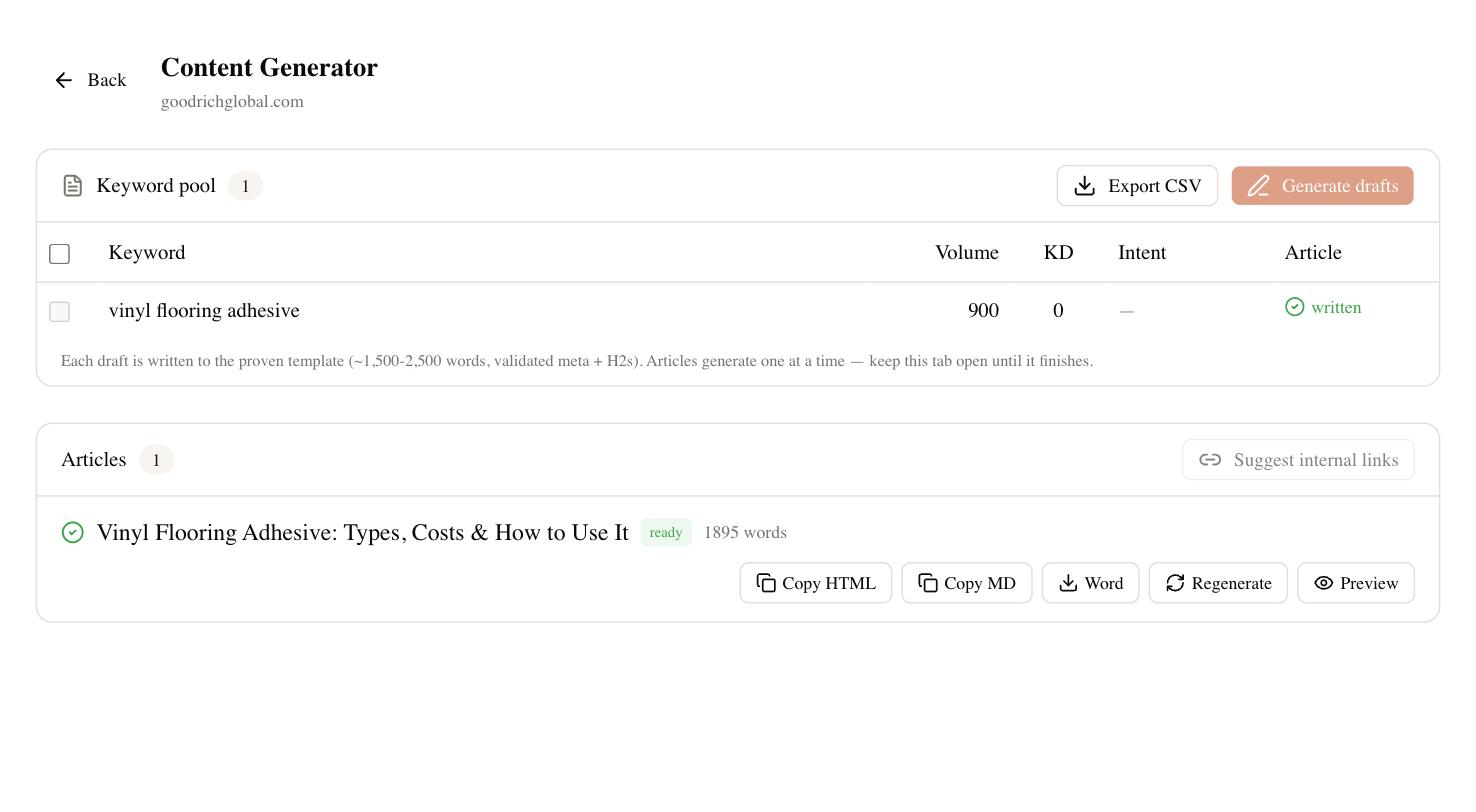
The difference is scope. SEO Rocket does the keyword research and competitor gap analysis that neither Jasper nor Frase covers with real data, drafts the article with Claude, and then shows you something both rivals miss entirely: whether your brand is being cited in ChatGPT, Perplexity, and Google’s AI Overviews. For a solo SEO or agency whose actual constraint is doing more work with fewer logins, folding research, writing, rank tracking, and AI-search visibility into one subscription is a stronger fit than pairing two specialists. It’s worth a look before you commit to either tool on this page.
So which should you pick?
Match the tool to your real bottleneck, not to a feature list. If your job is optimizing pages to outrank specific competitors and budget matters, Frase is the honest winner — it does the SEO research work Jasper doesn’t, and it costs less. If your job is producing a high volume of on-brand content across channels and SEO is one input among many, Jasper is the better writer and worth its premium, provided you accept you’ll add an optimizer alongside it.
And if the thing you keep hitting is tool sprawl — paying for research in one place, writing in another, and still having no idea whether AI search ever mentions you — that’s the case where a single AI-native workflow like SEO Rocket makes more sense than winning the Jasper-versus-Frase argument at all. Whatever you choose, run your own site and two competitors through it for a week before you decide; the tool that answers your real questions fastest is the right one, and no feature page will tell you that faster than a live trial.