If you are asking is Ahrefs worth it in 2026, you are almost certainly staring at a renewal invoice and doing the math. Ahrefs is one of the best backlink and keyword tools ever built, but the price has crept up while the job around it has changed, and that gap is what makes the question worth asking at all. This review is not a sales page for or against it — it is a straight look at what Ahrefs does genuinely well, where it now falls short, roughly what you will pay, and who should keep it versus who should move on.
I use Ahrefs data most weeks, so this comes from daily use rather than a feature sheet. The short version: it is still excellent at the two things it was built for, and increasingly expensive for everything it was not.
What Ahrefs still does exceptionally well
Two areas keep Ahrefs at the front of the pack. The first is its backlink index. It crawls the web aggressively and refreshes fast, so when you audit a link profile, chase a competitor’s new referring domains, or build a disavow file, you are working from one of the deepest and freshest link datasets available. Nothing in the cheaper tier matches that depth, and for a link-building specialist that alone can justify the bill.
The second is keyword and ranking data. Site Explorer gives you a clean, trustworthy read on a domain’s organic traffic, top pages, and keyword footprint, and Keywords Explorer’s difficulty and volume estimates are among the more reliable in the industry. The interface is dense but consistent, the exports are clean, and once you learn where things live you move quickly. If your day is competitive research and link analysis, Ahrefs earns its keep.
Where Ahrefs falls short now
The weaknesses are less about quality and more about shape. Ahrefs was designed for a workflow that predates AI writing and AI search, and it still treats those as somebody else’s problem. It will tell you what to rank for; it will not draft the article. It tracks Google positions beautifully; it barely touches whether ChatGPT, Perplexity, or Google’s AI Overviews ever cite you — and for a growing slice of buyers, that is where the discovery now happens.
Then there is the credit system. Reports, exports, and refreshes draw from a monthly allowance, and on a busy account you can burn through it well before month-end, which nudges you toward a higher tier than you expected to need. The learning curve is real too: Ahrefs is dense, and most users touch maybe a fifth of it while paying for all of it. None of this makes the tool bad. It makes it a specialist instrument in a job that increasingly wants one connected workflow.
How much does Ahrefs cost?
Prices move, so treat this as a band rather than a quote. Ahrefs entry plans run in the low hundreds a month, with the mid and higher tiers climbing quickly once you add users, more projects, or a bigger keyword and crawl allowance. Annual billing softens it a little. The honest number is rarely the headline number: factor in the credits you will actually consume and the seats your team needs, and the effective monthly cost is usually a tier above where you start.
For comparison, the weakest of the mainstream page-one rivals still cover core keyword and rank tracking for a fraction of that. You are paying the Ahrefs premium specifically for index depth. The question is whether you use enough of that depth to justify it.
Ahrefs pros and cons at a glance
Here is the trade-off in one view before we talk about who it suits.
| Strengths | Weaknesses | Best for |
|---|---|---|
| Deep, fresh backlink index | No built-in AI content writing | Link-building specialists |
| Reliable keyword difficulty & volume | Little to no AI-search visibility tracking | Competitive researchers |
| Clean Site Explorer & exports | Credit limits throttle heavy accounts | Large in-house SEO teams |
| Consistent, trustworthy data | Steep learning curve, dense UI | Agencies with the budget |
| Strong competitor analysis | Entry price in the low hundreds/mo | Users who live in backlink data |
Who Ahrefs is genuinely worth it for
Ahrefs is worth every dollar for a specific profile. If backlink analysis is the center of your work — competitive link audits, disavow management, link building at scale — the index depth is hard to replace and you will rarely regret staying. The same goes for large in-house teams and well-funded agencies where the data quality feeds real decisions and the price is a rounding error against headcount.
It is also the safe pick when you need defensible numbers to show a client or a boss. Ahrefs estimates are directional like everyone’s, but they are consistent, and consistency is what you want when someone challenges a report. If that describes you, stop shopping — the answer to whether it is worth it is yes.
The honest alternative: an AI-native workflow
For everyone else — solo SEOs, consultants, and small agencies whose real bottleneck is doing more with fewer tools — the calculus has shifted. Much of what you open Ahrefs for is now available on comparable, Ahrefs-grade data in tools built for how the job works today. SEO Rocket is the clearest example: you ask for what you need in plain language, and it runs the keyword research, competitor gap analysis, backlink lookups, and rank tracking on real data underneath, then drafts the content and tracks whether your brand is being cited across ChatGPT, Perplexity, and AI Overviews.
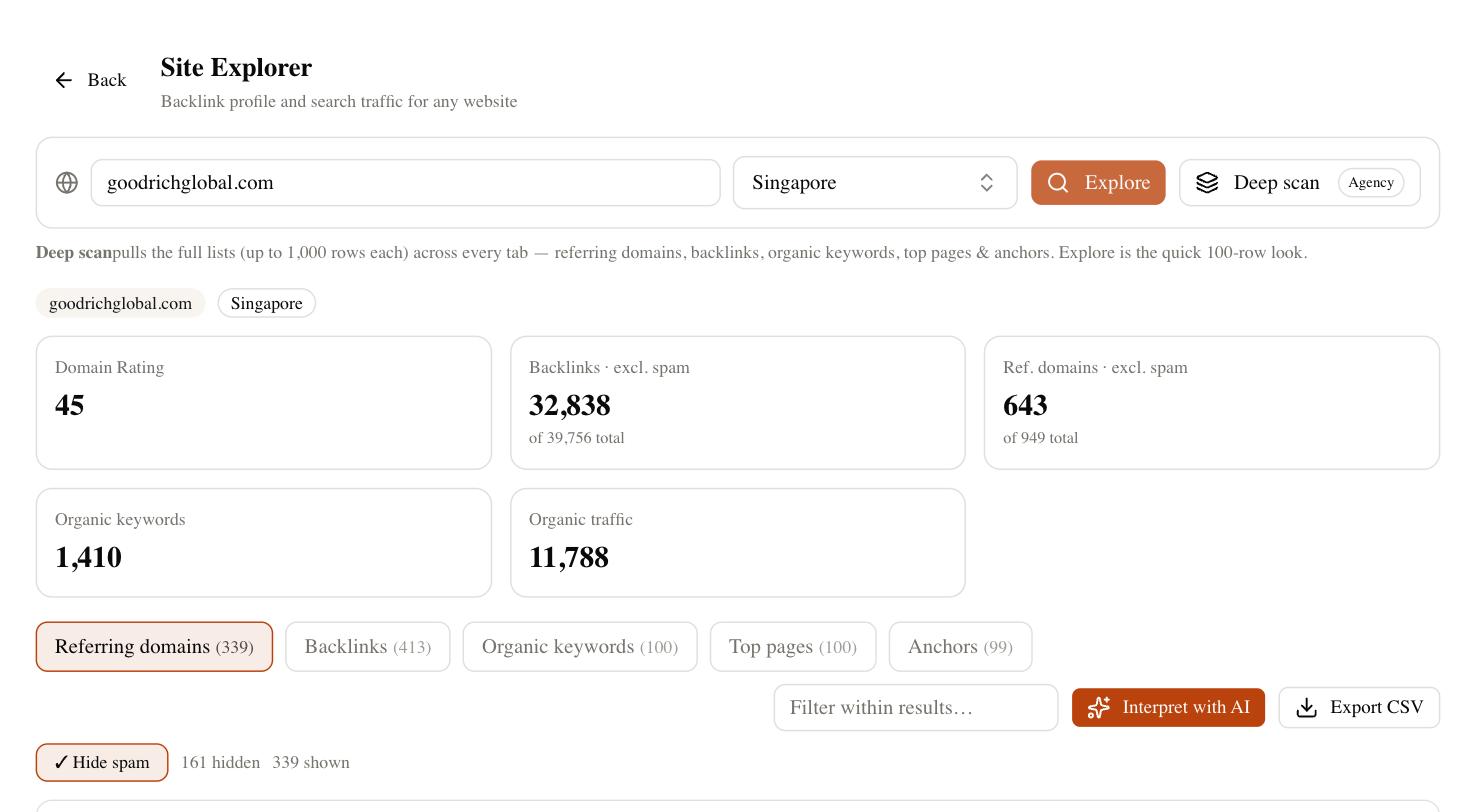
The saving is not just the sticker price, though entry pricing is a fraction of a comparable Ahrefs plan. It is the consolidation: a stack of Ahrefs plus a separate AI writer plus an AI-visibility tracker collapses into one subscription, and for consultants the client-dashboard side means a read-only report goes straight to a client without exporting anything. I would not pitch this to a hardcore link builder — Ahrefs still wins on raw index depth. But if your last three tasks were “check what I rank for,” “see what a competitor is doing,” and “produce a piece of content,” an AI-native tool covers that faster and cheaper.
The verdict: is Ahrefs worth it in 2026?
It depends entirely on your week. Match the tool to your real constraint, not to a feature checklist. Ahrefs remains worth it if you live in backlink data, run a well-resourced team, or need the most trusted numbers in the room — the depth is real and it is not going anywhere. It stops being worth it when you are paying enterprise-backlink prices for a mid-tier workflow you could run leaner and cheaper elsewhere.
A quick test before you renew: write down the three things you actually did in your SEO tool last week. If two of them were content and AI-search visibility rather than link audits, you are overpaying for depth you barely touch, and a leaner, AI-native tool will serve you better. If all three were deep in the link index, keep Ahrefs and do not look back. Either way, run your own site and two competitors through whatever you choose for a full ranking cycle before you judge it — positions jitter a few spots day to day, and no tool’s estimates are gospel.