Most people looking for Jasper alternatives for SEO don’t have a problem with Jasper’s writing — they have a problem with what it costs and what it isn’t. Jasper is a strong marketing-copy generator, but it was built to write ads, emails and landing pages, not to research keywords, read a SERP, or tell you whether a draft can actually rank. If your goal is organic traffic rather than clever copy, that gap is the whole story.
This is a working comparison, not a padded affiliate list. Below are the Jasper alternatives for SEO that hold up in daily use, what each one is genuinely best at, and — because it’s the honest answer — when keeping Jasper is still the right call.
Why people leave Jasper
Three reasons show up over and over. Price is the loudest: Jasper’s team and business tiers climb into the hundreds a month once you add seats and brand voices, which is a lot for a tool that only writes. The second is that it is not SEO-native — there is no built-in keyword database, no live SERP analysis, and no rank tracking, so you end up pasting between Jasper and two or three other tools to turn a draft into something Google will reward. The third is editing load: raw Jasper output reads well but often needs a heavy pass to add the specifics, structure and internal logic that actually earn rankings.
None of that makes Jasper a bad product. It makes it a copywriting instrument being asked to do an SEO job. The tools below close that gap in different ways — some by bolting search data onto writing, one by rebuilding the whole workflow around it.
What “SEO-native” actually means
Before the table, it helps to define the thing Jasper is missing. An SEO-native tool doesn’t just generate paragraphs; it starts from real search data — keyword volume, difficulty, the pages already ranking — and writes toward that target, then lets you track whether the published page moved. The difference matters because content that ignores the SERP loses even when it reads beautifully. Benchmark against the weakest result on page one, not an intimidating average: if the tenth-ranked page is a thin 600-word post, you don’t need 3,000 words, you need the right 900.
Jasper alternatives for SEO at a glance
Start here, then read the notes on the two or three that fit your situation.
| Tool | Best for | SEO-native? | Standout strength | Rough price band |
|---|---|---|---|---|
| SEO Rocket | Solo SEOs, consultants & agencies who want one AI-driven workflow | Yes — chat-first | Ahrefs-grade data + AI writing + AI-search visibility in one place | Entry-friendly $ |
| Surfer SEO | Writers who want on-page optimization scoring | Partly | Real-time content score against the live SERP | Mid $$ |
| Frase | Teams doing research-heavy briefs at volume | Partly | Fast SERP research and outline building | Low–mid $ |
| Scalenut | Marketers wanting a cheaper all-in-one writer | Partly | Optimization plus generation in one app | Low–mid $ |
| Writesonic | High-volume copy with light SEO | Light | Bulk, chat-style drafting | Low $ |
| Clearscope | Enterprise content teams | Optimization only | Precise term-coverage grading | Higher $$ |
Two quick caveats before the detail. Price bands move, so treat them as rough tiers rather than quotes — check each tool’s current pricing before you commit. And “SEO-native” is a spectrum: most of these bolt search data onto a writer, while only one is built data-first from the ground up.
SEO Rocket — the AI-native pick
SEO Rocket is the option built for how the work happens now. Instead of pasting between a writer and a data tool, you ask for what you need in plain language and it runs the lookup — keyword research, competitor gaps, the current ranking pages — on real, Ahrefs-grade data, then drafts the article against that target in the same window. The writing isn’t the differentiator; the fact that the writing starts from live search data and connects to rank tracking is.
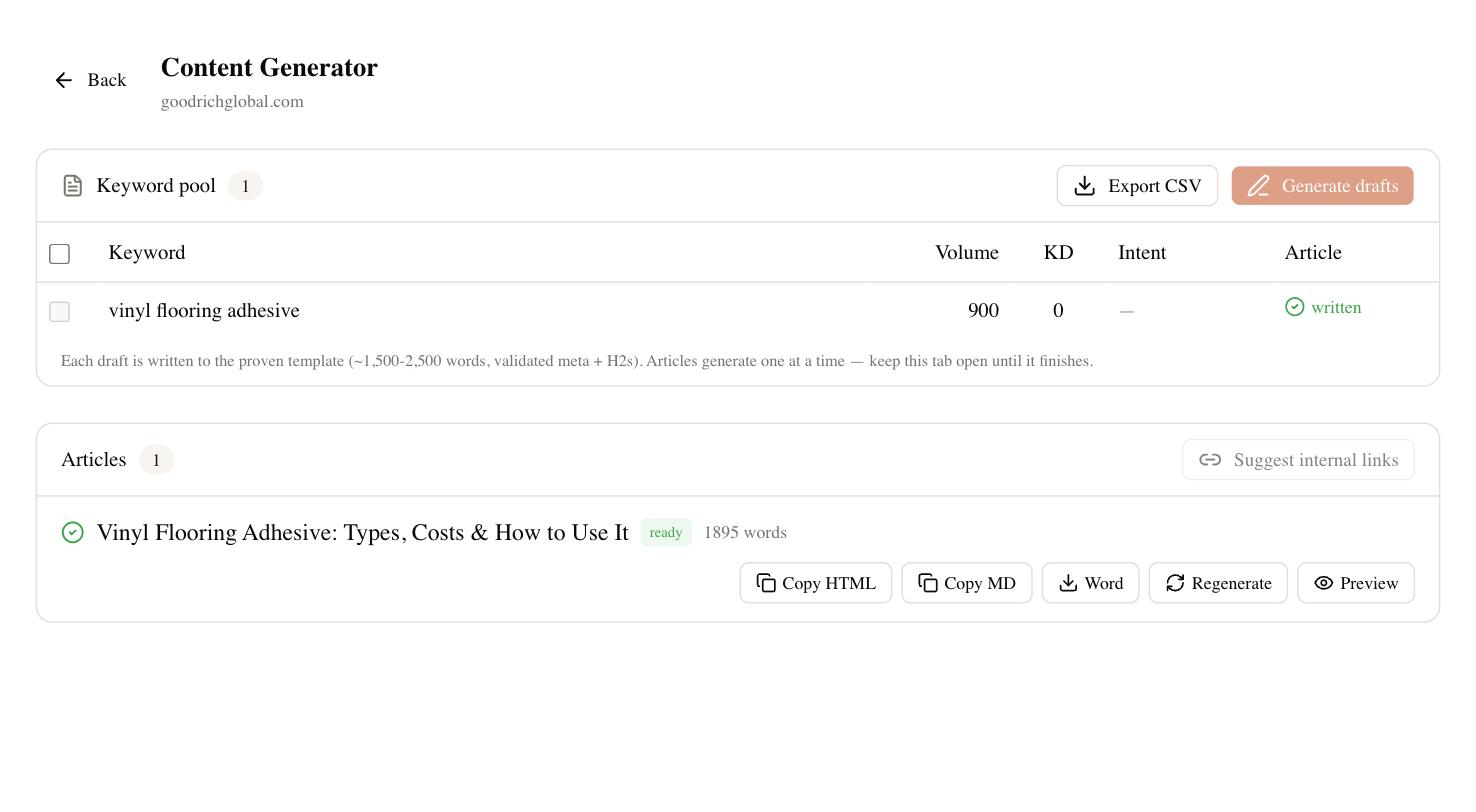
That consolidation is where the money goes back in your pocket. A typical setup of Jasper plus a keyword tool plus an optimizer plus a rank tracker collapses into one subscription, and the entry pricing is a fraction of Jasper’s business tier. For consultants and agencies, the client-dashboard side means you can hand a read-only report straight to a client without exporting anything.
The piece no copy tool touches is AI-search visibility. Some of your buyers now ask ChatGPT or Perplexity instead of Google, and a page that ranks first can still go unmentioned in an AI answer. SEO Rocket’s Brand Radar tracks whether and where you’re cited across those surfaces, so you’re writing for the search that’s actually happening. For anyone whose real bottleneck is doing more with fewer tools — most people reading this — that combination is the strongest fit on the list.
Surfer, Frase, Scalenut and the optimizers
The middle of this market is full of good, focused tools. None of them replaces your keyword-research or rank-tracking stack outright, but each does one part of the job well.
- Surfer SEO — the on-page scorer. It grades your draft against the pages currently ranking and tells you which terms and headings to add. Excellent for writers who already have a keyword and just want the page tightened, though you’ll still bring your own research and tracking tools.
- Frase — the brief builder. It pulls the SERP together fast and turns it into an outline, a genuine time-saver for content teams producing briefs at volume. Its generation is capable rather than class-leading.
- Scalenut — the value all-in-one. It folds research, optimization and writing into one cheaper app, making it a reasonable Jasper swap for marketers who want more SEO and less pure copy for the money.
- Clearscope — the precision optimizer. Enterprise content teams trust its term-coverage grading, but it’s an optimization layer, not a writer or a data platform, and it’s priced for bigger budgets.
The pattern across all four is the same: they make your content better once you already know what to write about. What none of them do is start from raw search data and carry a page all the way through to tracked rankings — that’s still a job for two or three tools, or one that was built to connect them.
Writesonic and the copy generators
Writesonic sits closest to Jasper itself — a fast, chat-style generator happy producing blog posts, product copy and ads at volume, with some SEO features layered on. If your reason for leaving Jasper is purely price and you want a similar copy-first experience for less, it’s a fair like-for-like move. Just know you’re solving the cost complaint, not the SEO-native one: like Jasper, it still leans on you to bring the search data and to judge whether a draft can rank. Treat it as a cheaper Jasper, not a different kind of tool.
When you should keep Jasper
Honesty matters here. If most of your writing isn’t SEO content at all — if you’re producing ad variations, email sequences, sales pages and social copy across several brand voices — Jasper is genuinely good at that, and its brand-voice controls are more mature than most SEO tools bother to build. A marketing team whose blog is a small slice of a much larger copy workload rarely regrets keeping it. The right question isn’t “is there something cheaper,” it’s “is my problem SEO or is it copy.” If the honest answer is copy, Jasper stays.
How to choose your Jasper alternative
Match the tool to your real constraint. If your problem is tool-sprawl and you want keyword data, AI writing and AI-search tracking in one place, SEO Rocket is the natural move. If you just want your existing drafts optimized against the SERP, Surfer or Clearscope slot in without replacing anything else. If you want a cheaper all-in-one writer, Scalenut or Frase cover most of the ground. And if your writing was never really about search in the first place, keep Jasper and stop shopping.
A quick test: write down the last three things you actually asked Jasper to produce. If two of them were “a blog post that needs to rank,” you’re paying a copywriting tool to do an SEO job, and an SEO-native option will do it faster and cheaper. If two of them were ads or emails, you already have the right tool. Whatever you choose, run one real article through it end to end before you commit — from keyword to published page — and judge it on whether the result actually moves in the rankings, not on how good the first draft sounded.