
If you’re weighing Frase vs Surfer SEO, you’ve already narrowed the field to two of the better content-optimization tools on the market — and picked the two that are easiest to confuse. Both promise the same headline outcome: feed them a keyword, and they tell you what to write to rank. Under the hood they solve slightly different problems, and buying the wrong one means paying every month for a workflow that fights how you actually work.
This is a straight head-to-head, not a feature-count contest. Below you’ll see where each tool genuinely leads, who should pick which, and — because it’s the honest answer for a lot of readers now — where a newer AI-native option changes the math entirely.
What each tool is really built for
Surfer SEO is a content-optimization engine first. Its core loop is the Content Editor: you give it a target keyword, it scrapes the current page-one results, and it hands you a real-time score based on term coverage, word count, headings, and structure. You write (or paste) into the editor and watch the number climb. It is very good at one thing — making a single page look, statistically, like the pages already winning.
Frase leans on research and drafting. It pulls the top-ranking results for your query, summarizes what they cover, and builds an outline and brief from that analysis, then helps you generate the draft with its AI writer. Where Surfer obsesses over the optimization score, Frase spends more of its energy on the earlier steps: what to say, in what order, and answering the questions searchers actually ask.
Frase vs Surfer SEO at a glance
Start with the summary, then read the sections that match your bottleneck. Price bands are approximate and move around, so treat them as directional rather than a quote.
| Dimension | Frase | Surfer SEO |
|---|---|---|
| Data quality | SERP-scraped research & question mining | SERP-scraped term/structure benchmarks |
| Ease of use | Fast, brief-focused, gentle curve | Clean editor; score can feel prescriptive |
| AI features | Strong AI research, outlines & drafting | AI writing plus tight optimization scoring |
| Best for | Writers & teams who start from research | SEOs optimizing to a measurable target |
| Rough price band | Entry plans roughly $15-45/mo | Entry plans roughly $70-100/mo |
Data quality and content depth
Neither tool owns a proprietary link or keyword index the way a Semrush or Ahrefs does. Both derive their guidance by analyzing the pages currently ranking for your term, which means their advice is only as good as the SERP they scrape — and both inherit whatever thin or bloated content happens to rank that day. Keep that in mind before treating either score as truth.
In practice, Frase’s research output is the richer starting point. Its question-mining pulls the “People also ask” and related queries into one place, which is genuinely useful when you’re building a brief from scratch. Surfer’s data is narrower but more actionable at the editing stage: its term suggestions and content score give you a concrete target to write against, and for many writers that measurable goal is worth more than a wall of research.
Ease of use and workflow
Frase tends to feel faster on the first session. The research-to-outline-to-draft path is linear and hard to get lost in, and the AI does a lot of the heavy lifting before you’ve written a word. Newer writers ramp quickly.
Surfer’s editor is clean, but the optimization score cuts both ways. It’s motivating when you want a clear finish line; it’s constraining when the “recommended” terms push you toward keyword-stuffed, robotic phrasing. Experienced editors learn to treat the score as a guide and ignore it past a certain point. If you’ll fight the number, that friction is real and worth pricing in.
AI writing features
Both tools now ship AI writing, and this is where the two have converged most. Frase’s AI is tuned around its briefs — it drafts section by section against the outline it built, which keeps long articles coherent. Surfer’s AI writing is wired to its content score, so drafts arrive pre-optimized against the target terms.
Here’s the honest limitation that applies to both: the underlying models are the same general-purpose LLMs anyone can access, wrapped in a SEO scoring layer. You get optimization guidance bolted onto generic generation, not a system designed from the ground up around your own site’s data, brand voice, and live rankings. For a single blog post that’s fine. Across a content program, the seams show.
Segment-by-segment verdict
There’s no universal winner here, so match the tool to the job:
- Pick Frase if your bottleneck is research and drafting speed — content teams and freelancers producing volume who want a brief and a first draft in minutes. Its lower entry price also makes it the easier starting point for a solo operator.
- Pick Surfer SEO if you already know your topics and want to optimize existing or new pages against a measurable target. SEOs who live in the “improve this page’s coverage” workflow get the most from its editor, and it pairs well with a separate research stack.
- Pick neither yet if your real problem isn’t one article — it’s running keyword research, competitor gaps, rank tracking, and AI-search visibility alongside the writing, without paying for four tools.
That last case is more common than it sounds. Both Frase and Surfer are point solutions for the writing step; neither tells you what a competitor’s whole domain is doing, whether you’re gaining or losing positions week to week, or whether ChatGPT ever cites you. If that’s your week, you’re buying half a workflow.
SEO Rocket — the AI-native third option
SEO Rocket is worth a look precisely because it collapses that gap. Instead of a content editor bolted onto a scraped SERP, it runs on real, Ahrefs-grade data and works chat-first: you ask for keyword research, competitor gaps, backlink profiles, or rank tracking in plain language, and it runs the lookup — then drafts the article in the same place. The AI writing isn’t a generic model with a score on top; it’s grounded in your actual keyword and competitor data.
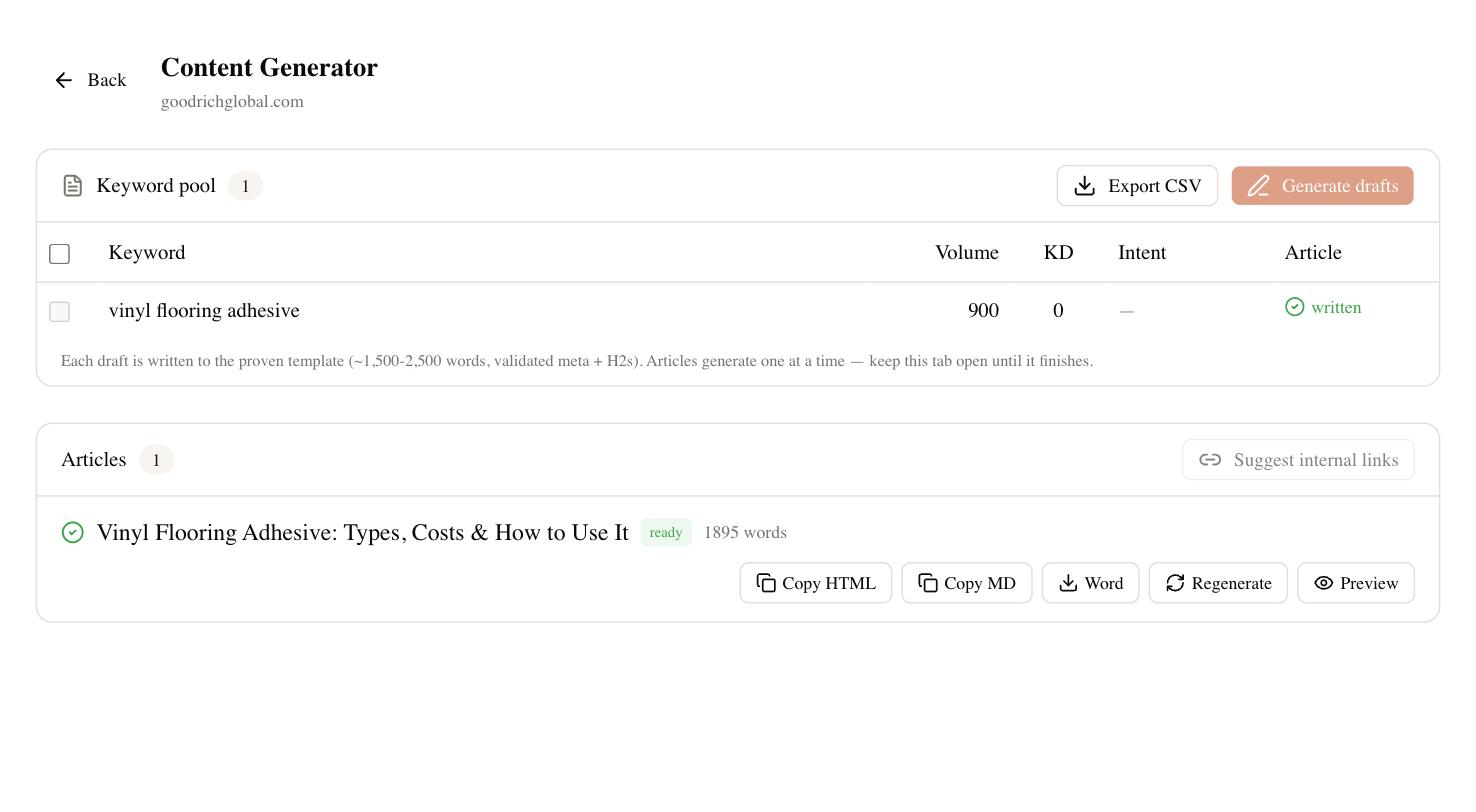
The piece neither Frase nor Surfer answers is AI-search visibility. Search is splitting — some of your buyers now ask ChatGPT, Perplexity, or Google’s AI Overviews instead of typing a query — and a page that scores 90 in an editor can still be invisible in an AI answer. SEO Rocket’s Brand Radar tracks whether and where you’re being cited across those surfaces, so you’re optimizing for the search that’s actually happening. Add site audit, competitor gap analysis, and agency client dashboards, and one subscription replaces a stack. For anyone whose constraint is doing more with fewer tools, that consolidation is the strongest fit on this list.
How to choose
Write down the three tasks you did in a content tool last week. If they were all “research a topic and draft it,” Frase is the leaner, cheaper pick. If they were “raise this page’s optimization score,” Surfer’s editor earns its higher price. But if the list included checking rankings, sizing up a competitor’s domain, or wondering whether AI search ever mentions you, a single-purpose writing tool will always leave you paying for the rest somewhere else — and an AI-native platform that does the research, the writing, and the visibility tracking in one place is the honest recommendation. Whichever you choose, run your own site and two competitors through it for a full ranking cycle before you judge; scores jitter, SERPs shift, and the tool that answers your real questions fastest is the right one for you.