
If you write for a blog and you have read a rankiq review before, you already know the pitch: a tool that hands you low-competition keywords and tells you exactly what to add to a post so it can rank. This rankiq review skips the affiliate gloss and looks at what RankIQ genuinely does well, where it frustrates people, who it actually suits, and roughly what you will pay — without pretending it is the only tool that can do the job.
Short version: RankIQ is narrow on purpose, and that focus is both its best feature and its ceiling. If you are a content blogger chasing Google traffic, it removes a lot of guesswork. If you need backlink data, rank tracking, or technical audits, you will be reaching for other tools within a week.
What RankIQ actually is
RankIQ is an SEO toolset built specifically for bloggers, created by Brandon Gaille. It is not a broad platform like Ahrefs or Semrush. It does two core things: it gives you a hand-picked keyword library for major blog niches — recipes, travel, personal finance, parenting, and dozens more — and it grades your draft against the pages already ranking, telling you which topics and terms you are missing.
More recently RankIQ has folded in AI writing and social content generation, bundled under an “Aided” plan that connects to models like Claude, Gemini, and ChatGPT. That moves it closer to an all-in-one content workflow, though the SEO optimizer remains the heart of the product and the reason most people buy it.
How RankIQ works in practice
The flow is refreshingly simple. You pick a keyword from the pre-built library — these are curated for a high traffic-to-difficulty ratio, so you are not sifting through thousands of terms yourself. You paste or write your draft into the content optimizer. RankIQ then scans the current top-ranking results and produces a grade plus a checklist of subtopics and phrases those pages cover that yours does not.
There is also a title optimizer that studies which words Google seems to favor in titles for your query, which is a small but genuinely useful touch for click-through. You write, you re-grade, you push the score up, you publish. For a solo blogger who has never known what “comprehensive enough” looks like, that feedback loop is the whole value.
What RankIQ does well
The curated keyword library is the standout. Keyword research is where most bloggers stall, and handing you vetted low-competition targets by niche removes the single biggest point of paralysis. You spend your time writing instead of second-guessing difficulty scores.
The content grader is clear and beginner-friendly. It does not drown you in metrics; it gives you a number and a list, and the list is actionable. The niche focus means the advice lands — it was designed for exactly the kind of informational content bloggers publish, not for enterprise landing pages. Reports of traffic gains among content-heavy blogs are common, and directionally the approach is sound: cover the topic more completely than the weakest page on page one, and you have a real shot at ranking.
Where RankIQ falls short
The honest weaknesses matter more than the marketing. First, RankIQ only optimizes content — it does no backlink analysis, no rank tracking, no site audits, and no competitor research beyond the SERP it reads for your keyword. You will still need a second subscription for the rest of SEO.
Second, the keyword library, while its best feature, is also a cage. If your niche is thin in the library, or you want to target a keyword nobody pre-selected, you lose much of the advantage. Third, the content grader can nudge you toward writing for the checklist rather than the reader — chase the score too hard and you produce bloated, term-stuffed posts that satisfy the tool and bore the human. Use it as a guide, not a scoreboard. Finally, the interface feels dated next to newer tools, and the bundled AI writing, while convenient, is not markedly better than using the underlying models directly.
RankIQ vs the alternatives
Content-optimization tools have multiplied, so it helps to see where RankIQ sits. Prices below are rough bands, not current quotes — check each vendor before you buy.
| Tool | Best for | Scope | AI-native? | Rough price band |
|---|---|---|---|---|
| RankIQ | Solo bloggers chasing Google traffic | Keyword library + content grader | Bolted-on AI writing | Roughly $30–50/mo |
| Surfer SEO | Content teams optimizing at volume | Content editor + SERP analysis | Add-on AI writer | Roughly $80–100+/mo |
| Frase | Writers who want research + briefs fast | Briefs + optimization + AI drafts | Yes | Roughly $15–45/mo |
| SEO Rocket | Bloggers & consultants wanting one workflow | Ahrefs-grade data + AI writing + AI-search visibility | Yes — chat-first | Low $ / entry-friendly |
Surfer is the closest head-to-head on content grading and arguably more powerful, but it costs more and expects you to bring your own keywords. Frase is cheaper and strong on research briefs. Each covers the optimization job; none of the traditional three give you backlink data or rank tracking either.
Where SEO Rocket fits
The gap RankIQ leaves — everything that is not content optimization — is exactly what an AI-native tool can close. SEO Rocket is chat-first: you ask in plain language for keyword research, competitor gaps, backlink profiles, or rank tracking, and it runs the lookup on real, Ahrefs-grade data underneath. The same tool then drafts the article and shows whether your brand is being cited in ChatGPT, Perplexity, and Google’s AI Overviews.
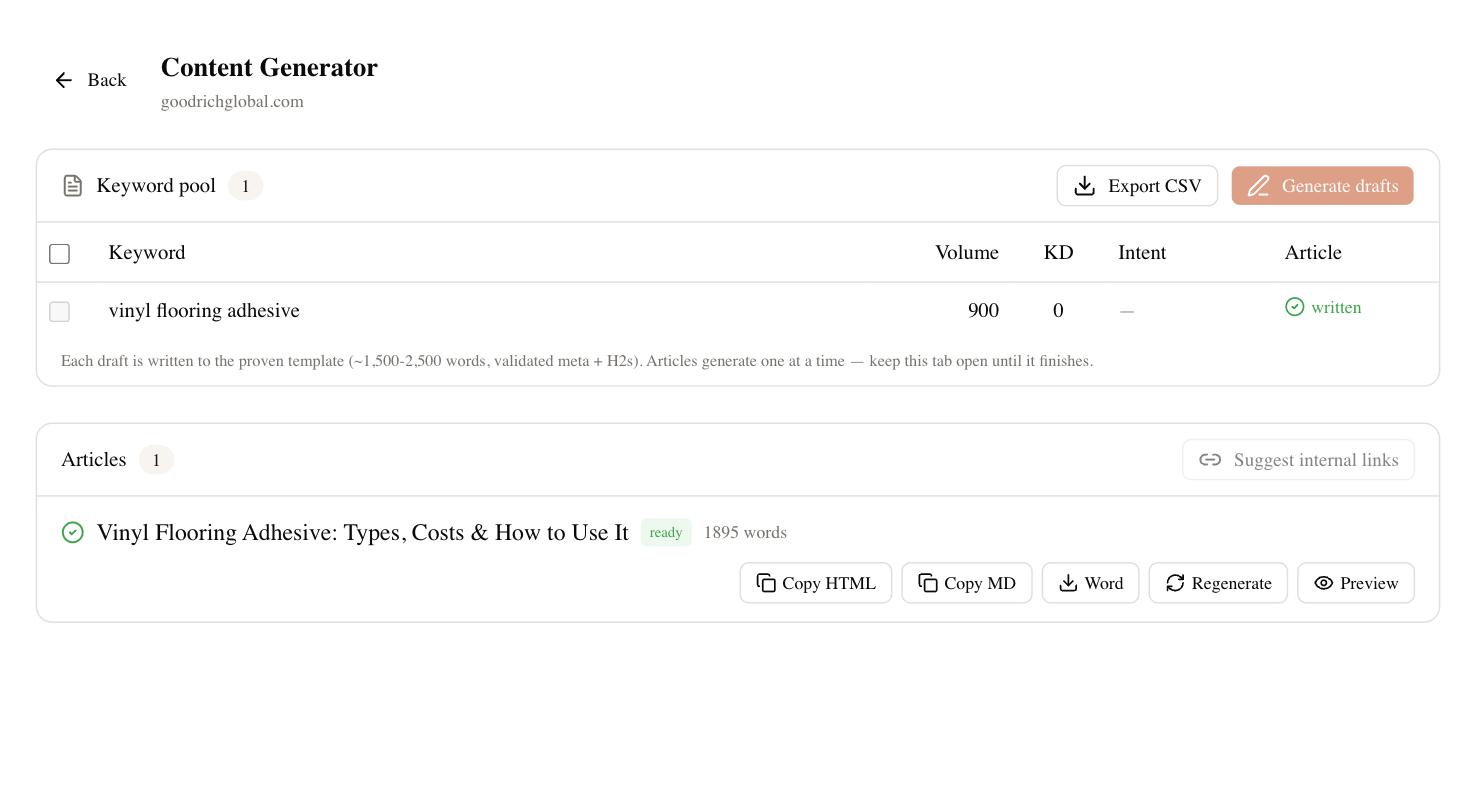
That matters because RankIQ optimizes for Google’s classic blue links, while a growing share of your readers now ask an AI assistant instead. A post that grades well in RankIQ can still be invisible in an AI answer, and nothing in RankIQ tells you so. For a blogger who wants curated keywords and a content grade, RankIQ does its narrow job well. For anyone tired of paying for three tools — one to find keywords, one to grade content, one to see AI-search visibility — folding all of it into a single AI-driven workflow is the leaner move, usually for less than a comparable stack.
Who RankIQ is for — and the verdict
Buy RankIQ if you are a content blogger, you publish in a niche its library covers well, and your main obstacle is not knowing which keywords to target or how thoroughly to cover them. For that person it is a genuinely good, affordable tool that shortens the path from idea to ranking post. It suits beginners especially, because it makes good decisions for you.
Look elsewhere if you need backlinks, technical audits, or rank tracking, if your niche falls outside its curated keywords, or if you want AI-search visibility built in rather than optimizing only for traditional Google. RankIQ is a sharp, specialized instrument — excellent at the one thing it was built for, and honest about being nothing more. Match it to your actual bottleneck. If content optimization is your whole problem, it earns its price; if it is one piece of a bigger job, budget for a broader tool alongside it, or pick one that already does the whole job.