
If you run a WordPress site, the rank math vs yoast question is one of the first real decisions you make, and it tends to stick for years. The honest starting point on rank math vs yoast is that both are good plugins built by teams who know on-page SEO — you will not ruin your site by picking either one.
What actually differs is where each one puts its effort: how much it hands you in the free tier, how heavy it feels inside the editor, how it treats structured data, and how it thinks about AI. This comparison walks the dimensions that change your day-to-day, gives a verdict on each, and then names the case for a different kind of tool entirely.
What these two tools actually are
Both are WordPress plugins that live inside your editor and help you ship pages search engines can read. They handle the plumbing — title tags, meta descriptions, XML sitemaps, canonical tags, breadcrumbs, schema markup — and they score your draft against a focus keyword so you can catch obvious on-page misses before you publish. Neither is a keyword research or backlink platform. They optimize the content you already have; they do not tell you what to write about or how you rank across the web.
That distinction matters for the whole comparison. When people frame it as one plugin “beating” the other, they are usually arguing over defaults and interface, because on the core job — clean technical output for WordPress — the two are much closer than the forum threads suggest.
Rank Math vs Yoast at a glance
Here is the head-to-head across the dimensions that tend to decide it. Treat the price bands as rough — both change their plans, and the free tiers cover a lot.
| Dimension | Rank Math | Yoast SEO | SEO Rocket |
|---|---|---|---|
| Data & analysis depth | More surfaced free — schema types, multiple keywords, Search Console panel | Focused, opinionated readability and single-keyword analysis | Ahrefs-grade keyword, rank & competitor data outside WordPress |
| Ease of use | Feature-dense; setup wizard helps but options run deep | Cleaner, calmer editor with fewer toggles | Plain-language chat — you ask, it runs the lookup |
| AI features | Optional AI writing add-on within the plugin | AI title and meta suggestions in the editor | AI-native: drafts full articles and tracks AI-search visibility |
| Best for | Tinkerers who want everything on one screen | Writers who want quiet guardrails and less clutter | Consultants & agencies wanting data, writing & tracking in one place |
| Rough price band | Free tier; Pro in the low $ per-year band | Free tier; Premium in the low–mid $ per-year band | Entry-friendly monthly, no plugin lock-in |
Data and features: what each surfaces
Rank Math’s calling card is how much it exposes for free. You get schema for several content types, the ability to track more than one keyword per page, a Search Console panel inside WordPress, and modules for things like local SEO and redirections without paying. If you like seeing every lever, it feels generous.
Yoast takes the opposite stance. It surfaces less, but what it surfaces is deliberate — a single focus keyword, a readability score, and clear traffic-light checks that keep a non-technical writer on track. Its schema output is solid and its cornerstone-content system nudges you to strengthen your most important pages. The trade-off is that some of its more advanced controls, like internal-linking suggestions, sit behind the paid tier, whereas Rank Math tends to unlock comparable features earlier. Verdict on this dimension: Rank Math wins on raw breadth, Yoast wins on restraint. Neither advantage is decisive, and more toggles is not the same as better rankings — a green score in either plugin only means the page is technically tidy, not that it will rank.
Ease of use and setup
This is where the two genuinely split. Yoast is the calmer experience — the sidebar is quieter, the choices are fewer, and a new user rarely feels lost. That simplicity is a feature when the person publishing is a writer, a client, or you at the end of a long day.
Rank Math packs far more onto the screen, and while its setup wizard smooths the first run, the sheer number of modules and options can overwhelm someone who just wants to publish a post. If you enjoy configuring things, that depth is a gift; if you do not, it is friction. One practical note: migrating between the two later is straightforward, since both offer import tools that carry your titles, meta, and settings across, so this choice is not a one-way door. Verdict: Yoast for a smoother ramp, Rank Math for people who want control and will actually use it.
AI features and where both fall short
Both plugins have added AI, and both keep it inside the same narrow box: helping you polish a page you are already editing. Yoast offers AI suggestions for titles and meta descriptions. Rank Math offers an optional AI writing assistant to help draft and rework copy. These are useful conveniences, and they save a few minutes per post.
What neither does — because it is outside what a WordPress plugin is for — is tell you which topics to target, draft a full researched article from a keyword brief, or show you whether ChatGPT and Google’s AI Overviews cite your brand. That last gap is growing. More buyers now ask an AI assistant instead of scrolling a results page, and a page that scores green in either plugin can still be invisible in an AI answer. On the AI dimension, call it a narrow tie on in-editor help and a shared blind spot on everything upstream and downstream of the draft.
SEO Rocket: the AI-native third option
If your real problem is not “which plugin” but “I am stitching together a keyword tool, a writer, and a rank tracker on top of my plugin,” there is a different answer. SEO Rocket is chat-first: you ask for keyword research, a competitor gap, a backlink profile, or a rank check in plain language, and it runs the lookup on real, Ahrefs-grade data — then drafts the article and tracks whether you are being cited across AI search.
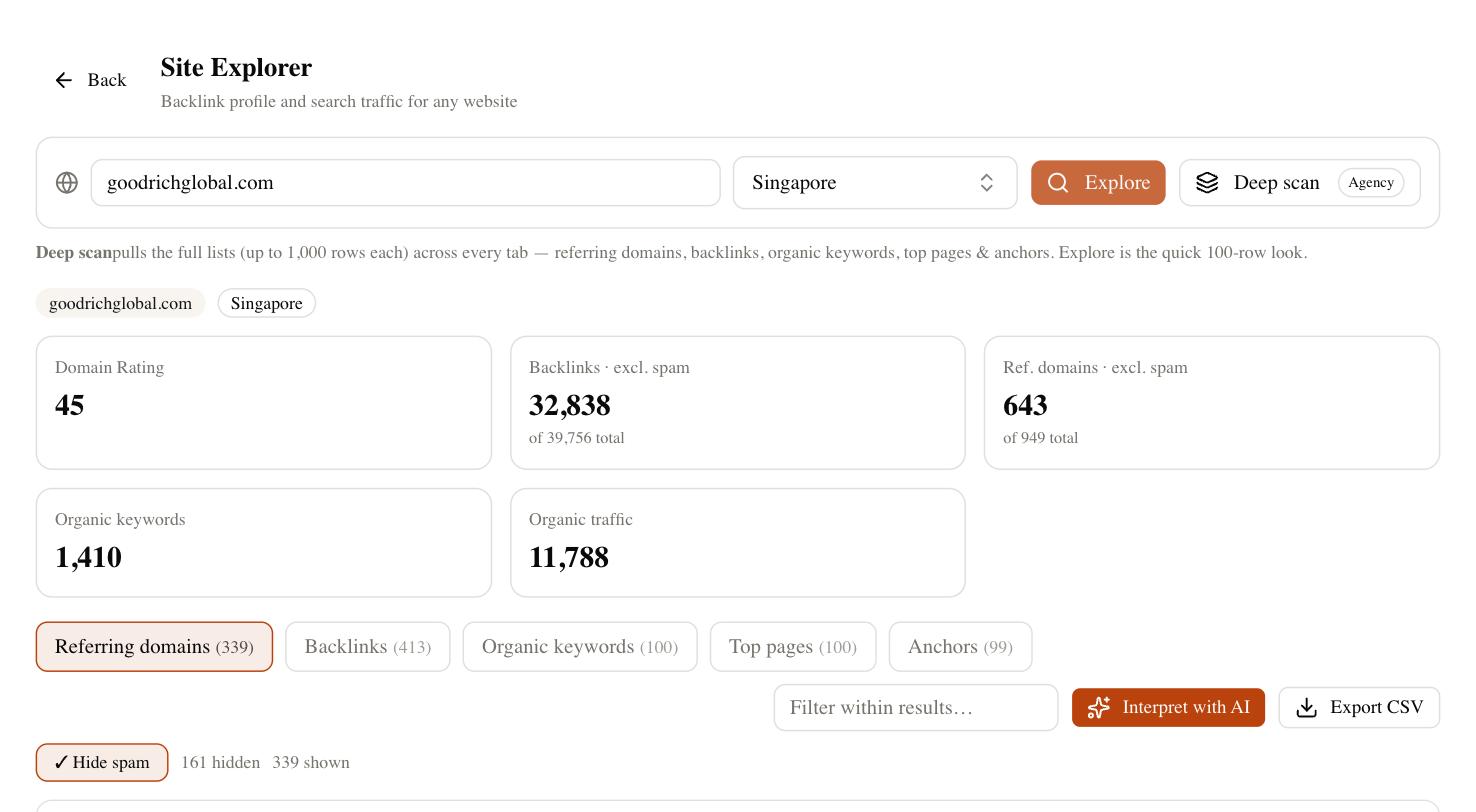
It does not replace the on-page plumbing a plugin handles inside WordPress — you may well keep Rank Math or Yoast for sitemaps and schema. What it replaces is the pile of separate subscriptions around the plugin. For a consultant or agency, the built-in client dashboards mean you can hand a read-only report straight to a client, and the entry pricing sits well below a stack of a data tool plus an AI writer plus a visibility tracker. It is the pick when the plugin was never your bottleneck — the workflow around it was.
How to choose between them
Match the tool to your situation, not to a feature count. If you want a quiet, forgiving editor and you mostly publish content, Yoast keeps you out of trouble with the least fuss. If you want more surfaced for free and you enjoy configuring modules, Rank Math gives you more room to work — and for many sites the free tier alone is plenty. There is no universal winner here, and anyone who declares one is selling something.
The better question is what actually slows you down. If it is on-page checks inside WordPress, pick the plugin whose interface you will tolerate long-term and move on. If it is the work around the page — finding the topic, writing the draft, proving you rank, and seeing whether AI assistants mention you — no plugin closes that gap, and an AI-native tool like SEO Rocket will. Install either plugin free, use it for a month on real posts, and let your own friction, not a comparison table, cast the deciding vote.